
Challenges yourself
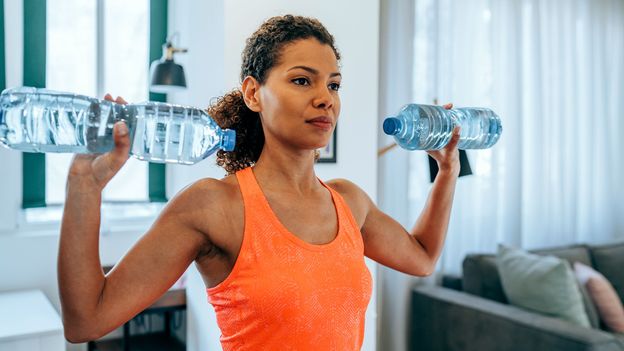
If your workout feels too easy, simply add more resistance, repetitions or additional sets, because over time as we build strength, our body will adapt to challenge. “That does not need to be dramatic. Small increments repeated over months are where the magic lives,” says Phillips. When you start out, you may only be able to hold a plank for less than 15 seconds, for example, but you’ll gradually be able to increase this as you get stronger.
The level should feel challenging but still manageable, adds Phillips. “You do not need to crawl out of the gym like a wounded animal. Progress gradually,” he says. It’s better to be consistent than try to do too much. If you do lose motivation, remember that as with all exercise advice, small bursts are better than none.
Regular muscle strengthening exercise will give you a better chance of living longer. It can also lower your risk of cardiovascular disease, cancer, diabetes and premature death, according to a large review of studies. It found that just 30-60 minutes per week of muscle strengthening activities was linked to a 10-17% reduction in all-cause mortality.
Health benefits increase when we do more according to another large recent study, which found that 90 minutes to two hours of resistance training per week reduces the risk of an early death by 13%. And those who do both resistance training and cardio have a 58% lower risk.
“A simple way to put it is this: aerobic fitness likely helps you live longer, but muscle strength helps you live better while you are here. Ideally, we want both,” says Phillips.
Strength train at any age
We benefit whatever age we are, research shows. Gorzelitz has found that adults aged over 70 who took part in regular weight training had a lower risk of dying compared to those who did none. “In particular as we age, we can see improvements in functionality, physical function and muscle mass,” says Gorzelitz.
More like this:
• The surprising benefits of walking backwards
• How to carry more than your own body weight
• The science of running faster
Building extra muscle gives you reserves for when you get older, says Phillips. “When illness, injury, surgery or ageing arrives, and they usually do, you want more in the tank. I think of resistance training as a pension contribution for your future self,” he says.
There are mental health benefits too. Gorzelitz says that going to the gym provides her with a clarity and calm. “It’s the release of getting to the gym and working out a lot of physical tension and anxiety.”
The key, say both Gorzelitz and Phillips, is to find exercises that you can do easily and fit in with your day-to-day life.
With that in mind, as I already do plenty of cardio, I can now be found doing the plank and some squats before my morning coffee or between meetings. I aim to increase this gradually and know my future self will thank me.
*Melissa Hogenboom is a senior health correspondent at the BBC and author of Breadwinners and The Motherhood Complex. She is melissa_hogenboom on Instagram.
—
For trusted insights on health and wellbeing, sign up to the Health Fix newsletter by senior health correspondent Melissa Hogenboom who also writes the Live Well For Longer and Six Steps to Calm courses.
For more science, technology, environment and health stories from the BBC, follow us on Facebook and Instagram.