
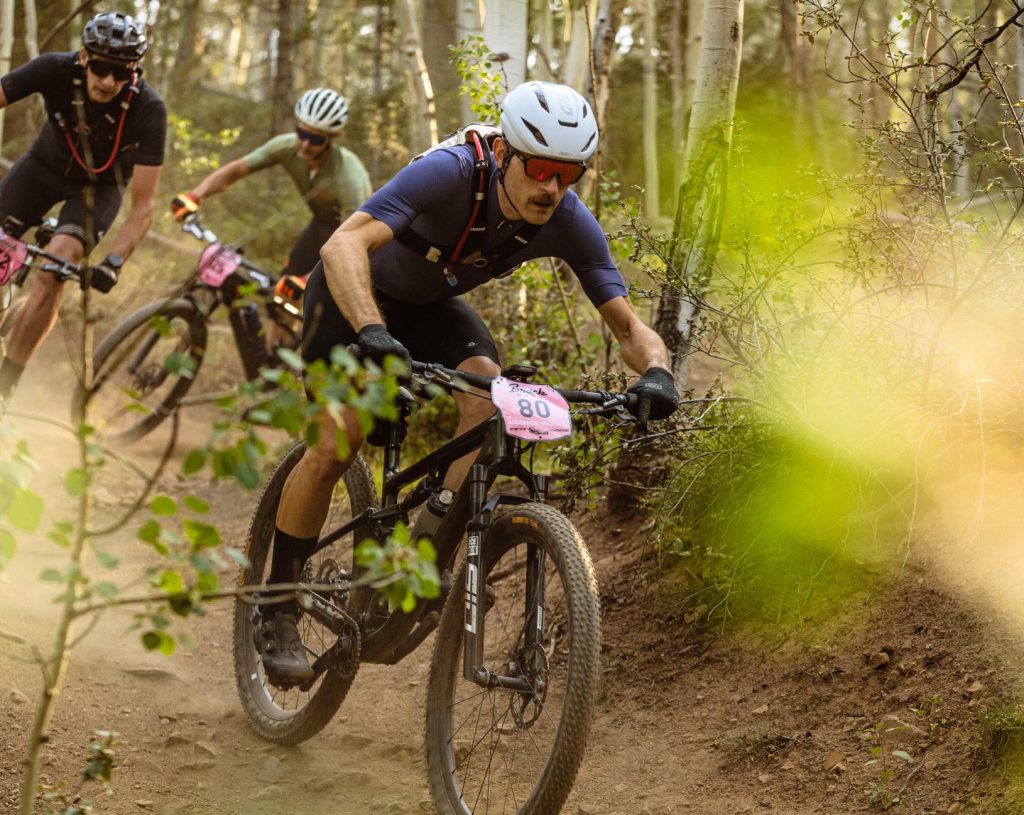
The 2026 Breck Epic race rolled to a stop on Friday, Aug. 14, after racers rode just shy of 200 miles in five days.
Emerging victorious from the men’s 30 plus, non-professional division was Vail’s Michael Anderson, a software engineer by day and self-coached mountain biker in his free time.
Going into his first-ever Breck Epic this year, Anderson said he never could have imagined winning his whole division.
“I came into the race not with many expectations,” Anderson said. “My training has gone pretty well this year, so I would have been happy if I was fighting for a podium spot. On the first day, I finished within a minute of first place, so from there, it showed me the potential that I could maybe fight for the win.”
His long background in STEM — having also worked as a data analyst — helped him in unexpected ways during the training process, from developing formulaic eating habits to meticulously tracking and creating workout routines.
“I’m a huge data nerd. I always have been.” he said. “I spend a lot of time researching the science behind endurance performance and what the optimal pathways are for building fitness. And then I spend a lot of time analyzing my own performance, my fatigue, and trying to manage that, while also trying to train as hard as I can without going over the limit. … It’s really data driven, and it definitely scratches the niche that I have.”
Using science, Anderson was able to discover the benefits of training at a moderate level of exertion, often referred to as zone 3.
“I did a really big block about six weeks long, where I spent a lot of time at that kind of tempo,” he said. “I would say it’s comfortably hard. It’s a pace that you feel that you can hold for 60 minutes, but then after that, it’s going to feel really, really difficult.”
This way of training isn’t usually favored by athletes, Anderson explained, and he hasn’t focused on zone 3 training in past athletic endeavors before the Breck Epic.
“A lot of people snub their nose at zone 3 training because it’s too hard to be easy and therefore recoverable, but it’s also not hard enough to build fitness,” Anderson explained. “A lot of exercise science says to actually minimize the time that you spend at zone three, and that was a dogmatic view that I had in previous years. But this year, I realized that I was going to be spending so much time there during this race that I needed to build my engine and tune my engine to be able to operate at that intensity for an extremely long period of time.”
Other science-backed methods that helped him win involved his pre-race diet, which was heavy in carbohydrates, even long before the race itself.
“It’s been a big trend in the last few years to consume a lot of carbs while you’re on the bike or doing any kind of endurance activity. People say to target between 60 to 90 grams of carbs per hour, going all the way up to 120, or even some of the pros to 250,” Anderson said. “The other side of that coin of getting carbs in is you can actually get out ahead of that and show up to the race with already completely filled glycogen stores in your muscles. … That was something that I learned through some of the research and exercise science.”
When it came time to race, Anderson said, this diet kept him energized, even while climbing almost 30,000 feet of elevation during the Epic.
“It totally worked,” he said. “The phrase I always used was ‘It felt like I had gas in my legs.’”
Anderson’s training regimen has brought him a long way from where he started out: a casual biker who mostly rode around his college town as a form of transportation.
“I started mountain biking when (my wife) and I moved to Vail in 2021, and I was very focused on going fast downhill and doing jumps and learning tricks and all that kind of stuff,” he said. “I was definitely hooked by the adrenaline more than the exercise at first, but as I was doing it more and more, what really fueled my passion was being able to do just huge days in the saddle and more big backcountry rides.”
His first-ever race was the 2023 Grand Traverse mountain bike race, which travels from Aspen to Crested Butte. When Anderson placed in the top 20 racers, it opened up a world of possibilities.
“That showed me ‘Oh, if I really put my mind to this, I could be really good at this. This could be really fun and really rewarding,’” he said.
That reward finally came last week.
Out of 27 competitors in his Breck Epic division, Anderson placed first with a time of 17:13:23, beating the next-place finisher by just under 37 minutes.
“This performance was so beyond my expectations,” he said. “I think three, four years ago Michael would be pretty proud of this week.”