
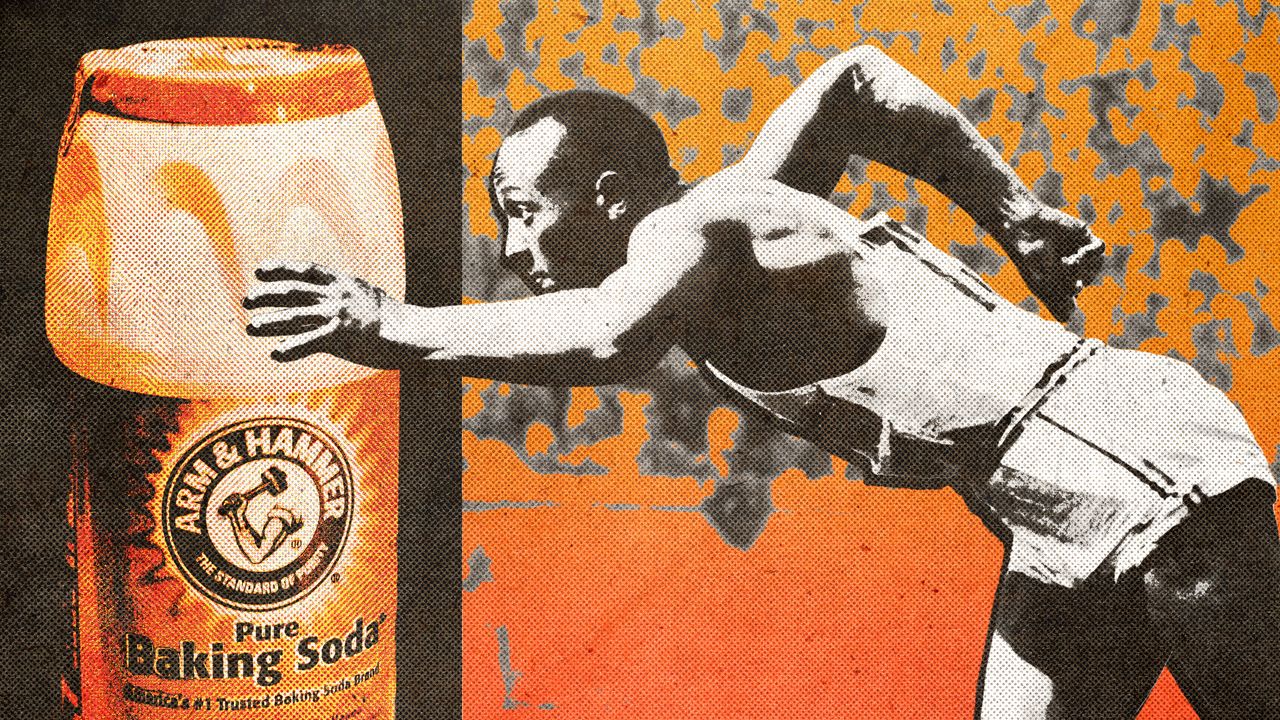
After the Kenyan long-distance runner Sebastian Sawe became the first person to officially break the 2-hour marathon barrier in London this past April — a historic feat that had been anticipated for decades — he held up his Adidas supershoe with his winning time penned on the side: 1:59:30. He’d smashed the previous world record of 2:00:35, set by Kelvin Kiptum in 2023, by more than a minute. That moment made Sawe and his carbon-plated footwear instant stars. But beyond Sawe’s training and shoes, a small sliver of the accomplishment may also have been indebted to another weapon in his arsenal: bicarb. To fuel his blistering 4:33 minutes-per-mile pace, Sawe drank a formula of sodium bicarbonate (more commonly known as baking soda) sold by the Swedish company Maurten, for which he’s a sponsored athlete.
He joins an increasingly large list of endurance athletes who’ve taken to downing the substance as a way of eking out whatever competitive edge they can. Molly Seidel, the 2020 Olympic marathon bronze medalist who has since become an ultrarunner, the running legend Eliud Kipchoge, and the reigning 800-meter Olympic champion Keely Hodgkinson are also sponsored by Maurten and have taken bicarb during competitions. Yomif Kejelcha, who placed second at the London Marathon and broke the 2-hour barrier just behind Sawe, has trained and raced using bicarb from the brand Santamadre, which sponsors him. In 2018, the International Olympic Committee recognised bicarb as one of five supplements that show evidence of enhancing athletic performance for elite performers. The question is: is it worth taking for non-superhuman athletes? We spoke to experts to find out.
What is bicarb?
Bicarb is just a fancy new term for what most of us know as baking soda (aka the orange box you leave in the back of your fridge to keep it from smelling). But the white powder is more versatile than you might realise: As an antacid, it can relieve heartburn, and in hospital settings, it’s used to buffer anesthetics and reduce pain. Perhaps most surprising of all is its effect on exercise performance. Studies on consuming bicarb for its athletic benefits date back to the 1930s. Its use has been investigated in running, cycling, martial arts, soccer, rugby, hockey, basketball, rowing, and swimming — mostly showing gains in events ranging from 45 seconds to 10 minutes. Research indicates that it can improve performance during short-term high-intensity exercise and delay the onset of exhaustion. In 2021, the International Society of Sports Nutrition went so far as to make a statement based on a “comprehensive review of the literature” that bicarb “improves performance in single- and multiple-bout exercise” for both men and women.
The problem historically, however, has been that consuming baking soda, typically by ingesting it orally as a tablet or drink mix, can cause gastrointestinal distress when taken in the amounts needed to see athletic improvement. “In the past, the first thing sodium bicarbonate hits when it hits your stomach is hydrochloric acid, and that combination leads to carbon dioxide, so the digestive issues were primarily incredible bloating, gas, diarrhea,” says Dr Guillem Gonzalez-Lomas, an orthopedic surgeon who specialises in sports medicine at NYU Langone. Not what you want on performance day.