
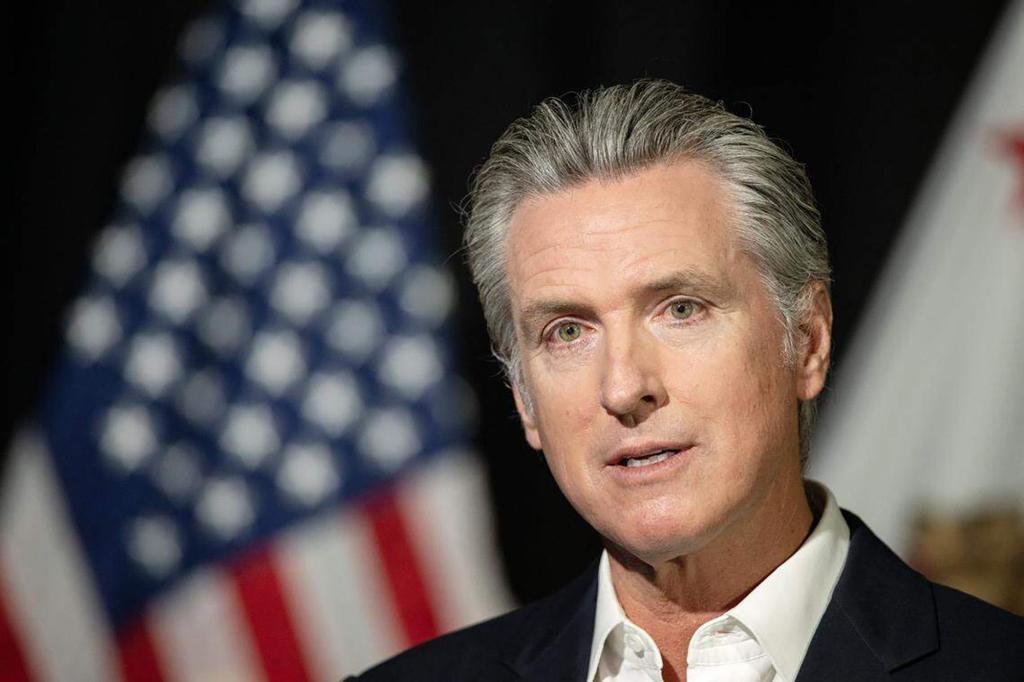
Gov. Gavin Newsom on Friday released his annual budget proposal to close the state’s projected $2.9 billion shortfall — significantly less than the $18 billion deficit initially estimated — that seeks to limit both cuts and new spending, but lacks a specific plan for potentially millions of Californians losing their health insurance as a result of recent federal policy changes.
“This budget reflects both confidence and caution,” Newsom, who skipped a news conference announcing the spending plan following his State of the State speech Thursday, said in a statement.
Newsom’s budget is only an initial proposal and will evolve as financial forecasts are updated and state lawmakers, who must work with the governor to finalize the 2026-27 budget by mid-June, negotiate changes. Government analysts have warned that the state’s tax revenues, which are heavily reliant on wealthy residents’ stock gains, could take a hit in a financial downturn.
While Silicon Valley’s artificial intelligence boom has helped push the state’s revenues $42 billion higher than expected, a summary of the budget proposal warned that the stock market could suffer “a significant downturn if returns on investment in artificial intelligence fall short of lofty expectations.”
 Republicans slammed Newsom’s nearly $350 billion budget, noting that the state’s nonpartisan Legislative Analyst’s Office in November projected an annual budget deficit about six times higher than his administration’s roughly $3 billion estimate. Part of the reason for the discrepancy is that the LAO adopted a more conservative outlook on tax revenue from residents’ stock market earnings.
“California families have to balance their budgets and make tough choices,” Tony Strickland, a Republican state senator from Huntington Beach, said in a statement. “The state government should be held to the same standard.”
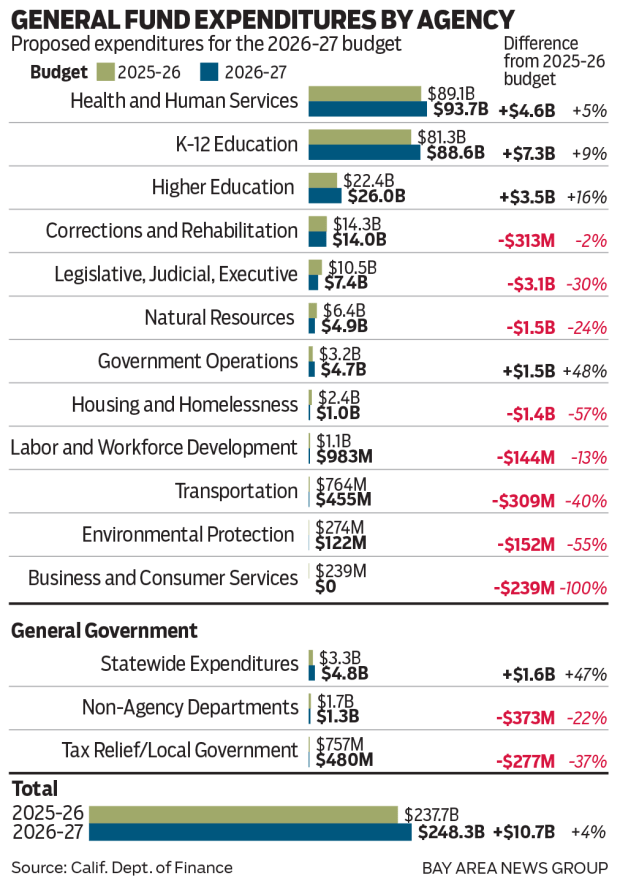
Newsom’s plan aims to fill the budget gap in part by proposing $1.55 billion in cuts to “state operations” and $1.2 billion in savings over two years by eliminating around 6,000 vacant positions. At the same time, it proposes a $1 billion expansion of community education programs, which Newsom touted during his State of the State speech, but that some education advocates said is not enough to ensure schools’ long-term stability.
The budget proposal increases overall education spending by more than $10 billion, in part due to voter-approved mandates to boost school funding as tax revenue rises — requirements that contributed to the deficit despite better-than-expected revenue gains. Housing and homelessness spending would decrease by about $1.4 billion, as the governor has proposed not sending money to some programs that are funded on a temporary, rather than an ongoing basis.
Overall health spending would rise by $4.6 billion, as the budget estimates the state will incur $1.4 billion in administrative and other costs as a result of changes to federal healthcare and food assistance programs, officials said. But the proposal does not lay out a plan for low-income residents who could lose their medical insurance due to the changes. Administration officials said they are open to working with lawmakers to find solutions.
“It’s something we’re going to have to monitor,” said Joe Stephenshaw, the state’s finance director, on Friday. “That’s the work we need to do over the coming months.”
The future of Medi-Cal, the state’s health insurance program for more than one-third of its residents, figures to be a major part of budget negotiations this year. The program is mostly funded by the federal government, and President Donald Trump’s “One Big, Beautiful Bill” cuts billions of dollars from it into the 2030s. As many as 3.4 million Californians could lose their eligibility for Medi-Cal.
In the Bay Area, there were about 2.1 million Medi-Cal enrollees in the nine-county Bay Area last year. It was unclear how many of those could lose coverage.
The proposed budget would pump an additional $2.4 billion of general funding into Medi-Cal in the next budget year, for a total of $48.8 billion. But it does not indicate whether Newsom aims to backfill $373 million in lost federal funds during the next budget year due to new work requirements, or $658 million in lost funds for emergency services for immigrants without legal status, as well as other major revenue reductions.
Plus, Newsom plans to boot potentially 200,000 refugees and other legal-status immigrants from full Medi-Cal coverage, saving $786 million. They’d still be eligible for emergency services.
The Trump administration made that population ineligible for Medi-Cal funding, and Newsom signaled he will not seek to backfill the spending. Stepping in with state funding would be “the right thing to do” for a population with complex medical needs, said Kiran Savage-Sangwan, executive director of the California Pan-Ethnic Health Network.
On the environment, Newsom’s budget proposed to offset a number of cuts that were made by President Trump and Republican leaders in Congress last year.
In particular, Newsom aimed to spend $200 million to create a new state rebate program for Californians who buy electric vehicles. Last year, Trump’s budget eliminated a federal tax credit of up to $7,500 that the Biden administration had passed to encourage people to buy EVs. Trump also ended federal approval for programs that allow solo drivers of EVs to drive in carpool lanes on freeways.
California operated a rebate program from 2010 to 2023 that provided rebates of between $1,000 and $7,500 to EV buyers. California currently has more EVs on the road than any state, making up about 25% of new car sales statewide. But to reach its climate goals, the trend needs to continue to grow.
Newsom also proposed Friday spending $2.1 billion from Proposition 4, a $10 billion climate bond passed in 2024 by voters, to increase wildfire prevention, flood protection, and parks projects.
The proposal does not include any new money for the state’s main program for funding local homelessness efforts. However, $500 million in homelessness funds approved last year will still be available to local governments — as long as the state determines cities and counties applying for the money have made sufficient progress in alleviating the crisis.
Newsom’s decision not to include additional funds comes as the Trump administration seeks to divert billions of dollars from homeless housing programs. A judge recently paused the funding shift, but local officials and advocates for homeless people worry the state is failing to prepare should the administration’s plans go through.
In a statement, Carolyn Coleman, director of the League of California Cities, said the proposal “endangers thousands of Californians at risk of falling into homelessness.”