
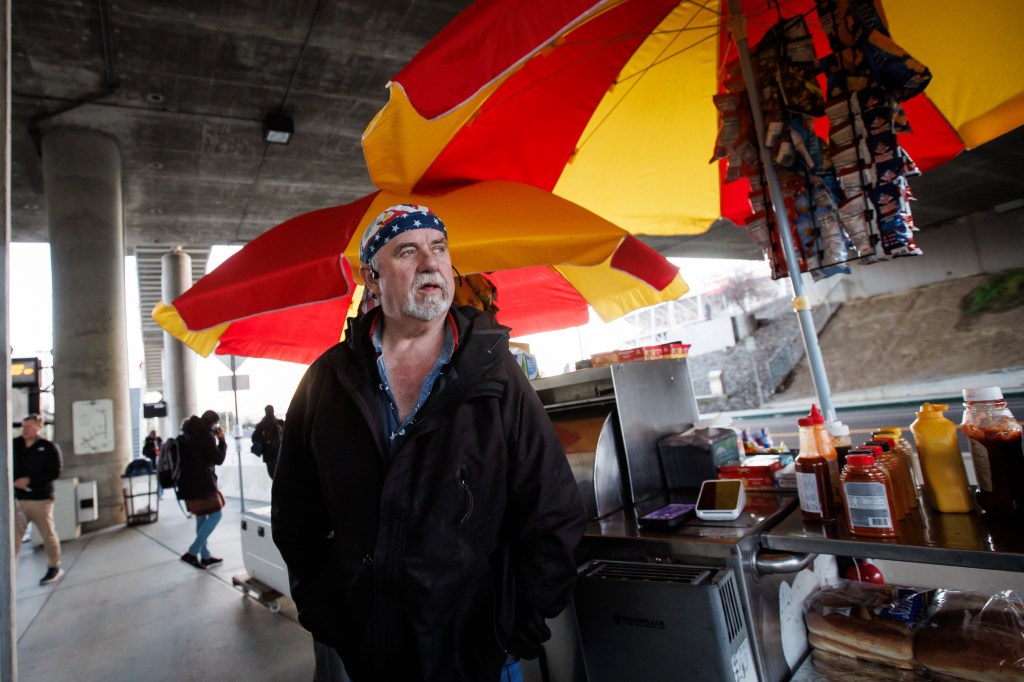
With his signature American flag durag and toothy grin, Howard Gibbins has been a familiar fixture at Santa Clara’s Great America Transit station for more than two decades now.
Known as the “The Hot Dog Dude” — a moniker given to him by Santa Clara University students that he wears with pride — Gibbins was feeding hungry commuters long before Levi’s Stadium was erected next door.
He splashed onto the food truck scene 25 years ago when he bought a white “roach coach,” painted it with American flags and began operating Burger Man Cruising Cafe. When the San Francisco 49ers made the move to Santa Clara 12 years ago, Gibbins said the city objected to his food truck in the area. So, he went from flipping burgers to slinging sausages and dogs from a cart he parks between the train tracks and Stars and Stripes Drive.
“I bring happiness to people,” Gibbins said. “My main customers are the commuters…I’m able to produce a little bit of food, a little bit of warmth in the stomach.”
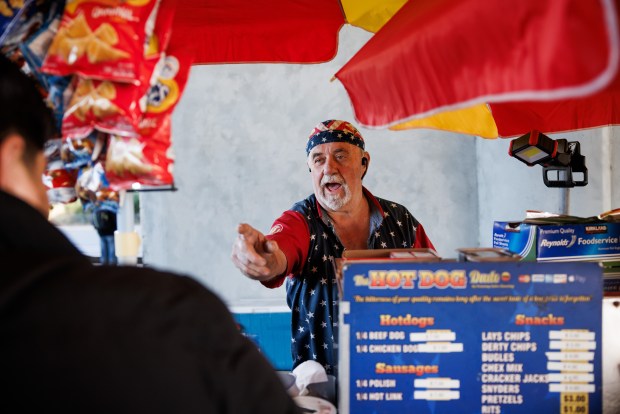 Hot dog vendor Howard Gibbins, also known as “The Hot Dog Dude,” chats with a customer at the Santa Clara–Great America station near Levi’s Stadium in Santa Clara, Calif., Wednesday, Jan. 7, 2026. (Dai Sugano/Bay Area News Group)
But the last five years have been tough. The COVID-19 pandemic ushered in a new culture of remote work, slashing the number of commuters traveling to their jobs in Silicon Valley.
Now, Gibbins and other street vendors in the area face another obstacle: Super Bowl LX.
The Big Game will be held in Santa Clara for a second time on Feb. 8, and with it comes a plethora of rules and regulations imposed on the city by its kingmaker, the NFL. That includes the adoption of a “clean zone,” which serves as a security perimeter for law enforcement and aims to regulate and restrict advertising and commercial activities in the area leading up to and during the game.
Santa Clara signed off on its more than 4-square-mile clean zone last month, which prohibits outdoor food and beverage sales — except those within a businesses’ normal operations — outdoor merchandise sales, advertising and promotional giveaways. Sidewalk vendors, even those with a permit like Gibbins, also will be banned from operating from Feb. 1 through Feb. 10.
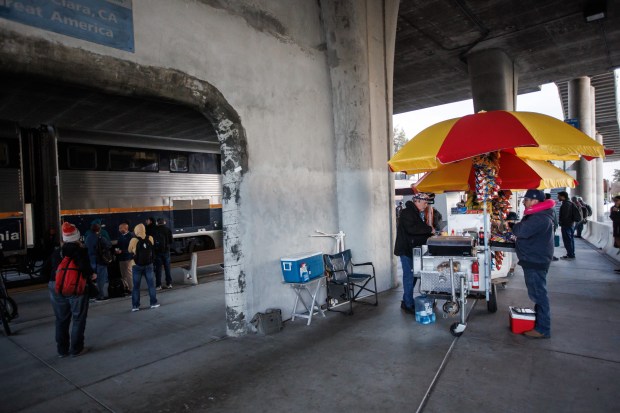 Hot dog vendor Howard Gibbins works at his stand at the Santa Clara-Great America station near Levi’s Stadium in Santa Clara. (Dai Sugano/Bay Area News Group)
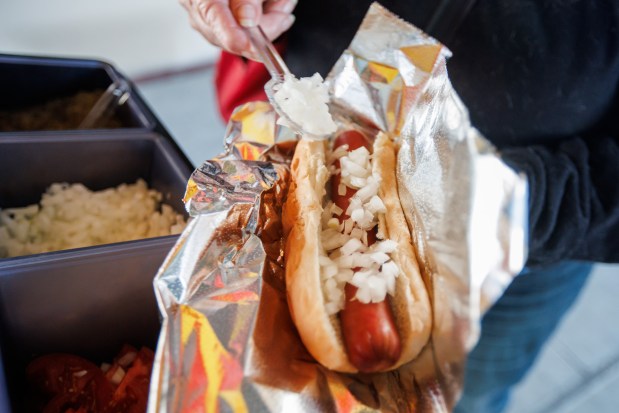 A customer loads condiments onto a hot dog. (Dai Sugano/Bay Area News Group)
Santa Clara city spokesperson Janine De la Vega said in an email that the rules were “applied uniformly to all commercial vending activity.”
“Allowing some vendors to operate while restricting others would have created confusion, enforcement challenges and potential safety risks in areas with extreme crowd density and limited emergency access,” she said.
Gibbins, who called concerts and 49ers game days at Levi’s Stadium “a little extra dessert” for his business, said the loss of income will hurt. During Super Bowl 50, he said the city gave him a pass, allowing him to keep his cart chained up at the train station while he lugged in chips, drinks and the rest of his offerings from his car parked down the block. His total haul for the day amounted to $4,500 in sales. But at 67 years old, Gibbins said that trekking in his wares isn’t an option for him physically anymore.
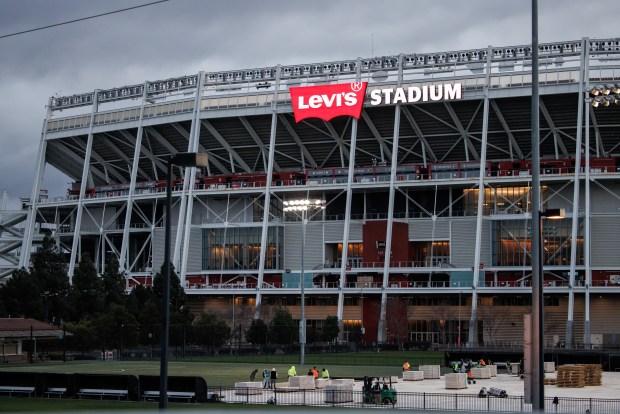 Levi’s Stadium in Santa Clara, is seen from the Santa Clara-Great America station, where hot dog vendor Howard Gibbins has his stand. (Dai Sugano/Bay Area News Group)
The prohibition of permitted street vendors around Levi’s Stadium for the Big Game is emblematic of a larger issue with clean zones that have triggered lawsuits against the NFL and Super Bowl host committees over First Amendment violations.
In the weeks leading up to Super Bowl LVII at State Farm Stadium in Arizona, a Phoenix man who wanted to erect temporary signage on his property sued the city, alleging restrictions on who he could sell advertisements to on a building he owned within the clean zone infringed on his free speech rights. The 2023 case made national headlines when a Maricopa County judge ruled that it was an “unconstitutional delegation of power” for the city to allow the ad approvals to be made by a host committee with an interest in “protecting NFL sponsors and the NFL.”
Bruce Hamilton, the director of the First Amendment Clinic at Tulane University Law School in New Orleans, said in an interview that clean zones pose other constitutional issues, as well, with unclear rules and regulations that can effectively chill free expression. They’re also much larger geographically than they need to be, he added.
While Hamilton said “legitimate reasons” exist for clean zones, such as safety and aesthetics, the NFL often uses them to prevent ambush marketing — when a company tries to capitalize on a major event’s popularity by advertising near the venue.
“To me, that’s really the reason for theses clean zones: to protect the commercial interest of the NFL and its sponsors,” Hamilton said. “That’s often done at the expense of local merchants who are just trying to make a buck like the sponsors, but they’re muscled out of the area when the big show’s in town.”
The NFL referred a request for comment on the role of clean zones to the Bay Area Host Committee, which issued a statement asserting clean zones are “standard practice from a public safety perspective to ensure clear paths of entry and exit, and to protect local businesses from outside entities disrupting their flow of operations.”
Carolina Martinez, the CEO of CAMEO Network — an organization that supports micro businesses in California — called the decision to prohibit permitted street vendors in the clean zone “disappointing.”
“Permitted street vendors should have a shot at benefitting from this major event just like any other small business,” she said in a statement. “Santa Clara is stronger because of its street vendors who bring vibrancy and reflect the rich culture of our communities.”
The CAMEO Network was one of dozens of groups that backed the Safe Sidewalk Vending Act, which effectively decriminalized street vending in the state in 2019. The law has made it harder to regulate food trucks and carts, requiring cities to establish a permit system and limiting the restrictions they can impose.
Santa Clara City Councilmember Albert Gonzalez, whose district encompasses the stadium, said that many of the vendors who have tried to capitalize on the big crowds from concerts or football games are unpermitted, which also raises concerns about food safety.
“They’re on sidewalks or blocking the sidewalks where it can hinder people mainly leaving after the events,” he said.
But ever since the city started issuing citations to vendors without permits, Gonzalez said the number of food carts or people selling alcohol from small fridges has dipped.
On a chilly January afternoon just weeks before Super Bowl LX, Gibbins chatted with customers, letting them know they wouldn’t see him for 10 days come Feb. 1. The quick-witted Hot Dog Dude worries about not being there for the commuters who rely on him for fuel for their long train ride ahead.
“When people come into the city, I’m usually the first guy they see,” he said. “I’m usually the guy who tells them they got off one stop too early.”
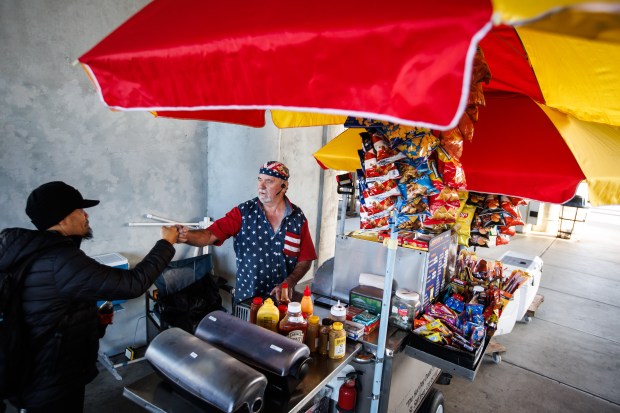 Hot dog vendor Howard Gibbins chats with a customer. (Dai Sugano/Bay Area News Group)
One of his regulars, Jenesther Edwards of Matenca, is dreading Gibbins’ absence from the station next month as she’ll have to plan ahead to make sure she has food for her two-hour train ride home.
“If you have a busy work week and you don’t get the opportunity to have lunch, it’s always nice that he’s here and you can at least grab something so that you don’t starve before you get home,” she said.
Gibbins knows he’ll survive the loss of income from not being able to sling dogs for the tens of thousands of fans making the voyage to see the Lombardi Trophy hoisted in Santa Clara once again. He’s in talks with the Bay Area Host Committee about some kind of reparations for not being able to work, but ultimately, he believes that responsibility should fall on the multi-billion dollar giant that is the NFL.
“The big guy who’s making the big money on the deal, they have no compensation for the little guy,” Gibbins said. “The little guy is going to get hammered. I just don’t get it.”
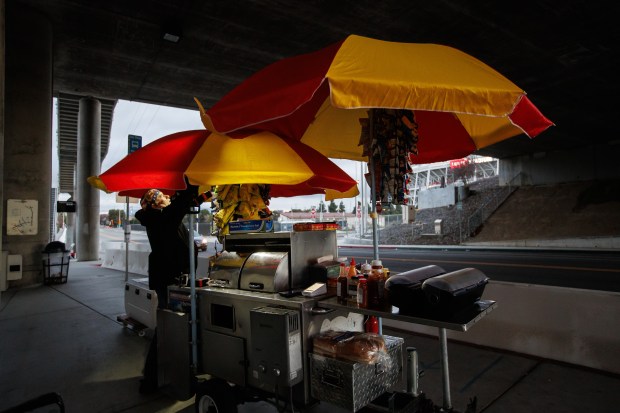 Hot dog vendor Howard Gibbins, also known as “The Hot Dog Dude,” attaches a portable light to his stand at the Santa Clara–Great America station near Levi’s Stadium in Santa Clara, Calif., Wednesday evening, Jan. 7, 2026. (Dai Sugano/Bay Area News Group)