
When someone brandishes a weapon on a Metro train or bus, sworn officers should respond.
But what if a homeless person is riding without paying and taking up several seats? Or a mentally ill individual is screaming at passengers? Most times, these calls do not warrant an armed response.
That’s where the new LA Metro Care-Based Services Division comes in.
Led by licensed clinical social worker Craig Joyce, the new arm of the emerging Department of Public Safety formed this week will consist of new Crisis Response Teams, along with existing services including: Metro Ambassadors, Homeless Outreach Management and Engagement (HOME) personnel and Community Intervention Specialists, said LA Metro.
Joyce’s division will work hand-in-hand with armed law enforcement, along with LA Metro Transit Security Officers who respond to security, code of conduct issues and emergency management, the transit agency explained.
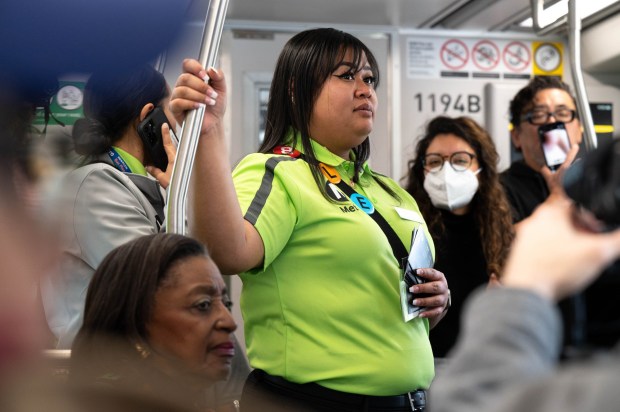 FILE: Metro Ambassador Jennifer Sory rides with passengers on the L line metro train on Monday, March 6, 2023. About 350 Metro Transit Ambassadors, who serve as greeters and are eyes and ears for problems and trouble on trains and buses, are an example of the care-first approach to public safety. They now fall under the Care-Based Services Division, formed Jan. 12, 2026, as part of the a new Department of Public Safety, This new division also includes: Homeless Outreach Management and Engagement (HOME), Community Intervention Specialists and Crisis Response Teams. (Photo by David Crane, Los Angeles Daily News/SCNG)
The idea is to match the call with the right kind of response, instead of the old model of always calling in armed law enforcement to every situation.
“It is a holistic approach to public safety,” said Joyce during an interview on Wednesday, Jan. 14.
“If there was a call and the words ‘mental health’ was part of that call, they would bring in a mental health team,” he said. “If the same call had a concern about safety, we may also then send in an officer.”
Presently, LA Metro hires law enforcement from Long Beach police, LAPD and the Los Angeles County Sheriff’s Department as sworn officers to patrol train stations, trains, bus depots, buses and trains. LA Metro serves 1,440 square miles, with 117 bus routes and 112 rail stations.
In June 2024, the Metro board voted to establish its in-house police department that would eliminate the need for officers from the three departments. In May, the agency hired William “Bill” Scott as Metro’s Chief of Police and Emergency Management. His previous job was chief of the San Francisco Police Department. Scott has begun recruiting officers for the new Metro force, and hopes to reach 400 by 2029, the agency reported.
Fourth District Los Angeles County Supervisor Janice Hahn, a member of the Metro board and former chair, agreed with the new approach to law enforcement on Metro.
“Public safety means different things for different people. Yes, we need law enforcement riding Metro, but we also need professionals to respond to people experiencing mental health crises or to get help to someone who is homeless and find themselves with nowhere to go but our trains,” Hahn said in an emailed response. “It makes sense to bring these teams together in one unified division and it speaks to the leadership and vision of our new Metro Police Chief Bill Scott.”
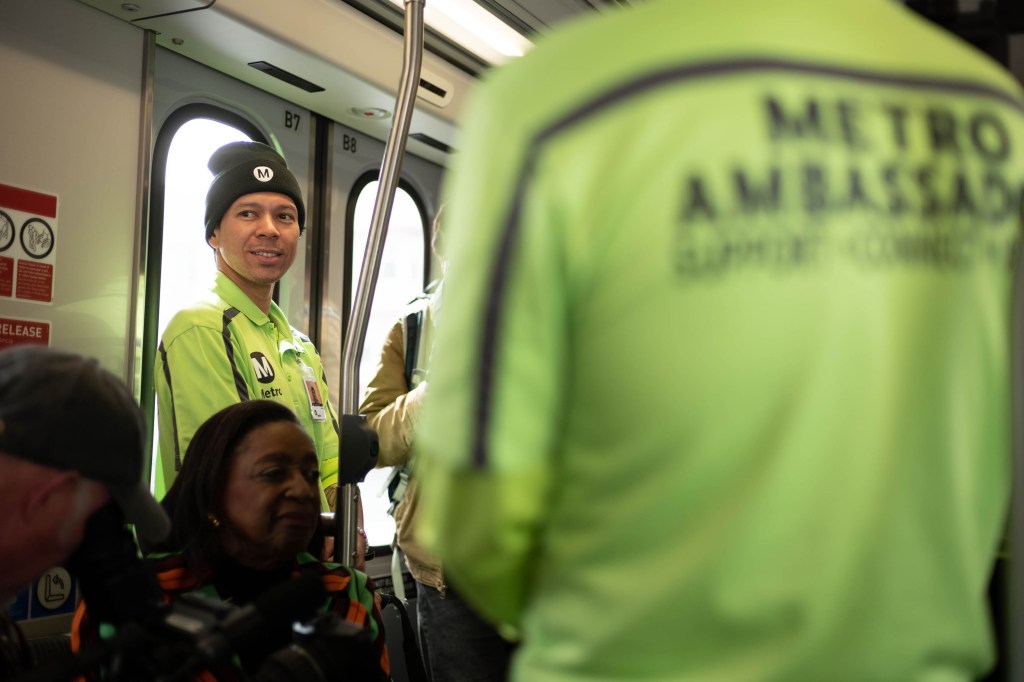
Also, LA Metro employs 350 Ambassadors as part of the new Division who are not armed and wear bright green shirts while directing passengers to the correct train or bus lines for reaching their destinations. They also use Narcan to reverse the effects of those with opioid overdoses and call 911 for help when needed. They can be seen at train stations and bus depots as well as riding on transit.
After a spate of violence in 2024 that included fatal stabbings and shootings on buses and trains and even a hijacked bus, LA Mayor Karen Bass, who chaired the Metro board at that time, ordered a surge in armed law enforcement officers. The board added an additional $18 million to the 2024-2025 budget for more law enforcement, bringing the total cost for the three agencies to about $195 million.
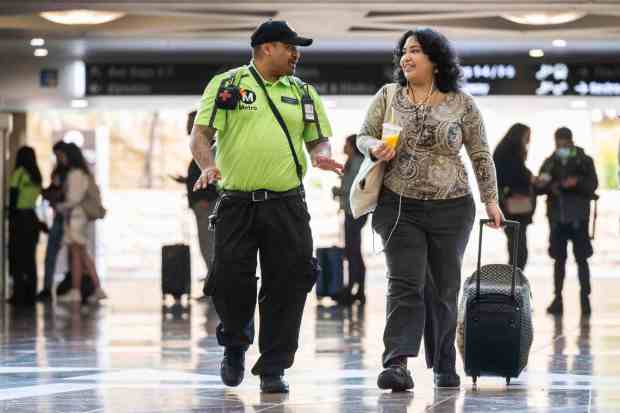 LA Metro Transit Ambassador Steve Gonzalez helps a woman find her train in Union Station on Friday, June 7, 2024 in Los Angeles. About 350 Metro Transit Ambassadors, who serve as greeters and are eyes and ears for problems and trouble on trains and buses, are an example of the care-first approach to public safety. They now fall under the Care-Based Services Division, formed Jan. 12, 2026, as part of the a new Department of Public Safety, This new division also includes: Homeless Outreach Management and Engagement (HOME), Community Intervention Specialists and Crisis Response Teams. (Photo by Sarah Reingewirtz, Los Angeles Daily News/SCNG)
The agency also added Ambassadors and Transit Security Officers to its public safety force and crime has continued to drop in the last two years, the agency reported. Metro also began a tap-to-exit program at certain high-crime stations, with the idea that removing fare-jumpers also reduces crime.
The idea is to remove non-paying riders, often who are homeless, mentally ill or taking illicit drugs, from the system. “The majority of violent crimes are from those with untreated mental health conditions and drug addictions,” said CEO Stephanie Wiggins at the time.
Joyce, who joined Metro in 2023, led the HOME team that scoped out unhoused folks riding the buses and trains as mobile shelters and connected with shelter and housing providers. Some sleep in dark corners of bus and train stations, under escalators or behind elevators. The 2025 Metro Point in Time Count found a 38% year-over-year reduction in homeless folks seeking shelter on the Metro system.
He said that experience, plus his time working with nonprofits on the county’s homeless problem since 2009, helps him lead the new division. He placed a strong emphasis on hiring peer support specialists who’ve experienced being unhoused or have recovered from substance abuse problems.
“Peers are a great resource to have,” he began. “They have walked the walk and talked the talk and can build trust.” The idea of working within the Department of Public Safety with mental health, social worker and peer counselors presents a new kind of safety patrol that has many different aspects to meet different needs.
The Care-Based Services Division received praise from Third District L.A. County Supervisor and LA Metro board member Lindsey Horvath: “When we lead with care, we create safer systems for everyone,” Horvath said in an emailed response. “This new division elevates proven programs that prioritize de-escalation, mental health support, and crisis intervention — delivering the right response, at the right time, to keep riders, employees, and our communities safe.”
Eli Lipmen, executive director of Move LA, a nonprofit supporting transit travel in LA County, said the new umbrella aggregating different public safety service units suits the complex challenges experienced by LA Metro, especially in Los Angeles.
“This approach ensures that the right type of services are deployed at the right time and transit riders feel safe on transit,” he wrote in an emailed response. “Metro has the opportunity to build this from the ground up and do it right and we look forward to seeing how it gets deployed in practice.”
Joyce did not know how long it will take for him to build his Crisis Response Teams, but said the agency is working on hiring. First deployments will be on parts of the Metro system with the highest volume of riders.
His teams will be dispatched to calls and also positioned at certain train stations and busways.
“By having these services under one roof, we think of it as all one team,” he said. “You will have a greater chance of collaborating and connecting. That’s our goal.”