
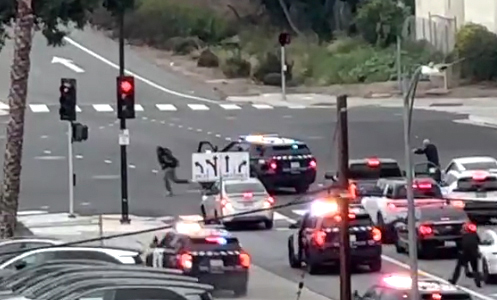
A witness’s video shows San Jose police cruisers, sirens blaring, racing toward a busy downtown intersection. Shots ring out. A man authorities said had been in multiple gunbattles with police — and had shot a sergeant in the head — emerges from the driver’s side of a police car, then runs from officers before collapsing amid a hail of gunfire.
Seconds later, another police vehicle speeding to the scene barrels over the man, the video shows. Officers fire at least a dozen more shots before approaching the suspect lying motionless on the ground — whom police later identified as 30-year-old Mohamed Husien of Davis and said was still armed.
The harrowing shootout unfolding in the middle of the city’s bustling downtown left bystanders shaken and describing the scene as a war zone, police acknowledged. And with the crucial moments captured on video, it puts the department under a microscope at a time when authorities’ use of force faces heightened public scrutiny.
Law enforcement experts who viewed the video of the Wednesday afternoon shooting said officers were almost certainly warranted in opening fire on Husien, who authorities said used a firearm with an extended magazine to target officers, including the sergeant who survived a grazing bullet wound.
Some experts, however, said the footage suggests a chaotic and potentially disorganized police response that may have endangered bystanders. They raised concerns about how a police vehicle ran over Husien after he fell to the ground and why officers continued firing after he no longer appeared to pose a serious threat.
“We’ve got a lot of hot lead going a lot of places,” said Roger Clark, a use-of-force expert and former Los Angeles County Sheriff’s lieutenant. “And this is not a rural area — this is urban.”
In a news conference Thursday, San Jose Police Chief Paul Joseph declined to discuss whether officers were justified in running over Husien or firing at him again, but said Husien continued to be armed and moving even after he collapsed in the first round of gunfire and was struck by a police vehicle.
Joseph said the police department’s standard process for investigating officer-involved shootings would seek to answer those questions. He added that Husien, initially sought over suspected armed robberies and carjackings, was clearly dangerous and “didn’t show any signs of surrendering peacefully and needed to be stopped for the safety of the officers involved in our community.”
The department did not immediately respond to questions about whether officers’ actions may have endangered public safety.
Authorities said that in the moments leading up to the video, Husien shot at a police sergeant after the officer attempted to use his patrol vehicle to block the car Husien was driving, which police said had been taken in a carjacking, setting off a close-range gunfight at the sergeant’s SUV. The sergeant was hospitalized with a skull fracture and expected to recover.
The shooting came after Husien led authorities on a violent, two-hour car chase spanning Hollister and San Jose, during which he opened fire on police multiple times.
According to the San Jose Police Department’s policy manual, deadly force is warranted to prevent the escape of someone suspected of fleeing a violent felony “if the officer reasonably believes that the person will cause death or serious bodily injury to another unless immediately apprehended.”
Clark said that while Husien’s actions appear to justify the initial use of deadly force, it seems unlikely that Husien continued to pose a credible threat after he fell to the ground — or after being run over by the police vehicle. He said officers are generally discouraged from using their vehicles as a means of force because it is unsafe.
“I don’t think he would have been run over if they had the discipline and command structure that is embedded in their training,” Clark said.
A short entry in the San Jose police manual states that officers are authorized to use a police vehicle as a means of force when it is “objectively reasonable to do so.”
San Jose police spokesperson Jorge Garibay said it was unclear whether running over Husien was intentional or justified because the department had not yet interviewed the officer who was driving. The department did not immediately respond to questions about why officers continued to open fire after the police car struck Husien.
Officers’ body camera footage of the incident will be essential to understanding whether Husien had a weapon, and at what point he posed a serious danger to officers or the public, said Greg Woods, a criminology professor at San Jose State University. Police said they would release the body camera video in 45 days.
“It’s easy for us in retrospect to try and Monday morning quarterback, but we need to understand the policies in place and the severity of the threat,” Woods said.
Lisa Hill, a criminal justice professor at California State University, East Bay, said some studies have shown that police “hot pursuits” like the chase after Husien can risk public safety, while noting the research is mixed.
She worried the video could add to the already strained relationship between law enforcement and some communities in San Jose, coming just weeks after a video showing a federal immigration officer shooting and killing a woman in Minneapolis while she was driving her SUV sparked national outcry. Federal officials have said the agent was acting in self-defense.
Hill called on police to move quickly to release additional information about the San Jose shooting.
“This video is shocking, and people see what they see,” Hill said. “So it’s going to be really important that police agencies, as quickly as possible, get out there and say exactly what happened.”
Joseph said while his officers’ actions will be investigated, he believed they responded bravely to a harrowing threat.
“Nothing about a deadly force encounter is pretty,” Joseph said. “You have an incredibly dangerous situation with a dangerous individual that individual needs to be stopped.”
Staff writer Caelyn Pender contributed to this report.