
Two Los Angeles County supervisors are turning to local taxpayers to fill the gap left by deep federal cuts to county healthcare services in the form of a half-cent sales tax measure.
Supervisors Holly Mitchell, who represents the Second District, and Hilda Solis, of the First District, are asking the five-member board to support placing the tax measure on the June 2 primary ballot. A vote on their motion is expected at the board meeting on Tuesday, 9:30 a.m.
If approved for placement on the ballot, a majority of voters in L.A. County is needed for passage.
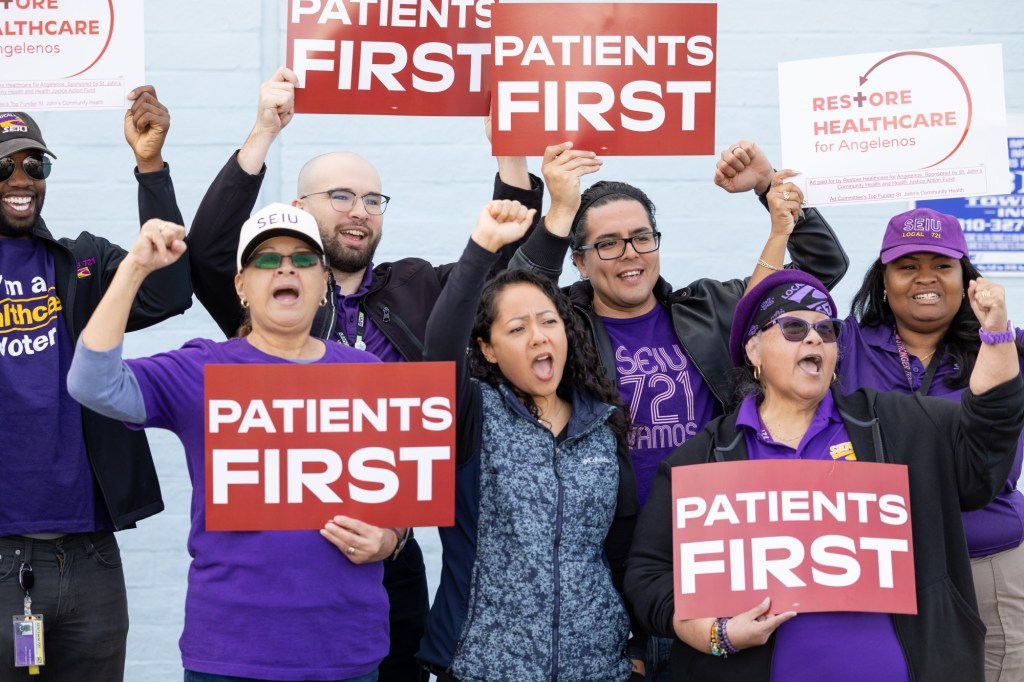
A coalition of clinic operators, county patients and public employee unions called Restore Healthcare for Angelenos, gathered in Inglewood recently to support the five-year sales tax that would raise about $1 billion annually for county healthcare services. The tax would sunset Oct. 1, 2031.
The cuts to Medicaid, known in California as Medi-Cal, affects 3.3 million low-income county residents who rely on Medi-Cal, according to the motion by Mitchell and Solis. Hundreds of thousands in the county may lose coverage as a result of cuts, and also from new rules that include renewing coverage every six months rather than each year, work requirements, and reductions in how much will be covered for non-citizens, according to CalMatters.
In addition to those falling off the Medi-Cal rolls, the county would experience reductions in healthcare services due to cuts in federal funding.
Also, the federal cuts within the H.R. 1 law (“Big Beautiful Bill”) that was adopted in July 2025 will result in losses of $750 million per year from the county’s Department of Health Services. About 70% of the DHS budget comes from federal funding. Also, the county Department of Public Health projects losses of $200 million to $300 million, the county reported.
Unless the gap is filled, the county will see cuts to emergency rooms and 23 county clinics, even possible clinic closures. The hospitals that would be hit hardest are: Los Angeles General Medical Center, Olive View Medical Center, Rancho Los Amigos and Harbor-UCLA Medical Center, the motion stated.
“The cuts in H.R. 1 will result in unprecedented and catastrophic impacts on residents and on health care and social service providers,” read the motion.
“The Board of Supervisors has an opportunity … to give voters a voice in protecting the healthcare safety net that millions of Angelenos depend on. We cannot stand by while federal cuts force families to choose between their health and their financial security. This measure will ensure our community clinics, emergency rooms, and public health services remain accessible when we need them most,” said Jim Mangia, CEO of St. John’s Community Health, a clinic provider and coalition member.
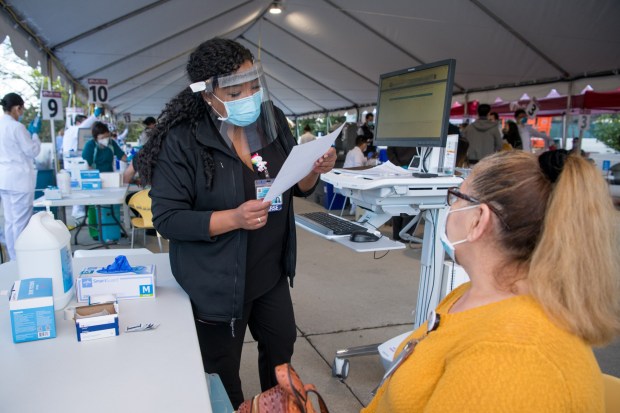 FILE — LA County Department of Health Services Supervising Clinic Nurse Jamie Robledo asks health questions to Loly Lemus, Nursing Attendant, at a COVID-19 vaccination clinic at LAC+USC Medical Center, Dec. 18, 2020. (Photo County of Los Angeles/Michael Owen Baker)
Already, about 120,000 people in the county between July and November 2025 have been dropped from Medi-Cal enrollment, the county reported, including 27,000 children. Without coverage, nonprofit clinics won’t get paid and will therefore implement service reductions and clinic closures, the motion stated.
Solis and Mitchell are concerned that county residents who no longer have Medi-Cal benefits and don’t get care at clinics, will have no choice but to go to county hospital emergency rooms, causing “an overcrowding crisis,” they wrote in the motion.
With the money from the tax measure, clinics and county hospitals can stay full-staffed and remain open. And patients will have coverage for their medical needs, the motion stated.
The supervisors reported that preliminary polling shows that 58% of county residents would support the tax increase in order to preserve county healthcare services.
If the ballot measure is not approved by the supervisors, the coalition has said it will gather signatures to qualify it for the November ballot.