
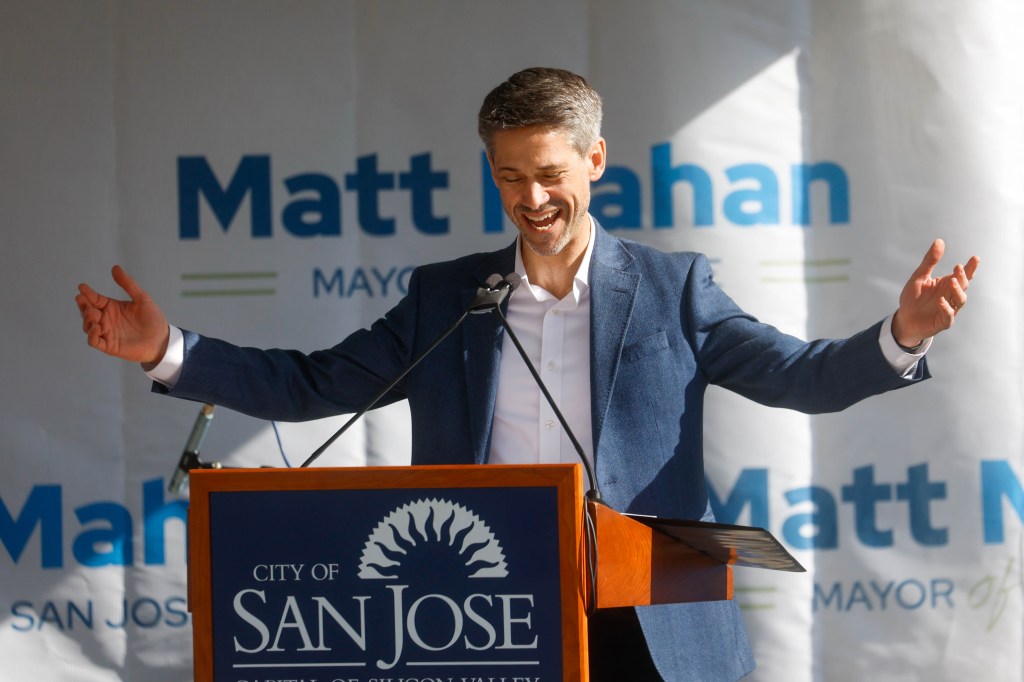
In what could be his last State of the City address as he dives headfirst into California’s gubernatorial race, San Jose Mayor Matt Mahan on Saturday continued to tout the progress his city has made under his “Back to Basics” agenda and how it could serve as a model for the state moving forward.
With some of the city’s Super Bowl festivities at San Pedro Square in the background, Mahan focused this year’s annual address on gains the city has made in addressing unsheltered homelessness and public safety, and on how policy decisions at City Hall have unlocked stalled housing projects amid rising construction costs and high interest rates.
“That’s what I promised you three years ago: clear goals with clear measures of progress,” Mahan said. “In these areas, San Jose has led the way. Now we need to double down on focus and accountability and let the San Jose story inspire the rest of our state to follow our lead.”
In Mahan’s short tenure on the City Council — first as a District 10 councilmember in 2020 and then sworn in as mayor in 2022 — he has trumpeted the need for San Jose to narrow its focus and deliver results on residents’ biggest needs.
In a recent report issued by City Auditor Joe Rois, 59% of participants in San Jose’s annual community survey said they were satisfied with the overall performance of the city in providing services. That figure marked a 7% improvement over the previous year. The report also noted widespread improvements across nearly all topic areas.
“I am so proud to see how far San Jose has come in just a few short years, and inspired by your vision for where we’re going together,” said Hall-of-Fame soccer star and San Jose native Brandi Chastain, who emceed Saturday’s event.
Homelessness has and continues to be the top priority for residents, according to the city’s annual community survey. Sixty-five percent of survey participants gave the city a poor or very poor grade for addressing the issue.
When Mahan entered public office, he said that around 5,500 residents lived in encampments, as the city’s shelter system had only 400 beds. Although the latest point-in-time count indicated at least 6,503 residents were homeless, what’s changed is that the city has invested significantly more in expanding its shelter system, allowing the unsheltered rate to improve by nearly one-third.
In the past 12 months, San Jose has added more than 1,200 beds to its system, bringing overall capacity to more than 2,000. This week, elected officials celebrated the completion of the city’s latest interim housing community, which added 162 units and the ability to serve up to 200 unhoused residents at one time, at the Santa Clara Valley Transportation Authority’s Cerone Yard.
Because the costs of building and operating shelters are prohibitive, Mahan acknowledged that the city could not expand its system further. He said the city is honing its system, not only to reduce costs, but also to track outcomes and improve collaboration to help unhoused residents find more permanent housing.
“Santa Clara County will soon provide mental and behavioral health services on-site at nearly half of our interim housing communities, with a vision to getting to all of them,” Mahan said. “We are integrating our systems, because the truth is, no one cares whose job it is to get people indoors and connected to services. They just care that we get it done, and we all have a role to play.”
Mahan also touted San Jose regaining the title of the safest big city in the country, as well as the police department’s 100% homicide clearance rate. With immigration enforcement operations across the country creating apprehension locally, he also credited the City Council with pushing forward legislation to prohibit law enforcement officers from wearing masks and federal agents from using city-owned facilities for their operations.
“We can enforce laws and have a secure border without terrorizing hard-working neighbors, who not only contribute to our community every day, but are doing the most American thing imaginable — working hard, sometimes two or three jobs at a time, just to create a better future for their children,” the mayor said.
Housing affordability also remains a major issue locally, as evidenced by a recent Remitly study that found the city to be the most expensive for first-time homebuyers. The community survey also rated the city’s efforts to add both market-rate and affordable housing poorly.
“We realized that our own rules, our approval processes, our timelines and our many taxes and one-time fees looked good on paper, but weren’t producing good results in the real world,” Mahan said. “We said ‘yes’ to every project that came before the council, but our own processes were effectively telling home builders ‘no,’ so we changed them, we cut fees, created incentives to build where it makes sense, and streamlined approvals so that housing could actually get built.”
After zero market-rate multi-family housing developments broke ground in 2024, the city’s policies were credited by developers in getting nearly 2,000 units started last year. Continuing and expanding some of the housing incentives could also unlock several thousand more units this year.
“Over the last few years, we’ve proven something very important: our biggest problems can be solved,” Mahan said. “At a time of division and declining trust in government, we’ve given people back hope by getting back to basics.”