Greekman’s $30 Monday nights bridge the affordability gap. Plus, L.A.’s Villa’s Tacos at Bad Bunny’s Super Bowl halftime show … Valentine’s Day pizza toast … the dim sum slump … and for those with sensitive “cat tongues,” a tiny cat robot that cools your scalding-hot tea. I’m Laurie Ochoa, general manager of L.A. Times Food, with Tasting Notes.
The great third place
Can a $30 dinner make a better city?
In his 1989 book “The Great Good Place,” the late sociologist Ray Oldenburg introduced the phrase “third places” for spaces that are neither home nor work (first and second places) but public gathering spots that welcome regulars and newcomers alike. They are, as Oldenburg wrote in his book, “homes away from home where unrelated people relate.”
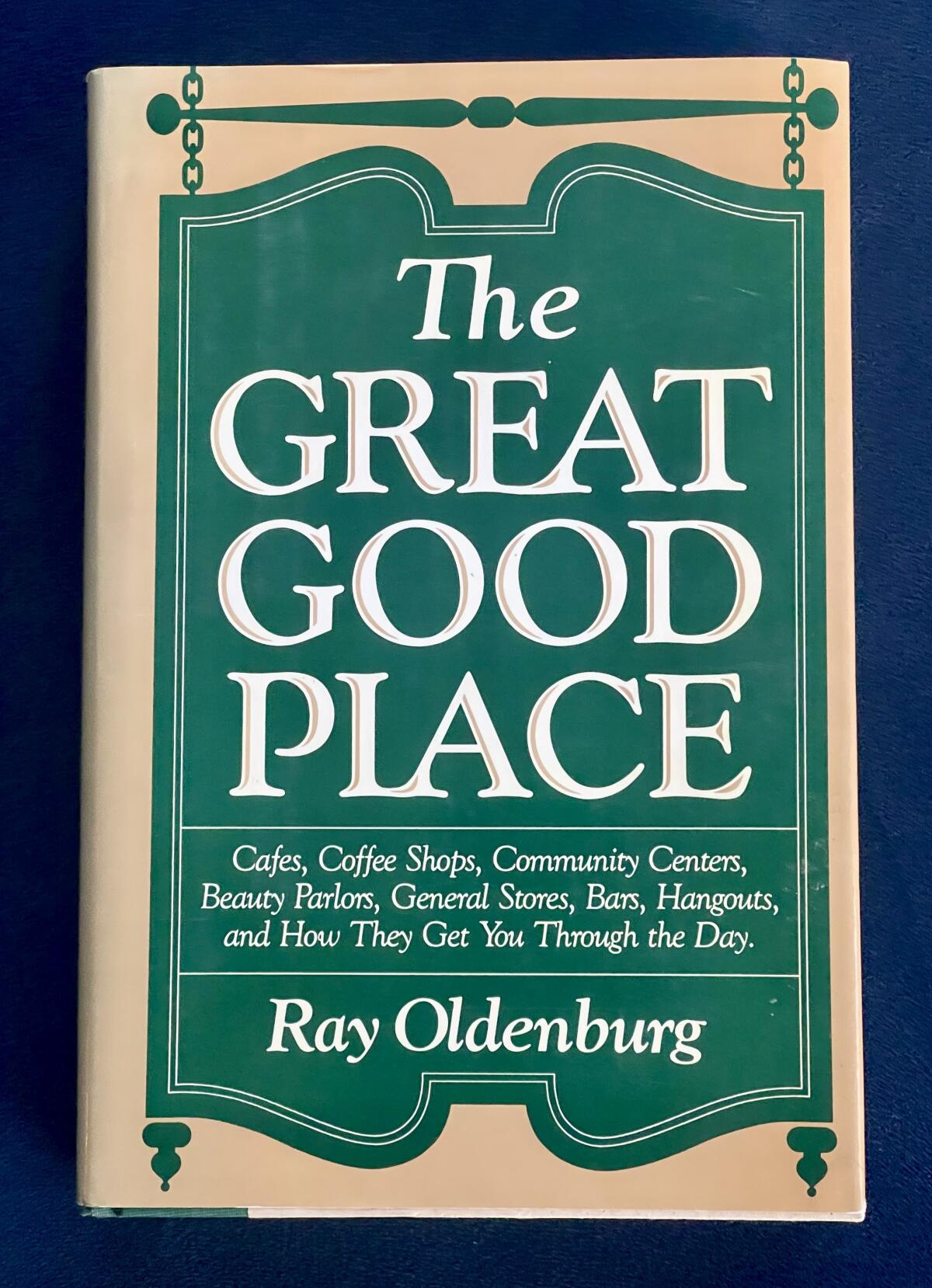
Ray Oldenburg coined the term “third places” in “The Great Good Place,” first published in 1989.
(Laurie Ochoa / Los Angeles Times)
Restaurants, diners, delis, cafes, bars and coffee spots have long been considered third places — along with libraries and even laundromats.
“We need to see our friends and neighbors and to be around people we don’t know,” Oldenburg and Karen Christensen wrote a few years back in an essay that described coffeehouses as “a perfect example of the third place” and even, in their infancy, “precursors of democracy.”
That’s because third places, Oldenburg says, are levelers: “The charm and flavor of one’s personality, irrespective of his or her station in life, is what counts.”
Los Angeles, like many great metropolitan cities, is fertile land for third places, with many of us happy to live in a place where we can expand our experiences beyond the food and culture of our own family traditions.
When restaurant critics Bill Addison and Jenn Harris chose Mercado La Paloma as their No. 1 pick in our recently published ranking of the 101 Best Restaurants in Los Angeles, they were, in effect, celebrating a third space. They could have given the spot solely to Gilberto Cetina’s Holbox. The seafood specialist, which was our 2023 Restaurant of the Year, has a Michelin star and lines out the door most days. But the Mercado, designed as a community gathering spot, has six other terrific food-hall style restaurants plus a few shops that together make it one of the most popular places for Angelenos — whether wealthy, working-class or on a student budget — to show off their city to visiting friends and family.
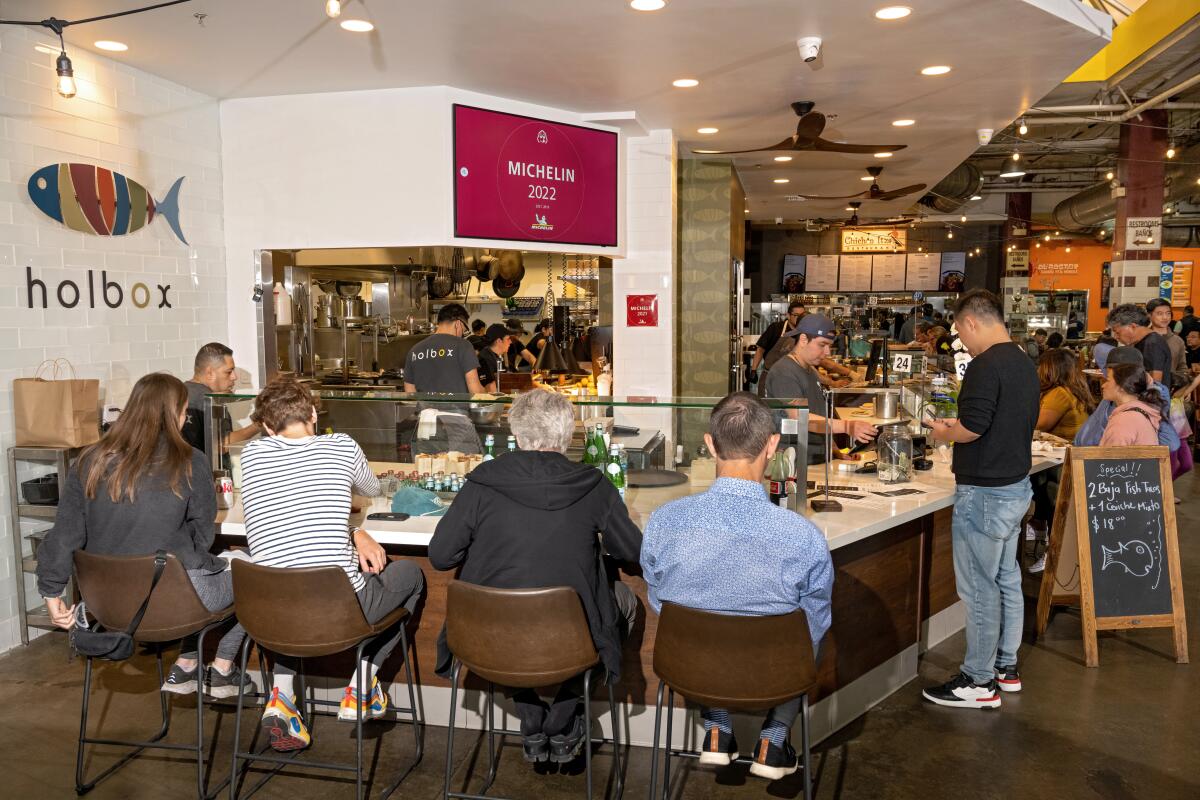
Diners at the counter at Holbox inside Mercado La Paloma with a view in the back of the Yucatan stand Chichén Itzá.
(Ron De Angelis / For The Times)
At the same time, the rising costs of food, rent and labor have made it harder than ever for L.A. restaurateurs to create and maintain third places, which, according to Oldenburg, should be affordable, informal and accessible. Michael Cimarusti’s wonderful restaurant Providence, which last year received its third Michelin star, cannot be a true third place when its tasting menus are $375 and $475 a person. But the chef’s more casual fish house Connie & Ted’s, with a $22 hot fish sammy and a $38 bouillabaisse, comes closer.
Late last year, as Addison reported, the acclaimed chef Morihiro Onodera, known for his exquisite — and pricey — omakase menus, relocated from his jewel box Atwater Village space to a larger spot between Echo Park and downtown, and he recruited Han Suk Cho, formerly of Kato, to create a custom bar menu.
Within this newer Morihiro Sunset space, four customers a night can still get Onodera’s full omakase experience at $450 a person. The twist is that the restaurant now also serves a much more affordable a la carte menu with nigiri and a few pub-style dishes, including cherry wood-smoked chicken. And with the added seats, you can usually get a table or spot at the bar without planning a month ahead of time. When I visited, there were a few happy regulars along with first-timers. Customers partaking in the omakase experience were seated beside others who were spending much less on a la carte items, and the conversation flowed as easily as Cho’s cocktails.
Not everyone can do this. Even with an open-minded customer base, restaurants are turning to increasingly expensive tasting menus to make even a small profit, which means a more divided restaurant scene.
That’s one reason so many restaurants — more than 460 — participated in the Los Angeles Tourism & Convention Board’s Dine L.A. Restaurant Week, which is actually two weeks and which was just extended at a good number of places to run through Thursday and Friday. The idea is for restaurants to offer menus priced to encourage new and returning customers to come in. Suzanne Goin’s A.O.C., Josef Centeno’s Le Dräq and Thomas and Vanessa Tilaka Kalb’s Agnes Restaurant & Cheesery are just a few of the places that have extended their Dine L.A. menus.
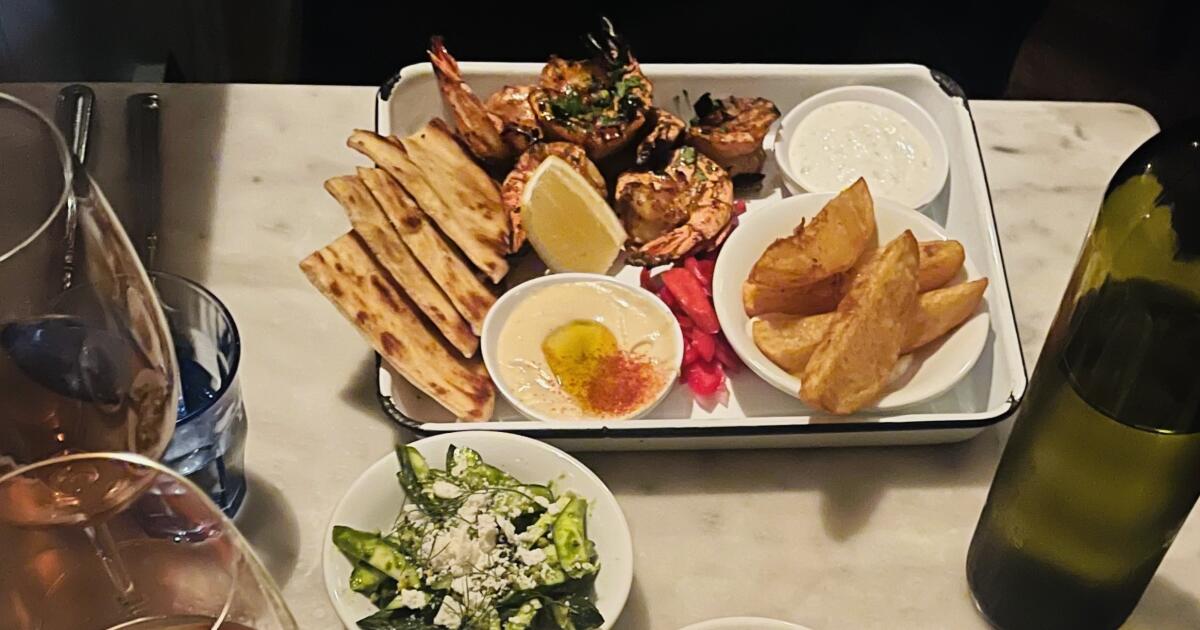
Not far down Sunset Boulevard from Morihiro, Jonah Freedman’s restaurant Greekman’s is doing its small part to help bridge the affordability gap year-round. On Monday nights, traditionally the slowest of the week, Greekman’s offers a $30 prix fixe menu. You might get prawn souvlaki with a side of what the restaurant rightly calls “very lemony potatoes,” kolokithi salad (marinated zucchini, pistachio, mizithra cheese and dill), plus hummus, tzatziki, pita and pickles.
Other side choices include smoked cauliflower, marinated beets with Greek yogurt and the restaurant’s “village” salad with tomatoes, cucumber and more. Everything comes at the same time and is served on a metal tray with small bowls for the sides. The restaurant’s general manager, Saskia Baden, likens it to a Mediterranean bento box. And on Wednesday nights — dubbed Wine Wednesday by Greekman’s, which has an excellent selection of Greek wines — all bottles are discounted by 50%.
“I’ve found what makes or breaks a restaurant is your weekday business,” Freedman said in a phone interview. “A lot of restaurants are closed on Mondays, but whether you are open for five or seven nights, you’re paying the same amount of rent. So as long as we staff the restaurant appropriately, it just made sense to stay open.”
But Freedman didn’t make his decision solely for business reasons.
“I really want Greekman’s to feel like a neighborhood restaurant,” he said. “And being open with regularity and consistency seems more neighborhood to me — you know, open every single day from five to 10. It’s a very simple kind of availability for the community to understand. And I think there’s something nice about a casual Monday dinner that feels reasonable and accessible, something fun to incorporate into your routine and that keeps you in dialogue with other people in your community.”
Sounds like a third place to me.
Fighting L.A.’s dim sum slump 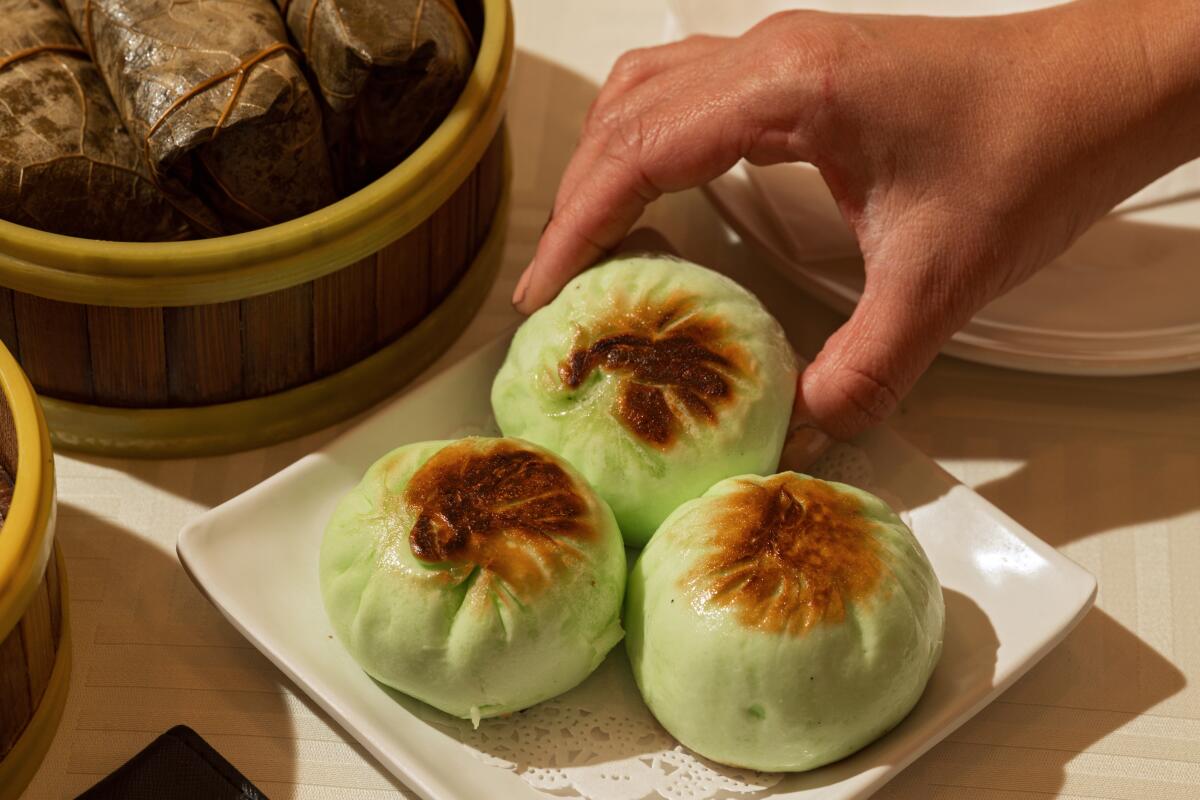
Pan-grilled pork and shrimp pandan buns at Sea Harbour Seafood Restaurant in Rosemead feature pandan-infused bread around a filling of both pork and shrimp.
(Ron De Angelis / For The Times)
Restaurant critics Addison and Harris also teamed up to find Southern California’s best dim sum … and found themselves asking: “What happened to all the good dim sum in L.A.?”
“For every har gau we recently encountered,” they wrote, “there were five with gummy wrappers sticking to the steamer liner that ripped to reveal lackluster seafood.”
And yet, even in a dim sum slump, there are excellent dumplings to be had. After a lot of eating, Addison and Harris winnowed their notes to the five best places to eat dim sum in Southern California: Sea Harbour, Longo Seafood (get the oatmeal snowcap buns) and Big Ma’s Kitchen, all in Rosemead, the Alhambra branch of Lunasia and the newly opened Palette Dim Sum in Tustin. Harris also put together a dim sum cheat sheet with what to look for in five core items, from shumai to the parcels of lotus-leaf-wrapped sticky rice known as lo mai gai.
Garden of vegan delights 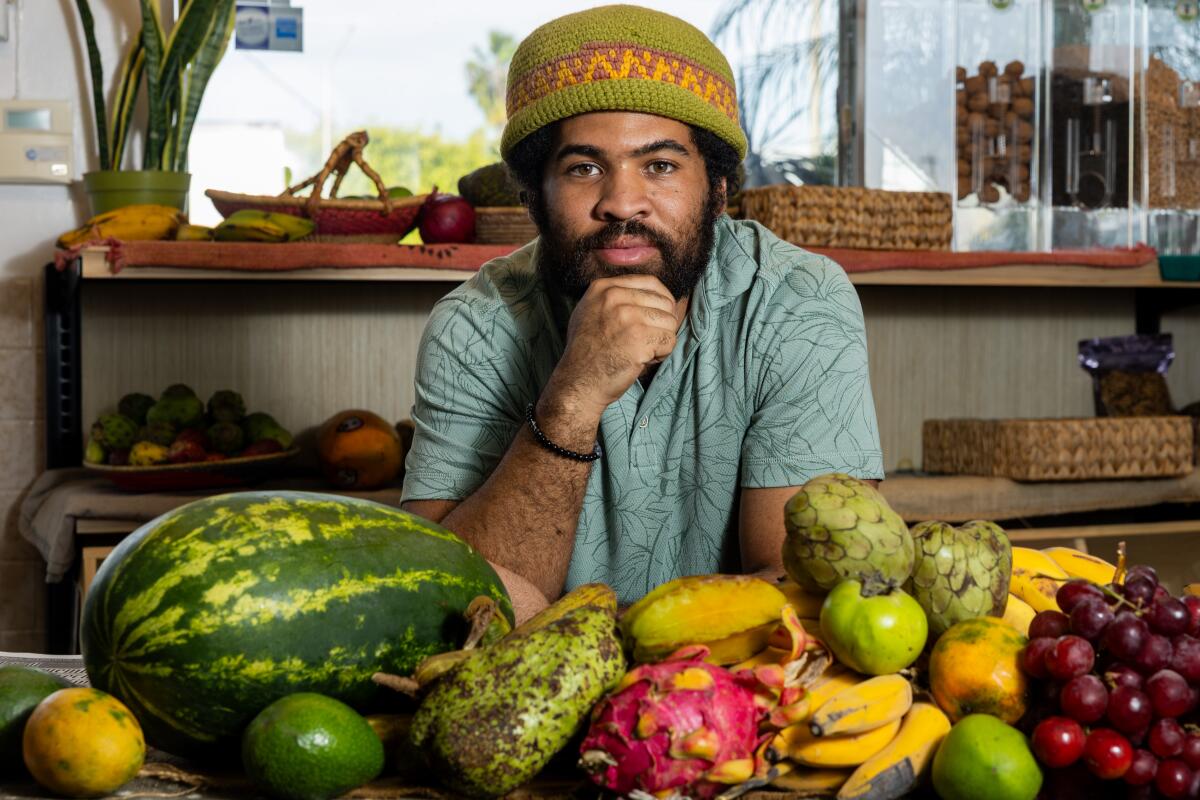
Imani Diggs of Imani Gardens at Crenshaw Food Hub.
(Ronaldo Bolanos / Los Angeles Times)
Imani Diggs is willing to drive 43 hours to Florida and back for a good watermelon. He’s selling them and many more fruits and vegetables, largely from Black farmers, at Imani Gardens inside the Crenshaw Food Hub, which he recently opened with partners Adam X and former Compton Community Garden director TemuAsyr Martin Bey. Two resident chefs — Amin Muhammad, known for his vegan pizzas and Wolf Collins, whose vegan soursop “fish” sandwich is a TikTok sensation — are running separate pop-ups out of the space.
“The idea is to have a place in the community to come get some groceries in a food desert,” Adam X told Harris, whose story has many more cool details about the project.
Plus: Senior food editor Danielle Dorsey put together a guide she calls “How to celebrate Black History Month in Los Angeles, deliciously” with 15 recommendations that represent some of the city’s best food and drink.
Also …Bad Bunny‘s Super Bowl halftime show, which music critic Mikael Wood described as “a loving and optimistic vision of the American experience,” caught the attention of L.A. taco lovers when the singer, as Andrea Flores wrote, handed a red-syrup-drenched piragua, or Puerto Rican shaved ice, to Victor Villa set up on the field with a portable version of his Villa’s Tacos stand. On Instagram, Villa wrote: “This one is for all the immigrants who paved the way before us to make this moment possible.”Deputy Food Editor Betty Hallock shares a recipe and some history of Tokyo-style pizza toast, which was said to have been first served in 1964 at the still-operating Cafe Benisica, notable also for its design by an artist who worked on movie sets for director Akira Kurosawa. In reporter Stephanie Breijo’s Quick Bites column on restaurant news, details about the intriguing new pop-up called Bruce at Chinatown’s Café Triste from chefs Brittany Ha, Hannah Grubba and Alex Riley, who worked together at the abruptly closed Horses. Breijo also has notes on Le Cirque alum Craig Hopson’s Electric Bleu, the former bistro pop-up that has become one of the Westside’s hottest restaurants. And the Eagle Rock restaurant Chifa has expanded its menu with a revamped version of Arroz & Fun, the Lincoln Heights spot that closed in 2023 but was loved for the way it blended its owners’ Chinese, Peruvian, Taiwanese and Salvadoran heritages.And even though the Super Bowl has passed, you might still be hungry for a good dip. Contributor Carolynn Carreño has you covered with her recipe for extra-cheesy queso fundido, which is not only melty but crispy from chorizo and a frizzle of fried parsley. Finally …
“Cat tongue” or “nékojita” is how the Japanese describe those who are especially sensitive to piping-hot food and drink. And for those who don’t want to blow on their tea the old-fashioned way to cool it down, there is a robot solution — a mini cat robot (actually an automated fan in cat’s clothing) designed to rest on the side of a cup or bowl and blow cooling air onto hot ramen or any other steaming liquid. Of course, there is a charming video to demonstrate how the tiny Nékojita FuFu works. And if you are persuaded, you can buy one at Japan House’s Waza shop for $39.
You’re reading Tasting Notes
Our L.A. Times restaurant experts share insights and off-the-cuff takes on where they’re eating right now.
By continuing, you agree to our Terms of Service and our Privacy Policy.