
The Carson City Council recently approved an increase in fees paid by the private users of pipelines used to collect, transport or distribute oil, oil products, industrial gas or water.
The original Pipeline Franchise Ordinance was created in 1978 to establish regulations for the issuance of franchises to construct, operate, maintain or remove pipelines along city streets. But the ordinance, including fees, has not been updated since 1995.
So the city contracted an auditor to compare the city’s pipeline franchise fees and regulations to other nearby municipalities and, on Tuesday, Feb. 3, the council approved an amendment to the municipal code, increasing fees and regulations — to the dismay of numerous stakeholders.
“I’m representing thousands of union workers whose jobs depend on refinery and energy infrastructure that occurs in Carson,” Richard Chou, organizer for the South Bay area Sheet Metal Workers Local 105 union, said during Tuesday’s meeting. “The proposed fee increase is significant. It could create unintended consequences and have impacts on jobs and working families.”
The proposed increase is 49 cents per linear foot, resulting in a cost of $4.62 per linear foot. This increase excludes any public utilities whose rates and regulations are overseen by the California Public Utilities Commission.
The city currently has franchise agreements with 22 private pipeline franchises, spanning a total of 694,991 linear feet throughout the city, resulting in an annual franchise revenue of about $2.1 million. The higher fees would increase this to $3.2 million.
“The franchise fees charged by the City to nonpublic utility companies that are not governed by the Public Utilities Commission have been significantly lower than the amount charged by other localities across the State of California resulting in significantly less revenue being collected by the City,” says the ordinance. “The City’s regulatory scheme needs to be updated to reflect a higher fee charged to such nonpublic utility companies.”
The ordinance will also allow the city to charge application fees to offset costs Carson currently absorbs, including for staff processing franchise applications, renewing existing franchises, and overseeing or installing and operating any facilities under a franchise.
Ramine Ross, senior manager for the Western States Petroleum Association, also attended Tuesday’s meeting, urging the council to delay a vote on the ordinance for 30 days.
“We have some serious concerns about the proposed pipeline franchise ordinance,” Ross said. “The ordinance includes requirements that duplicate current state and federal regulations.”
One of these regulations is the requirement that franchisees submit maps showing accurate “as-built” locations of their pipelines including the length, diameter and depth. And if franchisees violate any of the terms in this ordinance, they will be subject to increased fees.
Mayor Lula Davis-Holmes, however, said that stakeholders have had ample time to present their concerns to city staff.
Notice was given to all stakeholders on May 20, and a meeting took place on June 11, with representatives of 14 companies attending and providing input on the drafted ordinance, according to a city staff report.
Conversations also took place throughout the year and some concessions were made, including reduced insurance requirements, flexible performance guarantees, adjusted deposit rules and force majeure provisions.
“We’re talking about an ordinance that has not been updated since 1978,” said Planning Commission Chair Diane Thomas. “Changes were made based on those discussions. So, who is it that didn’t make it to the table? Obviously, it wasn’t important enough to make it to the table.”
Many of those who will be impacted by the amendment are oil refineries, providers or distributors. And multiple refinery workers attended Tuesday’s meeting to speak against the ordinance.
“The additional costs could pile up because the increased financial pressure refineries in Southern California have already had refineries closing down in recent years,” said Jasmine, a Carson resident who works at the Torrance Refinery. She did not give her last name during the public comment period. “I don’t want these good-paying jobs like mine to disappear.”
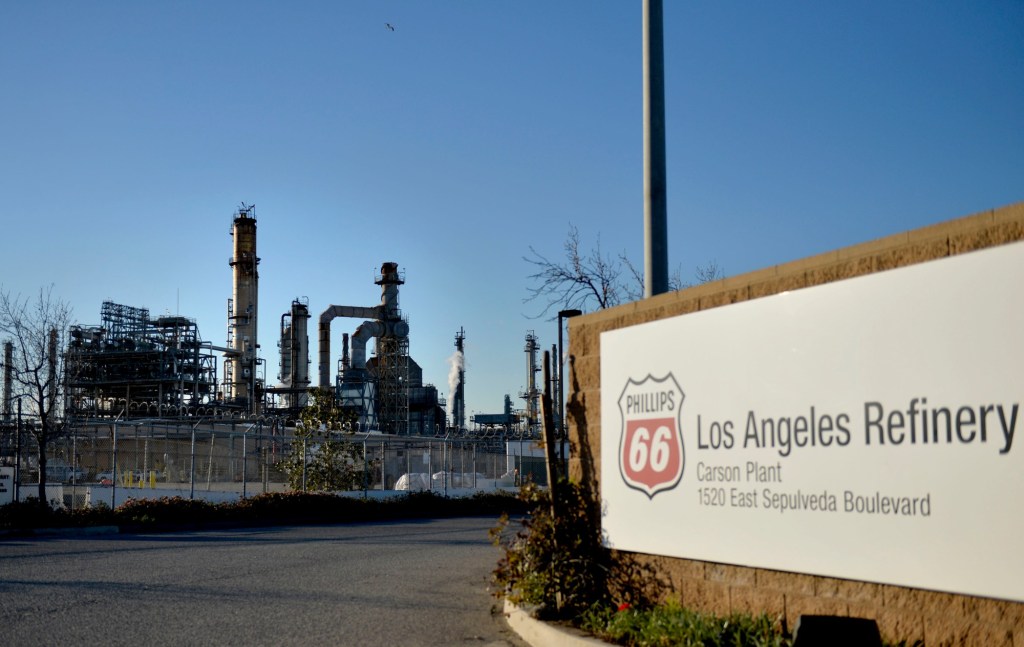
The latest in Southern California refinery closures was actually the Phillips 66 refinery in Carson and Wilmington, which resulted in 900 workers losing their jobs. The company has cited “market dynamics” as the reason for the closure.
But, Thomas said, refineries and oil companies need to be held accountable for their impacts on the community.
“I’m so happy that this is coming to the forefront,” she said, “because Carson has been plagued all of its history with oil companies that feel so privileged that they don’t need to pay their fair share.”
Phillips 66, for example, is now paying the city more than $16 million in back taxes after a 2018 audit discovered that the company had not been paying the full amount of special business license taxes required by the city.
Davis-Holmes put forward a motion to approve the ordinance, encouraging stakeholders to work with city staff on any concerns they may have. The motion was approved 3-2, with Councilmembers Jim Dear and Jawane Hilton dissenting.