
The struggle to incorporate the area that would make up the city of Carson began in the late 1950s and continued on for nearly the entirety of the 1960s. The topics of the debate ran the gamut from the important and the complex – which neighborhoods and chunks of land to include– to the most basic, what to call the new town.
Various consolidation attempts were filed under different names during these early efforts: Dominguez, Keystone, Victoria Park, Carsolinguez, Carson-Dominguez and finally and officially, Carson.
The election on incorporation was held on Feb. 6, 1968, with 17,351 voting for and 9,951 voting against. Voters also chose “Carson” as its name over “Dominguez,” and elected a slate of people to run the new burg. Carson’s incorporation became official on Feb. 19, 1968.
Once that matter had been settled, Carson’s new councilmembers seemed to realize that their new city was seriously lacking in some necessary public facilities.
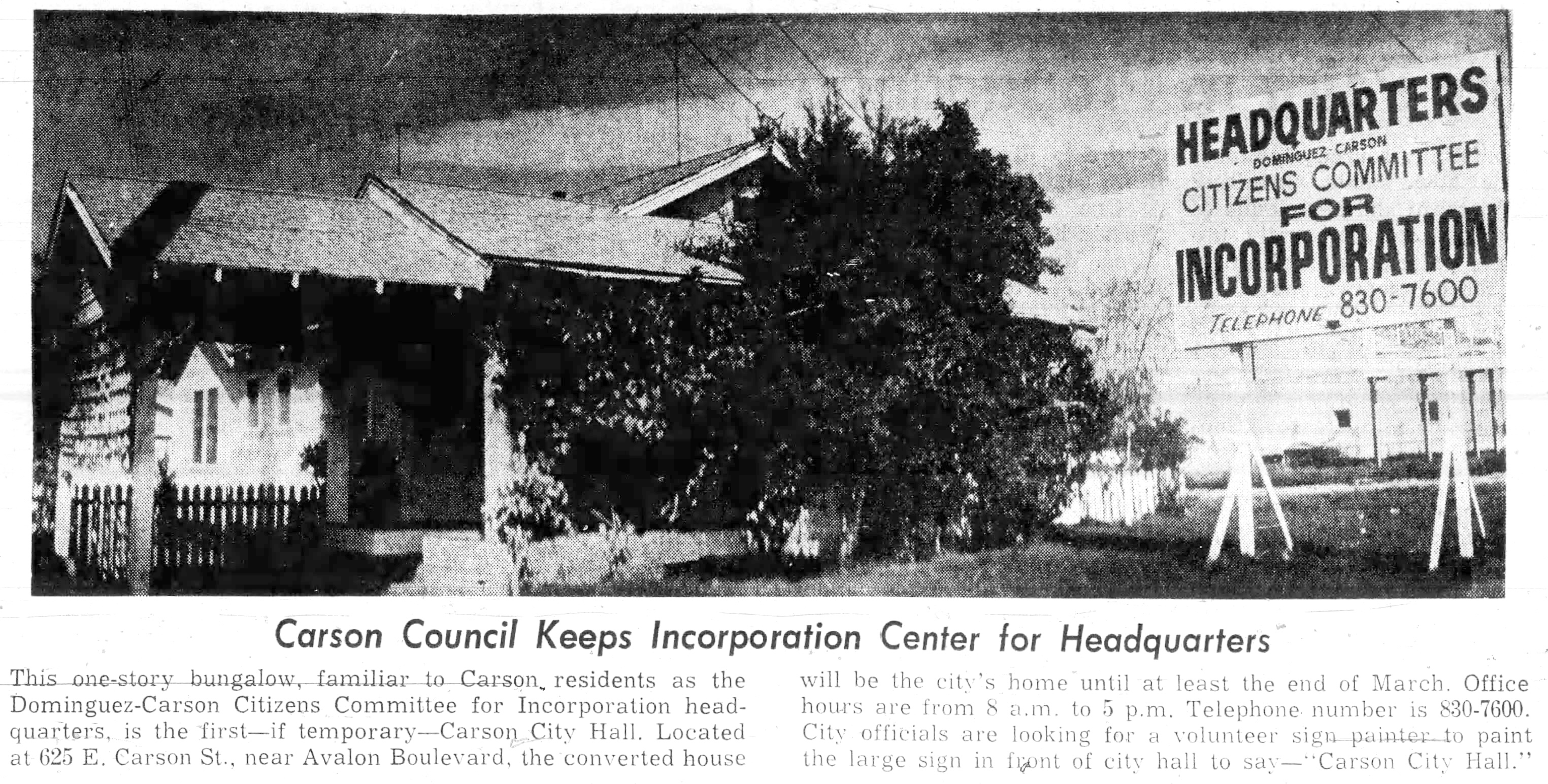
This one-story bungalow, familiar to Carson residents as the Dominguez-Carson Citizens Committee for Incorporation headquarters, is the first, if temporary, Carson City Hall. Located at 625 E. Carson St., near Avalon Boulevard, the converted house will be the city’s home until at least the end of March. Daily Breeze, Feb. 26, 1968, Page 9. (Daily Breeze archives)
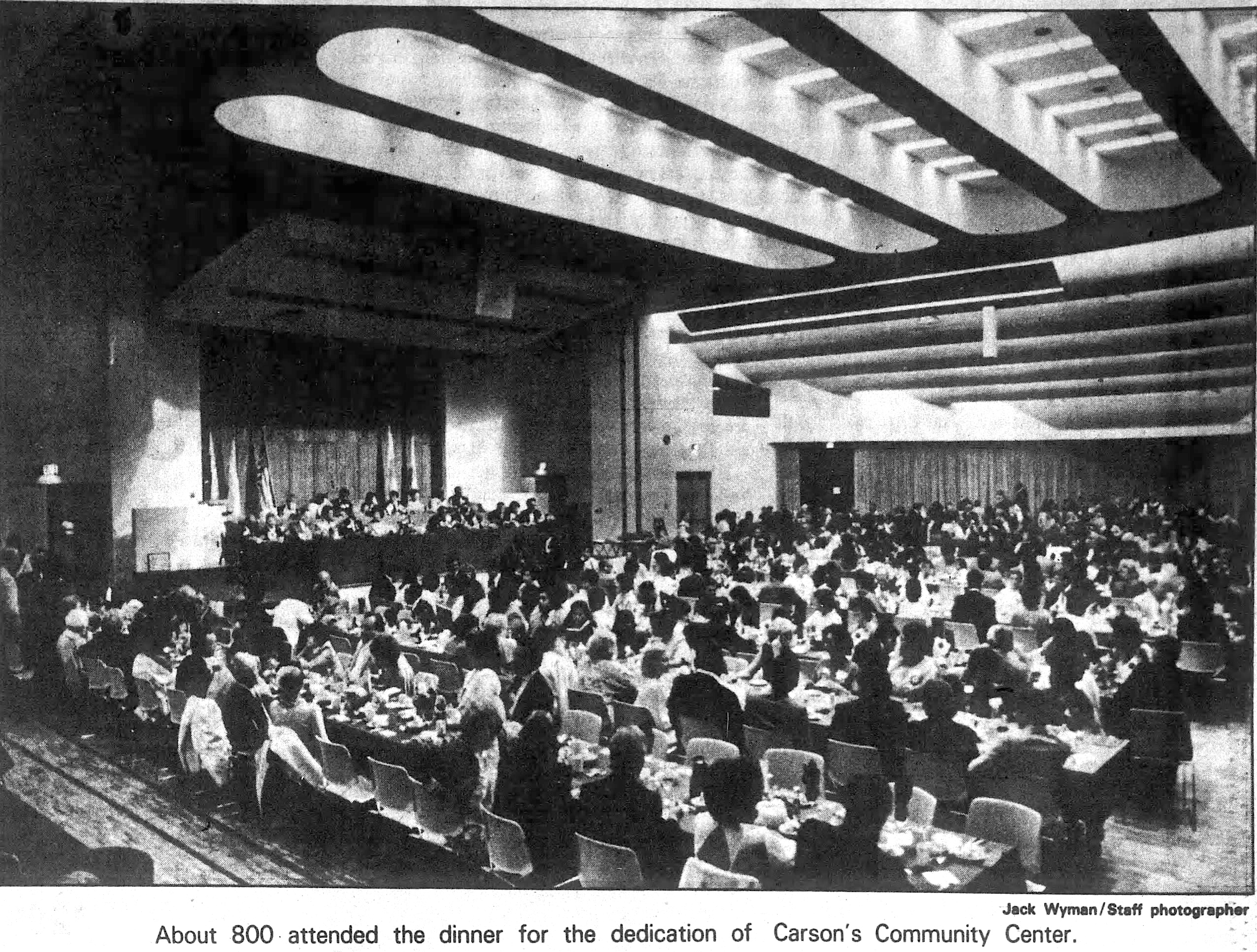
About 800 attended the dinner for the dedication of Carson’s Community Center. Daily Breeze, April 17, 1983, Page 17. Jack Wyman/Staff photographer. (Daily Breeze archives)
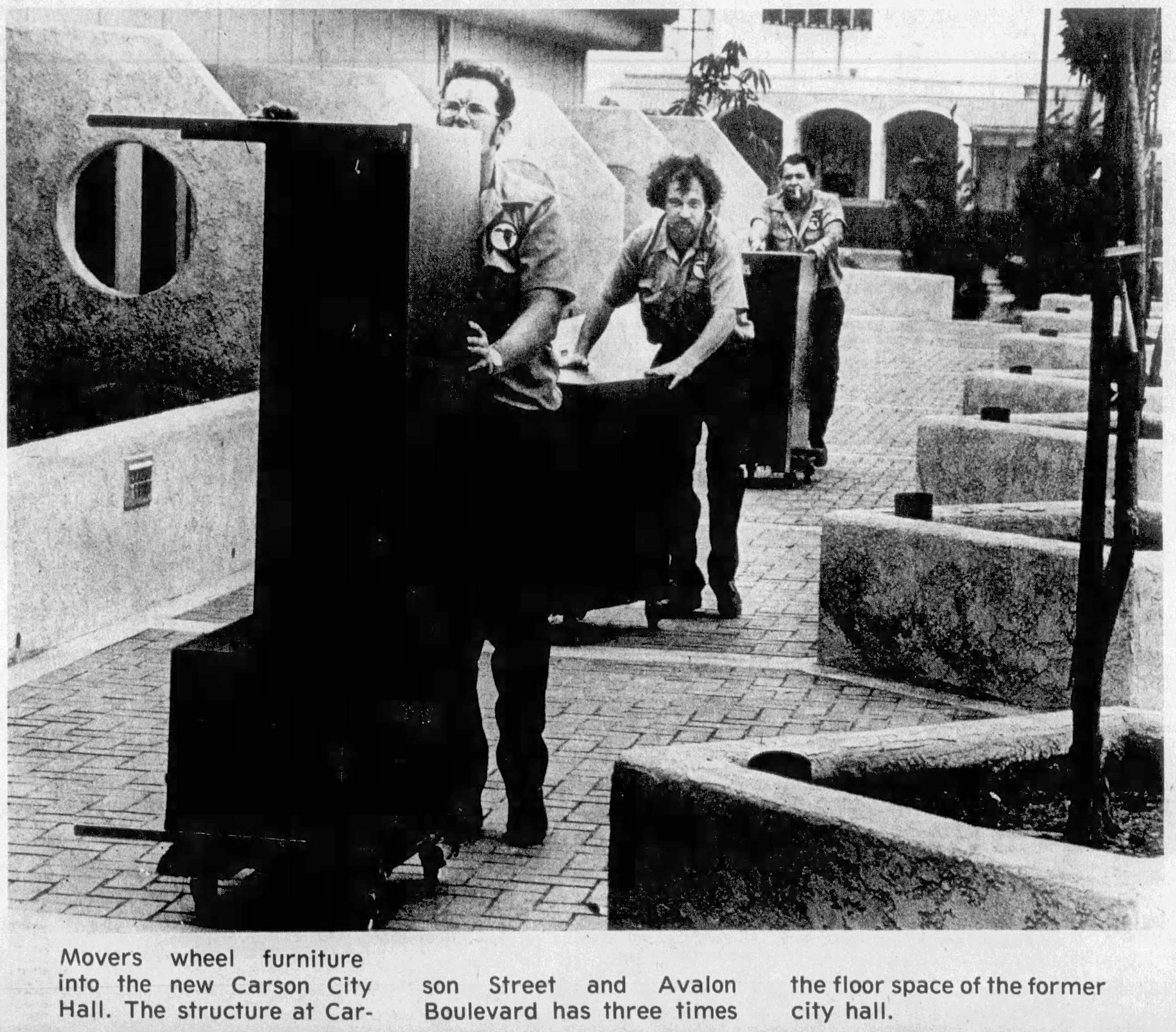
Movers wheel furniture into the new Carson City Hall. The structure at Carson Street and Avalon Boulevard has three times the floor space of the former city hall. Daily Breeze, July 12,1976, Page 13. (Daily Breeze archives)

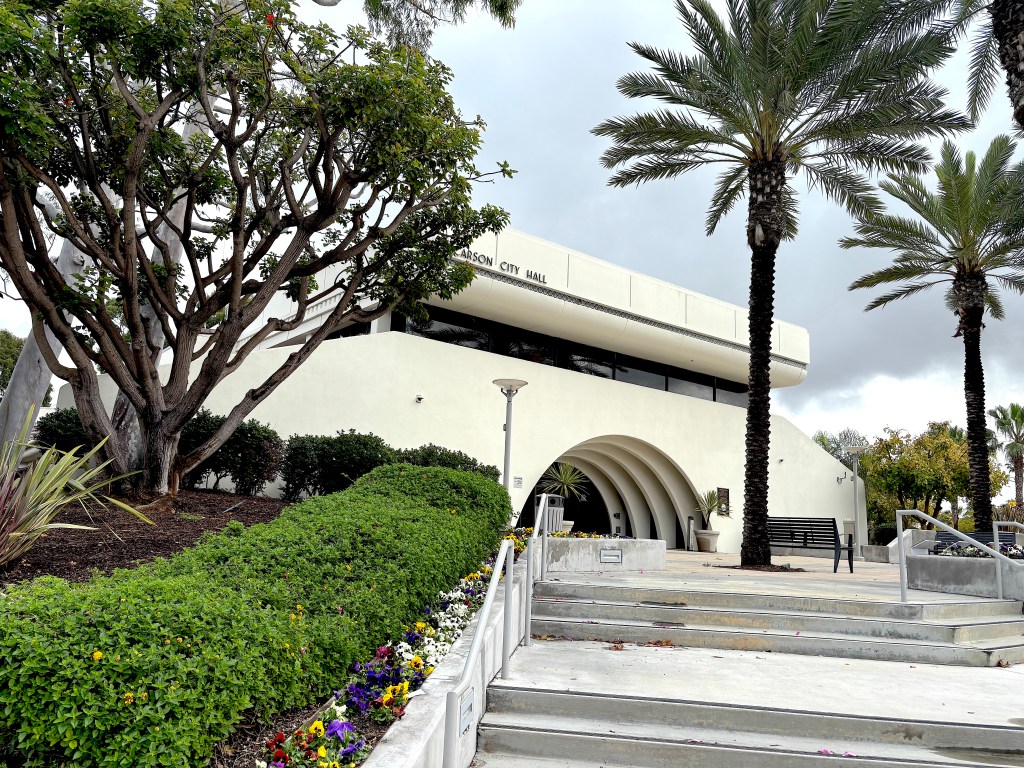
The front entrance to Carson City Hall in the Carson Civic Center. Feb. 11, 2026. (Photo by Sam Gnerre)
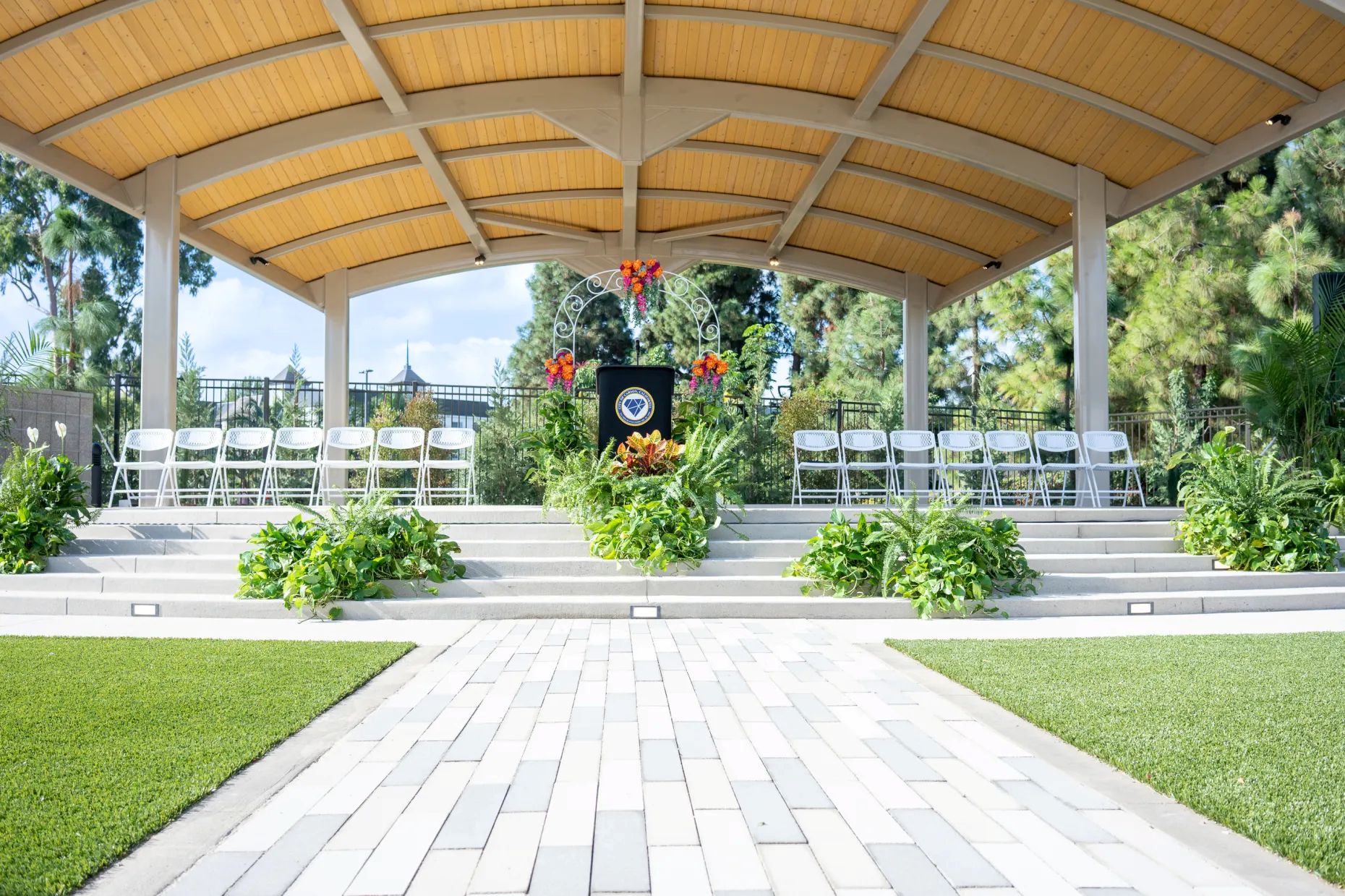
Carson’s new amphitheater, which is part of a 13,000-square-foot facility, is part of the largest outdoor space in the South Bay. The amphitheater and a neighboring courtyard area provide a central gathering space to host artistic performances, cultural events and community celebrations reflecting the community’s diversity and vibrancy. (October 2025/Photo courtesy City of Carson
Show Caption
1 of 5
This one-story bungalow, familiar to Carson residents as the Dominguez-Carson Citizens Committee for Incorporation headquarters, is the first, if temporary, Carson City Hall. Located at 625 E. Carson St., near Avalon Boulevard, the converted house will be the city’s home until at least the end of March. Daily Breeze, Feb. 26, 1968, Page 9. (Daily Breeze archives)
After all, the official swearing in ceremony and celebration following incorporation had to be held at Carson High School to accommodate the crowds.
The house-like building, 625 E. Carson St., that was acting as the town’s first city hall had previously served as headquarters for the incorporation effort. It quickly became apparent that it would be way too small for the city’s present and future needs.
A modular unit in a vacant lot at 228th Street and Avalon Boulevard was used temporarily as Carson’s second city hall, followed by a move to an industrial building at 21919 S. Avalon Blvd. in 1968. It sufficed for several years before the rapidly growing city outgrew it as well. Something bigger was needed.
Fortunately, city leaders in the late 1960s had formulated plans to create the Carson Civic Center, a full complex of municipal buildings with a new city hall as its nexus. The civic center plan was approved by the council in 1969, and ground was broken for it in February 1971.
In addition to Carson City Hall, it would eventually include a community building, an event center, an outdoor amphitheater and, just across East Desford Street, a long-needed Los Angeles County Sheriff’s regional station and a U.S. post office.
The 60-acre site lies between Carson and 213th streets on the north and south, and Avalon Boulevard and the 405 Freeway on the east and west.
The new post office building opened first, in 1973, followed by the sheriff’s station in 1974. Unfortunately, the plans for the main buildings in the new civic center had to be placed on hold in 1971 because of adverse economic conditions resulting from a nationwide recession.
At long last, ground was broken for the new Carson City Hall on Jan. 10, 1975. The city had hired three architects to design the new building in 1973: Robert Alexander, Frank Sata and Robert Kennard.
Kennard was an award-winning Black architect who had been mentored by renowned African American architect Paul Revere Williams. Kennard, who died in 1995, formed the Kennard Design Group in 1957. His daughter, Gail Kennard, now runs the firm.
The $3.5 million, 60,000 square-foot Carson City Hall, with its innovative interior design and Aztec temple-styled facade, was dedicated on Feb. 21, 1976. Still undergoing finishing touches at the time, it opened for business a few months later on July 12.
Next came the 73,0000 square-foot Carson Community Center, an $8.5 million structure that lies just east of City Hall. Its dedication on April 15, 1983, was the centerpiece of a weekend-long celebration for the 15th anniversary of the city’s incorporation.
Eight hundred people attended the ceremonies at the center, which was followed the next day by a city-sponsored parade and a gala ball held there.
The opening of the adjacent Clarion Hotel at 2 Plaza Center Drive on the eastern edge of the complex in 1988 helped to boost meeting and convention business at the Civic Center. The hotel is now a DoubleTree by Hilton location.
Thirty-two years later, a new facility was dedicated in the Carson Civic Center on Oct. 23. The $10 million, 1,000 seat outdoor amphitheater and event center took three years to plan and construct.
Carson Mayor Lula Davis-Holmes told those at the ceremony that the amphitheater project would bring “world-class performances, community celebrations and cultural transitions” to the city.
This latest addition to the Carson Civic Center is another example of how far the city’s public facilities have come since its 1968 incorporation.
Sources: “Carson,” by Cindy Tino-Sandoval, Arcadia Publishing Co. (Images of America series), 2006. Daily Breeze archives. “The History of a City…Carson, California,” by Jack E. Jerrils, City of Carson, 1972. “My Carson, Your Carson: A Picture Book of the Past and Present,” by Charlotte Trejos, Trejos Literary Agency, 1987.