
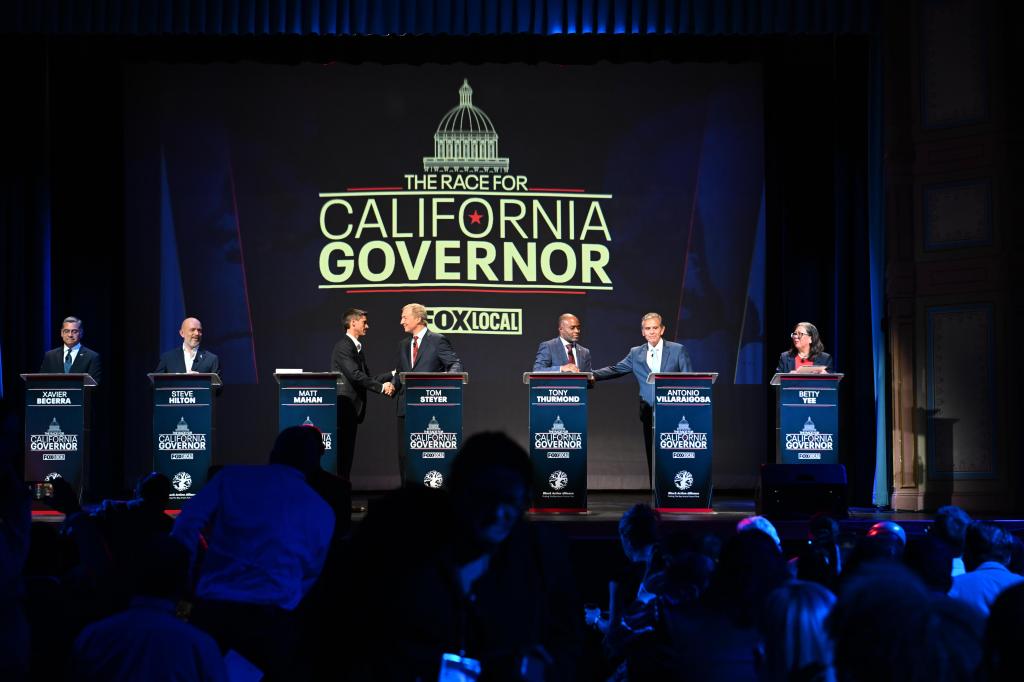
In the first independent poll since San Jose Mayor Matt Mahan joined the governor’s race, Republican former Fox News host Steve Hilton has surged to the lead of a crowded field, followed by Democrat U.S. Rep. Eric Swalwell, with many voters still undecided as to who should succeed Gov. Gavin Newsom.
The survey of 1,000 likely voters by Emerson College on Feb. 13 and Feb. 14 came less than two weeks after seven of the candidates duked it out in the first major televised debate of the race.
The poll offered the first look at Mahan’s chances of being the next governor and showed him near the back of the pack with 3.4% support. A 43-year-old moderate Democrat in his fourth year as mayor, Mahan entered the fray late last month, saying he was frustrated by what he sees as “business as usual” in Sacramento.
Hilton, who took shots at both his absent GOP rival and six Democratic contenders during the debate, saw his support increase by five points since Emerson College’s last poll in December. The United Kingdom-born businessman currently leads the field at 17.1%, followed by Swalwell at 14.1%, who saw a two-point bump since the last poll. The other Republican in the race, Riverside County Sheriff Chad Bianco, was third with 13.5%, followed by former Rep. Katie Porter at 9.8% and billionaire philanthropist Tom Steyer with 8.8%. Porter’s support decreased by one point since December, while Steyer saw a five-point increase. 21% of voters are still undecided, according to the poll.
Thad Kousser, a political science professor at UC San Diego, told the Bay Area News Group that the poll shows there is “no clear front-runner in a race where we’re only three-and-a-half months away from the primary.”
Politicians who have “much less governing experience” than more prominent politicians like former health secretary and Attorney General Xavier Becerra and former Los Angeles Mayor Antonio Villaraigosa are emerging in the polls, Kousser said. Becerra’s polling numbers stayed stagnant in the latest Emerson College poll at 3.5%, while Villaraigosa dipped from 5% to 2.8%.
“I think that shows that to remain current and at the top of the mind of California voters you either need a large social media presence or the money to run a major statewide ad campaign,” Kousser said.
Hilton said in a news release that the poll “confirms what we’re seeing on the ground at our Town Halls up and down the state.”
“When people see the clear contrast between 16 years of Democrat one-party rule that have given us the highest poverty, highest unemployment and highest cost of living in America and Steve Hilton’s positive, practical ‘Califordable’ plan: $3.00 gas, cutting electric bills in half, your first $100-grand tax free, a home you can afford to buy, Steve’s message wins hands down,” Hilton said.
But the former Fox News host also warned that Bianco could “act as a spoiler” by splitting the Republican vote, leading to two Democrats in the November runoff. California operates under a “jungle primary” system where the top-two candidates, regardless of political party, advance to the general election.
At a debate earlier this month, Hilton criticized his GOP opponent, calling him a “RINO,” which stands for “Republican In Name Only.” Bianco was not present at the debate due to a scheduling conflict.
Spencer Kimball, executive director of Emerson College Polling, said in a news release about the poll that the “Republican electorate in California is split between Steve Hilton (38%) and Chad Bianco (37%), while Hilton also picks up a plurality of independent voter support at 22%.”
Kimball also noted that “Democratic voters have not yet clearly coalesced around one candidate.” The crowded field has some Democrats worried about the possibility of both Hilton and Bianco making it into the runoff, shutting out the party that has controlled the Governor’s Office since 2011 if Democrats split the vote.
Political data expert Paul Mitchell, who drew the Proposition 50 congressional maps passed by voters last November, recently created a simulator that allows users to plug in different variables — including polling data — to calculate the odds of who will advance to the general election.
Utilizing only polling that has been conducted in 2026, the simulator puts the chances of a Republican versus Republican matchup at 18%.
“For frame of reference, an 18% chance is about equivalent to the chances of San Francisco being fogged in during your morning rush hour,” Mitchell posted to one of his X accounts. “Not exactly an unheard of event.”
The Emerson College poll also shows state Superintendent of Public Instruction Tony Thurmond at 2.1%, former state Controller Betty Yee at 1.8% and former Assemblymember Ian Calderon at 0.6%.
Though Mahan came in seventh among 11 candidates, his campaign voiced optimism.
Adrian Rafizadeh, Mahan’s campaign manager, said in a statement that the poll shows he is “already attracting significant support.”
“Even though his campaign is now just a couple weeks old, we are continuing to build more momentum every day,” Rafizadeh said. “It is clear that as more voters learn about Mayor Mahan’s record and his practical approach to lowering housing and energy costs, bringing our unsheltered neighbors indoors, and lifting up every public school, that they will continue to join his campaign to get state government back to basics.”
Kousser, the political science professor, said Mahan’s position in the poll shows what many pundits already knew: “he is in no way a household name across the state so he’s going to have to earn his place on the ballot.”
But Mahan might have the resources to get his name — and vision — in front of voters. His campaign touted on social media that the mayor raked in more than $7 million in his first week. Campaign filings showed that the money has come largely from tech titans and the ultra-rich.
Mahan also will receive support from a newly formed independent expenditure committee — which can raise and spend unlimited sums but cannot coordinate directly with a candidate. The group has raised at least $3.3 million from tech leaders including Y Combinator executive Michael Seibel and Riot Games co-founder Marc Merrill, according to POLITICO.
“If you do have the resources on the air, on digital media you can — if your message resonates — rise quite quickly,” Kousser said.