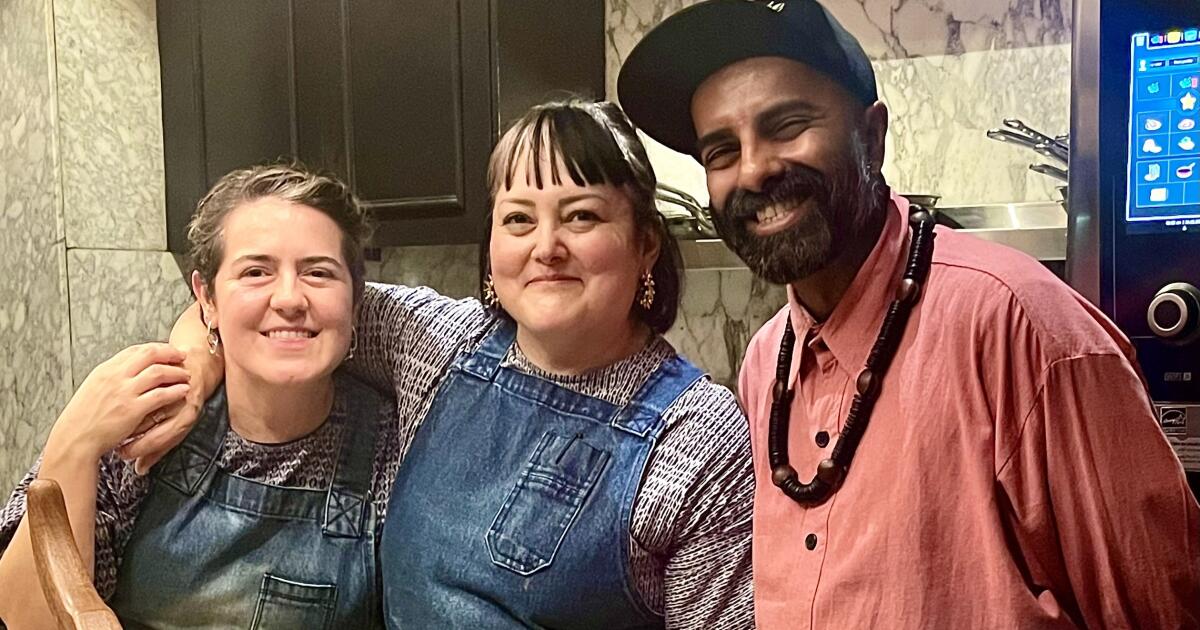
Is it fusion, or something else? Plus, all the love for Altadena, and a heavy metal taco spot finds its fixed home. I’m Daniel Hernandez, editor of L.A. Times Food, with this week’s Tasting Notes.
Fusing flavors, with reason
Though they were only serving in town for one night, the chefs and staff behind the Mexico City supernova Masala y Maíz managed to cause what felt like a temporary ripple in L.A. dining during their pop-up last week. It reminded this diner that despite the era’s current dedication to culinary and cultural boundaries — you should only cook what you know, write what you know — a spirit of mixture and melding can actually lead to something extraordinary, and not cringey, in practice.
It all started with three little corn masa dumplings.
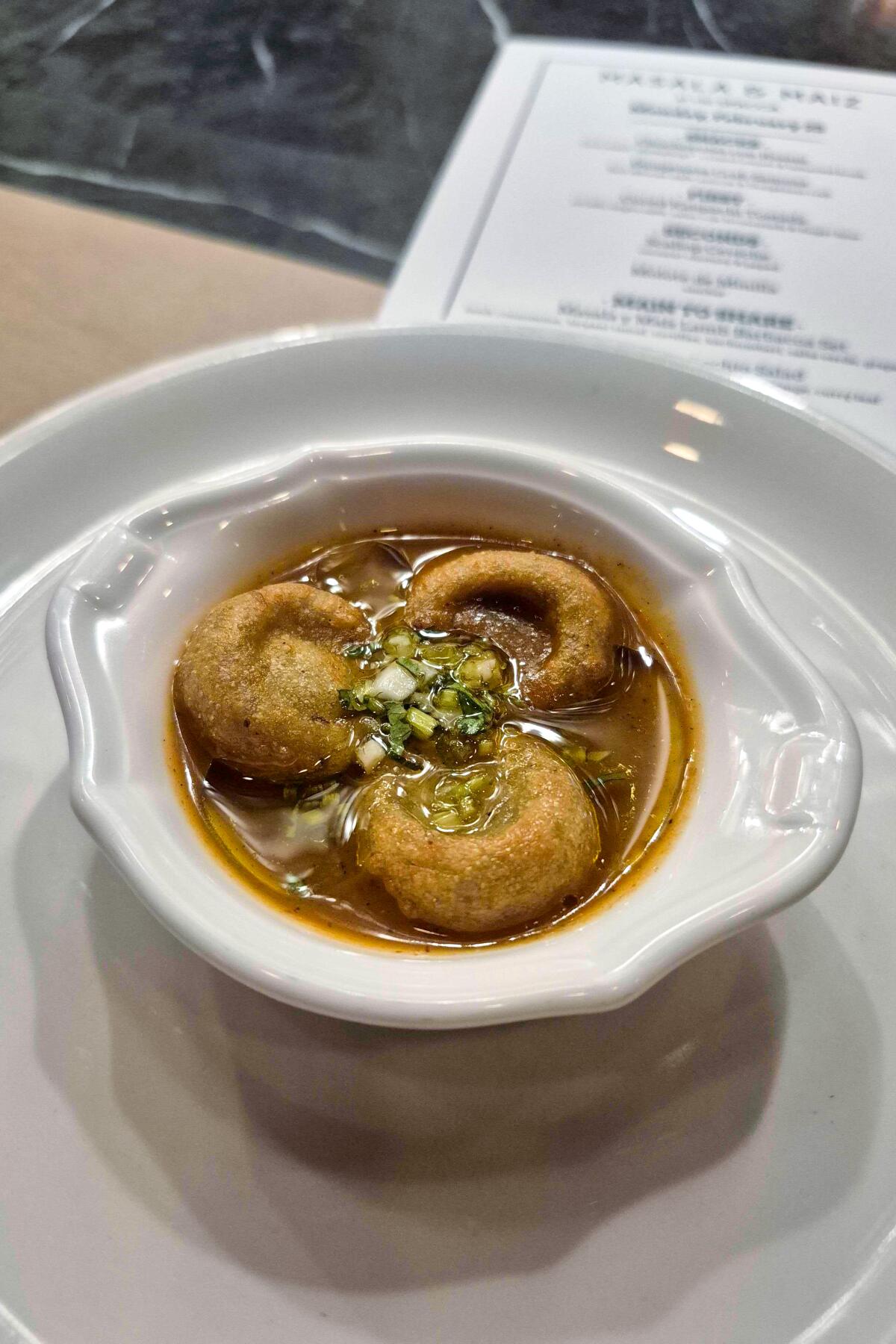
The chochoyotes starter at the Masala y Maíz pop-up in L.A.
(Daniel Hernandez / Los Angeles Times)
Chefs Norma Listman, who is Mexican and spent formative years in the Bay Area, and Saqib Keval, who is California-born Indian American with family ties to East Africa, began their single-night pop-up at Chi Spacca on Melrose Avenue with chochoyotes. These are masa rounds with button-like indentations that are sometimes added to broths and soups, and they’re not seen often in L.A. Listman and Keval prepared the chochoyotes with a broth of rasam, a tomato and tamarind recipe from southern India, by way of East Africa. The dish also used kashmiri chiles grown in the Mexican state of Hidalgo, Listman told me as she pressed tortillas by hand.
It was a revelatory bite, or three, since I ate the dumplings without pause to make room for the subsequent courses. With that start, the Masala y Maíz crew took a roomful of audibly excitable diners on a journey from the center of L.A. to the center of Mexico City, with ping-pong swings from southern Mexico to Africa and India. All of it proved how masterfully the chefs have managed to combine the flavors of distinct world cultures.
I’ve been to the couple’s Mexico City spot, which has become both a chic, internationalist restaurant and a platform for their fervent activism related to social justice and reform in the restaurant industry. Watching the team work from a corner counter seat, I reconnected with my second city in a raw, nostalgic way. Masala y Maíz has catapulted itself into its own category because deep to its core it embraces Mexico City’s habits of jubilant improvisation. I don’t mean they cook slapdash. It’s far more precise, but still fixated on fun, on melding, on yes, fusing.
“Fusion” cuisine is of course far out of favor. The term is about as cliché as “foodie” or “craft.” Many have likened it to mash-ups in music. There’s nothing inherently wrong about mixing Shania Twain with DaBaby over a drill track, but did anyone need to do that? Is there a reason?
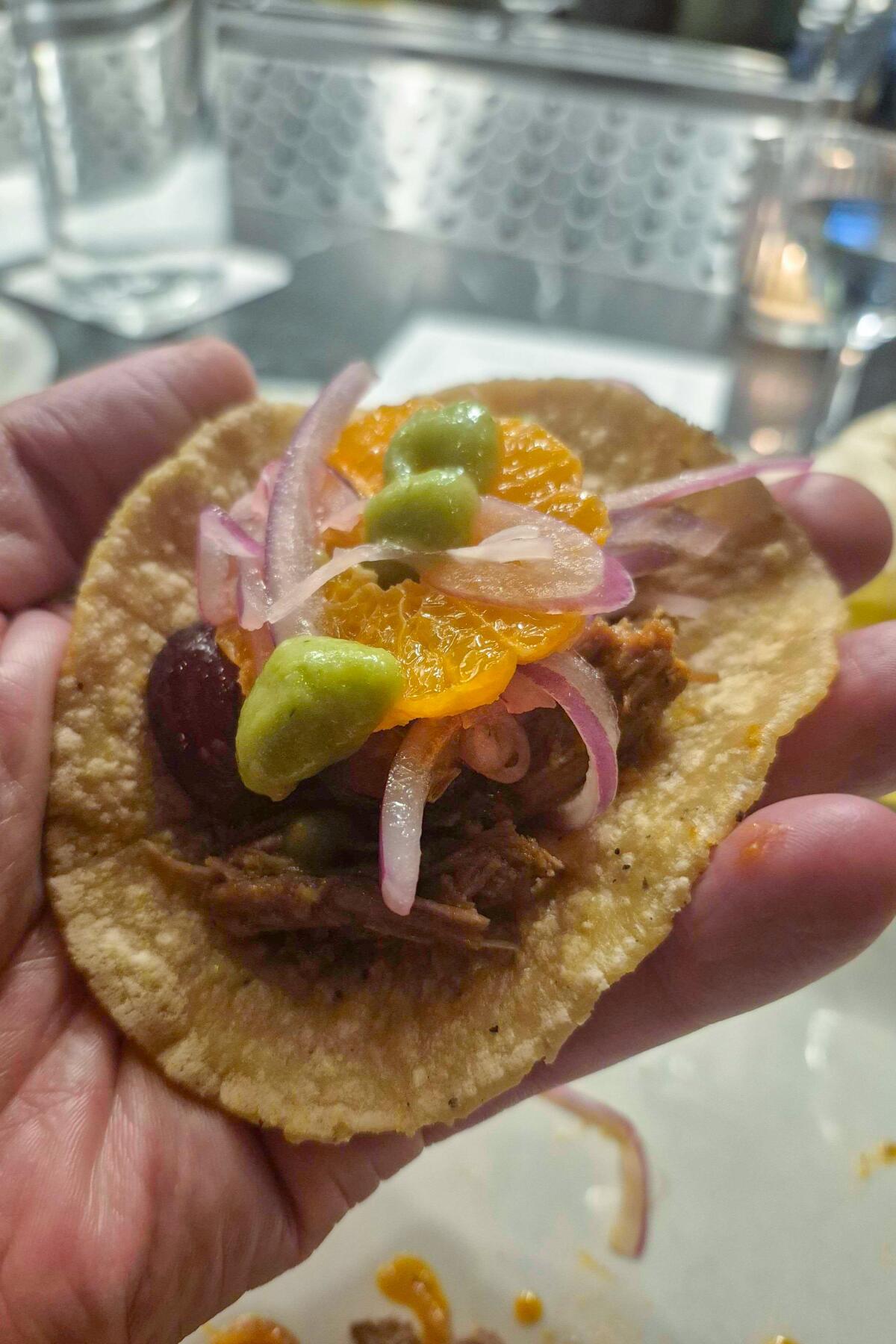
A taco composed of the Masala y Maíz lamb barbacoa main dish. The tortillas employed masa from L.A. molino Komal.
(Daniel Hernandez / Los Angeles Times)
Masala y Maíz have plenty.
Multiple ingredients and cooking practices bind Mexico and India, going back hundreds of years. Indeed, since trade routes opened between the East and Mexico’s Pacific in the 1500s during Spanish colonial rule, ingredients that are beloved equally and reciprocally in Mexico and India are plenty: tomatoes, beans, rice, cilantro, ginger, peppers and various spices, to name only a few.
During the pop-up, diners were eating this historical exchange, and it felt perfect for a city infinitely suited for cultural melding, ours. We tasted it in the cured kanpachi tostada with a recado negro raita, a fermented salsa roja and ripened finger lime pearls. Or the lamb barbacoa with a biryani tamal, kachumbari and achaar grapes.
Far from senseless, all of it made sense, an intentional hybridization. But is it fusion? No, the chefs said in an interview.
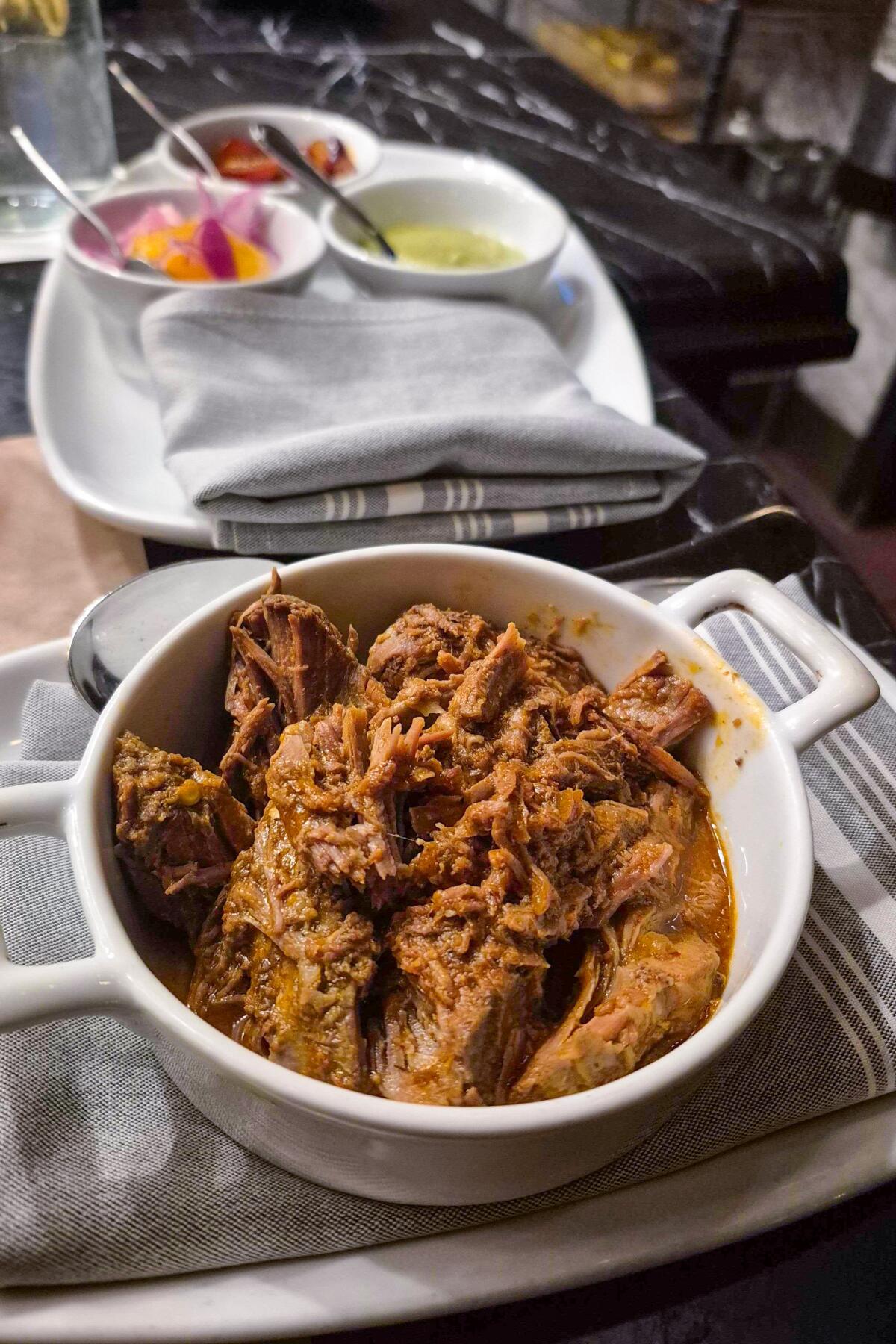
The lamb barbacoa came with a consomme, biryani tamal, kachumbari, salsa verde and grape achaar.
(Daniel Hernandez / Los Angeles Times)
“Fusion to me, for us, is a capitalist term that usually happens when a white chef goes to a country in the Global South and has an aha! moment and does a stupid mash-up of cuisines with no historical reference,” Listman said.
“I think fusion is a term that perhaps is the best that people speaking in English have to describe two foods coming together,” Keval said. “I like the term mestizaje. We use the term mestizaje rebelde [rebel mixture] to talk about the politics of it, and to talk about the rebelliousness of the mestizaje we’re practicing.”
“We’re seeking a balance, but we’re also being respectful of technique,” Listman added, noting, for example, that if a corn dish wrapped in banana leaf is not made technically like a traditional tamal is made, then you can’t call it a tamal.
The pair, who met in Oakland and eventually made their home in Mexico City, are openly activist in their stances, down to the political slogans on their restaurant napkins. But when you take a bite of their food, you remember that it all comes back to one thing. Flavor. The combinations are just right, precise but not precious.
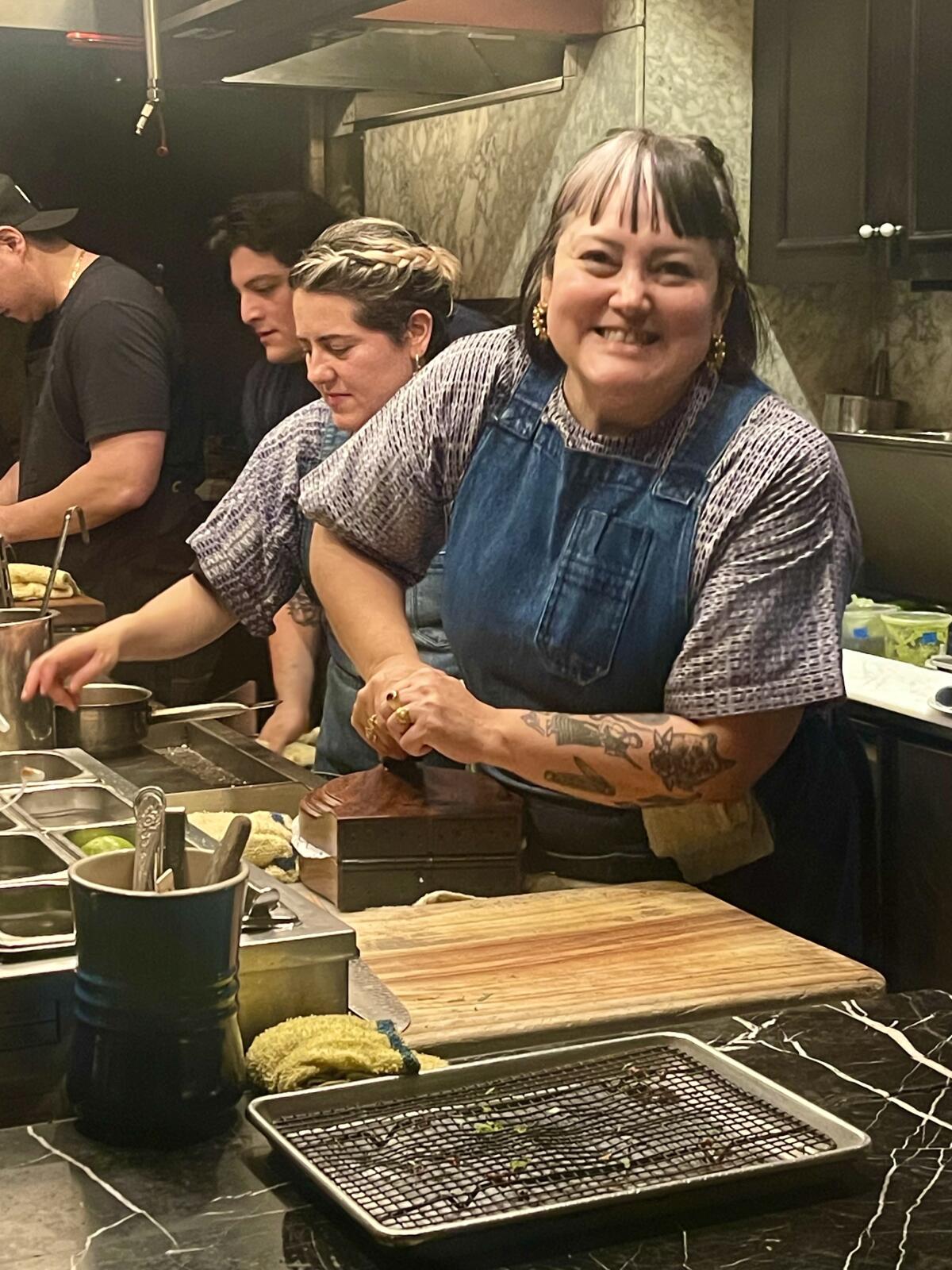
Chef Norma Listman pressed tortillas throughout the night.
(Laurie Ochoa / Los Angeles Times)
The tasting menu at Chi Spacca was priced at $185. And by the vibe in the room, it was clear that it felt like a worthwhile treat for people in L.A. who may be unable to secure a reservation at the restaurant during any recent trips to Mexico.
That was the case for a diner who sat solo at the counter like me. Palki Maheshwari was treating herself because she hadn’t been able to get a seat at the restaurant in visits south. Did she have any connection to Mexico? She described herself as an Indian American enthusiast of Mexico, because genuine Mexicanists come from all backgrounds, I thought.
“Every single bite had just the essence of both India and Mexico blended in one,” Maheshwari said as the meal wrapped up. “Perfectly balanced and also completely unique. They weren’t trying to be Indian, they weren’t trying to be Mexican. Just this beautiful marriage between the two, and both can be pretty dominant flavors in their own right.”
And by the way, Maheshwari asked, did I have any Indian heritage myself? What a perfectly chaotic cultural question, I thought, and one I’ve been getting more of in recent years as I move about the city. No, I said. Full fronterizo. But the exchange was right on theme.
We were lucky enough to experience it, even for a single night. I hope that Listman and Keval can return sometime soon.
You’re reading Tasting Notes
Our L.A. Times restaurant experts share insights and off-the-cuff takes on where they’re eating right now.
By continuing, you agree to our Terms of Service and our Privacy Policy.
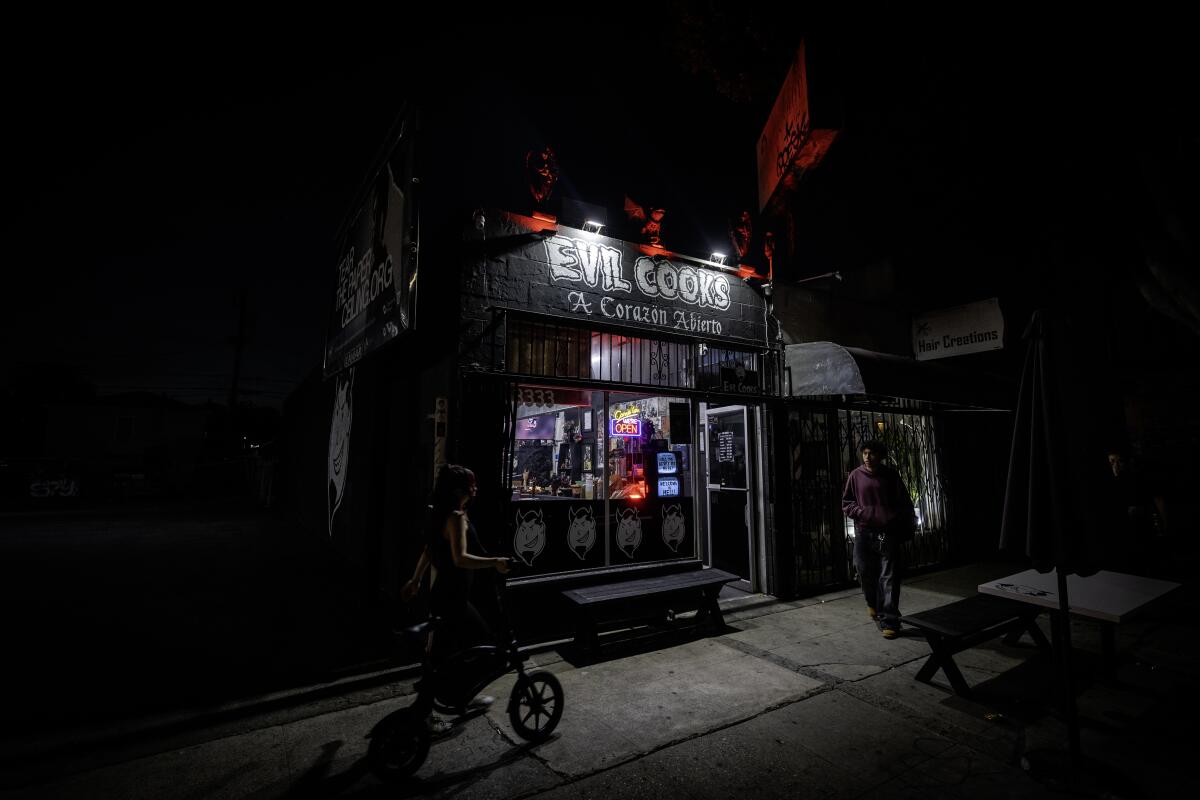
The exterior of Mexican restaurant Evil Cooks in El Sereno.
(Etienne Laurent / For The Times)
This week, critic Jenn Harris dives deep into the wild wonders of Evil Cooks, the darling (and diabolical) taquería that first broke onto the L.A. taco scene in 2019 with a front-yard pop-up in El Sereno and a breakout run at Smorgasburg. Does the energy translate to their inaugural brick-and-mortar? Read the review.
Also …It’s all love for Altadena, the resilient foothills community that suffered immense losses in the Eaton fire. The Food staff offers its latest list of restaurants to visit as Altadena continues to rebuild.Plus, the beloved Altadena coffee pop-up Bevel has found a full-time home, reports Angela Osorio.Carolynn Carreño’s new turkey chili recipe is objectively delicious, I can report. The team tasted it in our Test Kitchen. A new red-sauce pasta and pizza joint is drawing fans in Valley Village, writes Stephanie Breijo.Are you observing Ramadan? Here are spots to break the fast after sunset.