
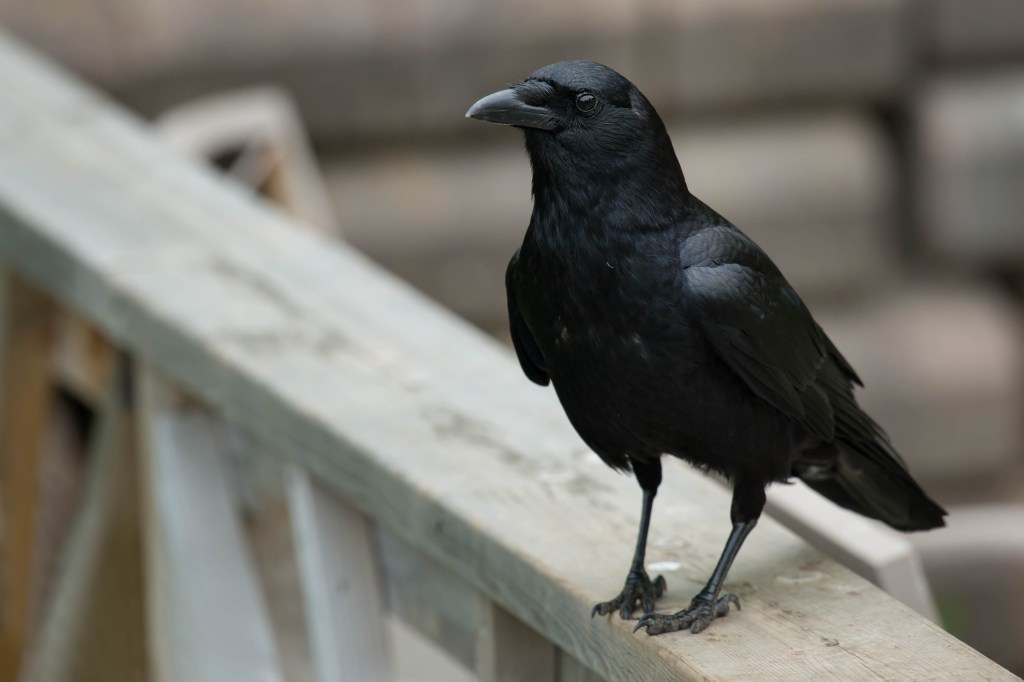
DEAR JOAN: We have been noticing an odd behavior with the crows. Our local senior center was painted recently, and the wall adjacent to the walkway is being attacked by the crows. They are chipping the new paint in multiple areas. The building has a stucco finish, and the paint is a tan color.
Do you have an idea why they are doing this? It’s almost as if they were eating the paint chips.
— E. Bianchi, Alameda
DEAR E.: Crows are extremely intelligent, and they also have a keen sense of style. Obviously the blandness of a tan wall offends them.
OK, that last part is a joke. Their decorating skills are pedestrian at best, and as it turns out, they have a fondness for white or tan walls not on an aesthetic level but as a nutritional one. Paint chips can be rich in calcium carbonite (limestone), which crows not only like but need in a balanced diet.
Light colored, newly painted surfaces also can attract insects that crows find irresistible.
When your senior center decides to repaint the wall, you should suggest they go for a darker color.
DEAR JOAN: I love the sound of coyotes harmonizing, sometimes in the daytime but mostly during the night. I wonder why their songs don’t inspire neighborhood dogs to sing along?
— Mary Lock, Woodacre
DEAR MARY: The primary reason dogs, for the most part, don’t answer the mournful howls of their evolutionary cousins is because they don’t speak the same language.
The coyotes are talking to each other, or at least sending out a vocalization that can be heard by other coyotes. Dogs might hear the calls, but they don’t understand the message any better than we do. Most likely they hear the sounds of nearby predators, and they might be silenced by fear.
Some dogs will howl, but they aren’t joining the conversation. They might be expressing their fear, or sending out a warning to others that trouble is nearby.
DEAR JOAN: I’ve had cats that hardly meowed at all, but I have a Siamese now who just seems to meow all the time. Is it a breed thing, or do I just have a chatty cat?
— Dee, Antioch
DEAR DEE: The vocalizations of cats can be dependent on breeds. Siamese cats, and I’ve had a few, are known as the most talkative of all cat breeds. I think it has to do with their personality. They know what they want and try their best to tell you. They also are highly opinionated and are not shy about letting us know if we’re doing things incorrectly or not to their liking.
They not only meow, but they often add in chirps, trills and yowls. If that makes you feel judged at times, that’s because you are being judged.
Other talkative breeds include the oriental shorthair, the Balinese, the Japanese bobtail, the Tonkinese, the Burmese, the sphynx, and the Bengal.
Cats don’t meow at each other very much. They reserve their words for humans, for which we should be honored, or maybe chastised.
The Animal Life column runs on Mondays. Contact Joan Morris at AskJoanMorris@gmail.com.