
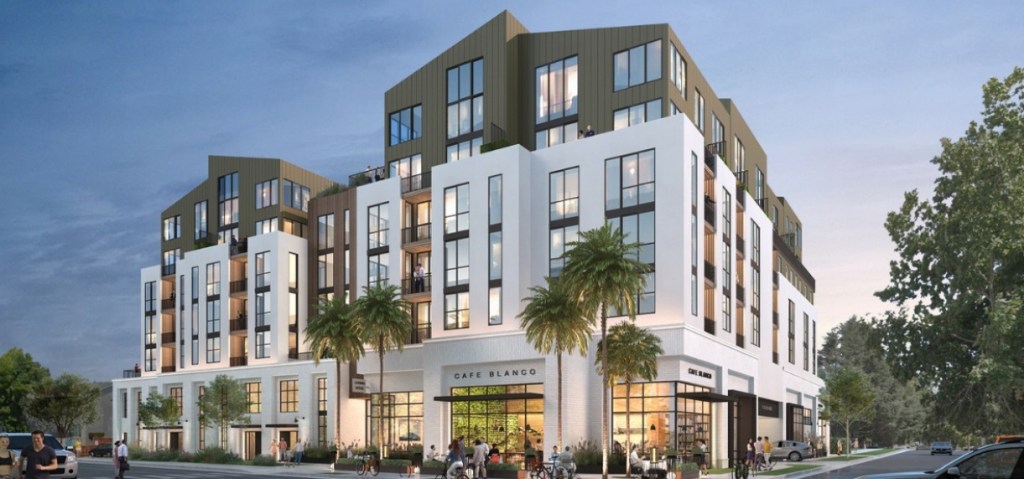
A seven-story project that rankled many Willow Glen residents will be allowed to move forward, after the San Jose Planning Commission denied an appeal that sought to limit the building’s impact to the neighborhood.
Redco Development had proposed a 126-unit mixed-use project near the intersection of Willow Street and Kotenberg Avenue, replacing a 5,500-square-foot commercial building that currently houses a liquor store.
The appeal on Wednesday argued the project did not meet certain city design standards. However, the Builder’s Remedy provision under state law limits the city’s authority to reject qualifying housing projects, even if they conflict with the general plan, land use, or zoning rules, except when public health or safety are threatened.
“There’s no question the developer has the legal ability to do the project,” Commissioner Michael Young said. “There’s a reason why the state has passed all the building and planning bills that they have. It’s because folks like us, and I’m including myself … we don’t want anything to change. We just want our single-family neighborhoods to stay the same. (The) problem is that can’t happen anymore.”
The Builder’s Remedy is a provision under the state’s Housing Accountability Act that created a pathway for developers to move forward with housing projects containing some affordable units that did not adhere to local zoning and planning guidelines in places without a compliant housing element.
Redco filed its preliminary application with San Jose in June 2023, several months before the California Department of Housing & Community Development certified its housing element.
Its proposal includes 52 studios, 50 one-bedroom, 20 two-bedroom and four three-bedroom apartments. This includes 15% of the base number of units for very low-income households and another 15% to moderate-income households.
If not for the Builder’s Remedy, the current commercial zoning designation for the property at 940 Willow St. could have curtailed the project because it would have required 100% affordable housing.
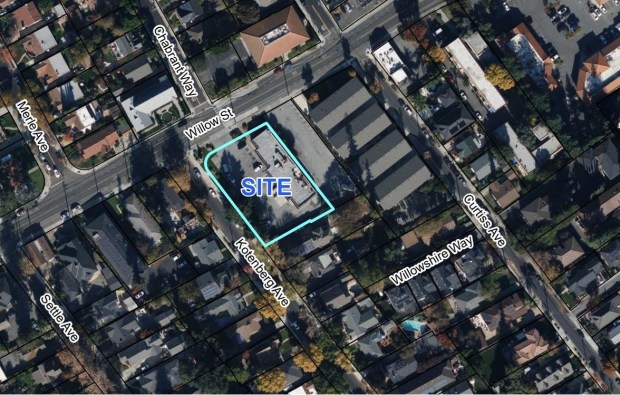 A seven-story mixed-use project planned at 940 Willow St. has rankled Willow Glen residents. (Google Maps)
The majority of nearby residents objected to plans for the site, citing concerns about impacts to traffic, the sewer infrastructure and how the building could change the character of the neighborhood.
Maren Sederquist, who lives a few houses away from the proposed development and is president of the Willow Glen Neighborhood Association, said she supported affordable housing, but insisted residents should not have to bear the consequences of San Jose’s failure to submit a compliant housing element on time.
“Over 1,800 neighbors have signed a petition opposing this project,” Sederquist said. “Only holding planning Zooms where questions are not allowed to be answered shows a lack of respect for your new neighbors. I ask that you take our concerns seriously.”
David Fox, a landscape architect who previously served on the Campbell Planning Commission, filed the appeal, arguing that the city could still facilitate the project in compliance with state law without surrendering its own standards.
Fox referenced another Builder’s Remedy project that he worked on at the corner of Meridian Avenue and Dry Creek Road, where residents dropped an appeal after the developer listened to concerns and amended its design.
He asked the city to include four objective standards, including a five-foot landscape buffer, downward-facing lights and flat roofs.
“There has been no effort by this developer to work with the neighborhood,” Fox said. “I understand the attorney’s points (and) I understand that there is law, but there is also nuance. I don’t believe, and my development team doesn’t believe, that the city is tied and cannot do anything. In this case, the Planning Commission does have the power to look at the director’s decision and make changes to that decision if the standards are objective and definable and written down.”
Dan Golub, an attorney from Holland & Knight and a representative for the project, said while the developer made some changes in response to residents’ feedback, the setback request would have led to a significant redesign. He added that the application of city standards also was carved out of Builder’s Remedy projects.
“The problem we have with the appellant’s analysis is, even though the law is clear that you may not disapprove this project for its inconsistency with the general plan and zoning, the appellant says you should approve it on the condition that it be made to comply with the general plan and zoning,” Golub said. “ I think it comes down to the same thing at the end of the day and that’s a disapproval of the project on a ground that the state law doesn’t permit.”
In denying the appeal, Young also referenced San Jose’s current affordability challenges and the need for housing to moderate rents and lower costs.
“None of us like a seven-story building, I get it,” Young said. “But, the future of this city is going to go one way or the other. Either we’re going to stay the same (or) people can’t afford to live here, right? So my kids, my grandkids, I’d like to be able to live in San Jose … They can’t afford the rents, let alone buy a house.”