
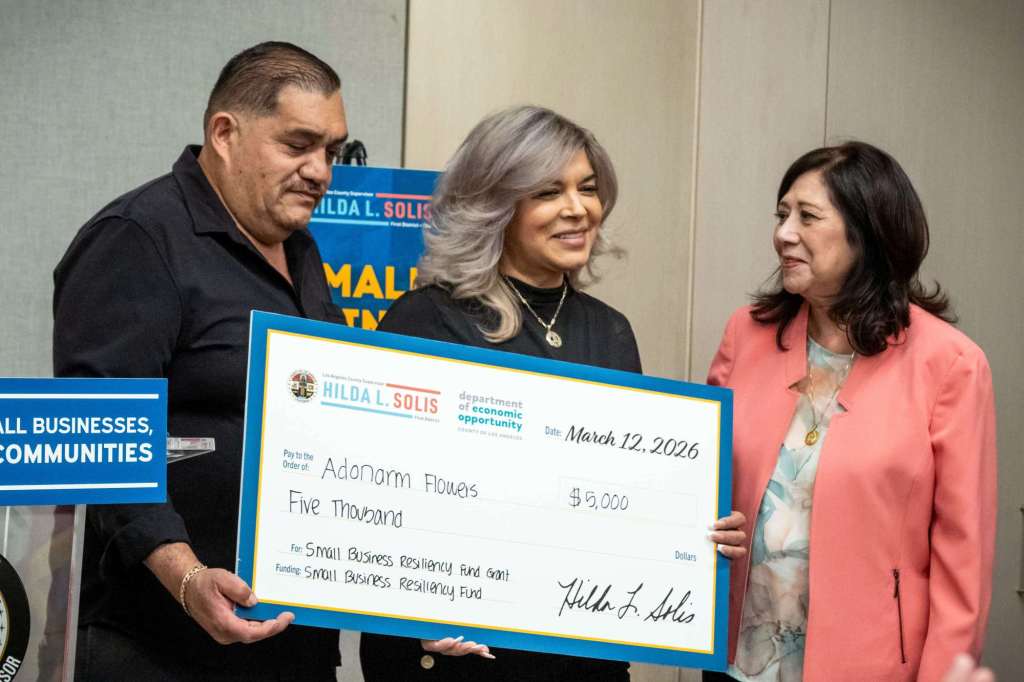
Armando Torres, who owns a flower shop in East Los Angeles, has seen business dwindle to a trickle in the past year because customers are scared to patronize his shop out of fear of being swept up in immigration raids.
The veteran florist said this past Valentine’s Day, usually one of the busiest for florists, business was down 44% as compared to past February sales, causing him to layoff two employees — a delivery person and a flower designer.
“I have lost a lot of customers,” Torres said Thursday, March 12, during the kick-off of a new round of grants from Los Angeles County for small businesses economically damaged by nearly a year of raids conducted by the Department of Homeland Services and Immigration and Customs Enforcement.
“I no longer have the old ones and I don’t have any new ones,” he said in Spanish, speaking through an interpreter. “There is a big loss of foot traffic in the area.”
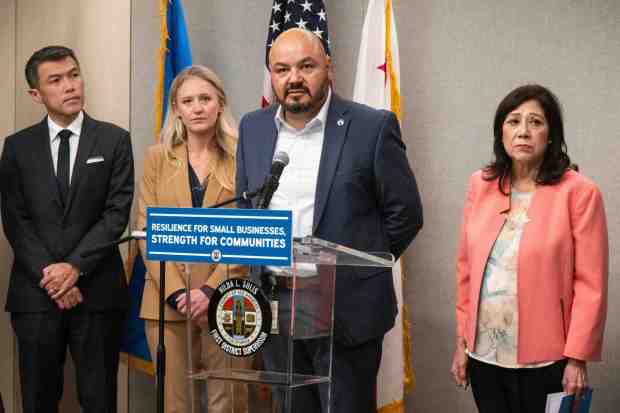 Los Angeles County Consumer & Business Affairs Dir. Rafael Carbajal speaks during a press conference on a business grant program for small businesses economically damaged by ICE and DHS raids with Stephen Cheung, CEO and president of LA County Economic Development Corporation, Kelly LoBianco, director of LA County Dept. of Economic Opportunity and LA County Sup. Hilda Solis in Los Angeles on Thursday, March 12, 2026. (Photo by Sarah Reingewirtz, Los Angeles Daily News/SCNG)
Torres received a $5,000 grant on Thursday to help keep his business afloat.
The second round of grants totals $3.6 million to provide monetary relief of between $2,500 to $5,000 to 872 businesses. This builds on an initial $1.53 million awarded to 367 small businesses. All together, the program has distributed grants to 1,200 businesses and is part of a $5.13 million funding package, the county reported.
Businesses in heavily Latino East Los Angeles, a county unincorporated area, as well as parts of the city of Los Angeles, Bell, Pico Rivera and several areas in the San Gabriel Valley and San Fernando Valley, are reeling from the loss of customers, plunging revenue, workforce depletion and mounting debts. These are part of the ripple effect from immigration raids implemented by President Donald Trump that have removed undocumented residents from homes, courthouses, schools, churches and businesses and sent them to detention centers in California and other states.
“They have not stopped and they continue to cause fear and anxiety,” said First District Supervisor Hilda Solis, who initiated the program in June, along with Fourth District Supervisor Janice Hahn. Solis said grants for businesses affected by immigration enforcement is unique to L.A. County and is gaining attention in other states and counties subjected to immigration sweeps and business disruptions.
“Workers are being torn from job sites. People are being snatched from their homes and their cars. This is having a devastating impact on our small businesses. Small business make our economy roar and now, that roar is getting smaller,” Solis said.
“Many workers, families, and small businesses continue to face uncertainty and economic disruption as a result. Through this effort, we are taking meaningful steps to provide resources that help stabilize our local businesses, protect jobs, and support the communities that power our economy,” said Solis.
Solis said undocumented workers, those here with green cards, and those in families with mixed status have been affected. But the indirect effect is loss of jobs and small businesses facing bankruptcy. The drop in retail sales also reduces county tax revenues used to pay for social welfare programs, Solis said.
Los Angeles County has about 3.5 million immigrants or about 35% of the population. Among those, there are about 948,700 undocumented immigrants who work in retail trade, construction, hospitality, other services and manufacturing, according to a study in January from the Los Angeles County Economic Development Corp.
The LACEDC estimated that undocumented workers in LA county generate $253.9 billion in economic output — about 17% of the county’s overall economy. This supports more than 1 million jobs, the report concluded.
East Los Angeles’s retail stores, restaurants and other establishments have been hit hard.
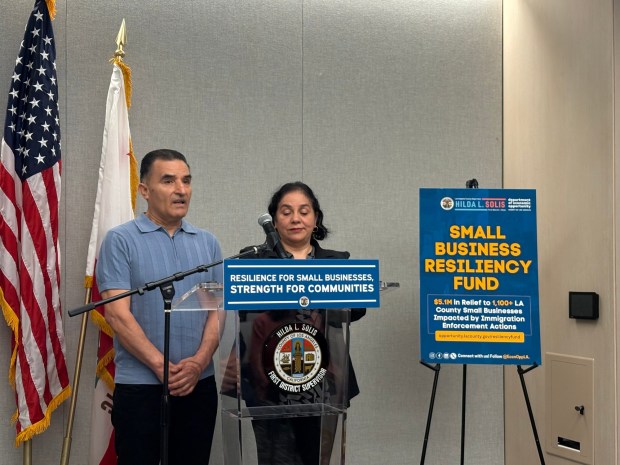 Gerardo and Maria D’Avila, owners of Taqueria Ameca in East Los Angeles, talk about the grant they received to help their small business at event at Hall of Administration on Thursday, March 12, 2026. (photo by Steve Scauzillo)
Gerardo and Maria D’Avila, co-owners of a successful small restaurant, Taqueria Ameca, said fewer people are stopping by for a taco, burrito or their specialty, the Tortas Ahogadas. They can’t afford to hire any other employees so it is just the couple that runs the eatery at 747 S. Atlantic Blvd. in East Los Angeles, they said.
“Every time there was an immigration raid nearby, or news of one, the streets would be empty and there would be no customers,” said Gerardo D’Avila. The couple will use the $5,000 grant to pay back rent, in order to keep their business open, they said.
Included in the funding for the second round of grants is about $649,000 from the supervisor’s discretionary funds, transferred to the county Department of Economic Opportunity to fund checks to 146 eligible applicants from the first round that were left out of the program after initial funds ran out.
“The problems and challenges our businesses are facing are severe,” she said.
Solis said the effect of public immigration enforcement, often by masked ICE and DHS agents who during their crackdown pulled people out of cars, off bus stops and sidewalks, has sent a chill not just to Latino businesses but to the larger flower district and commercial and wholesale districts in downtown Los Angeles. The raids, combined with Trump’s tariffs on foreign supplies, have combined to slow economic growth in the county, she said.
These local recipients, who spoke to the media at a press event held in the Hall of Administration building Thursday, are one aspect of how the immigration raids are affecting L.A. County’s economy, she said.
Schools are also seeing drops in enrollment, because children are afraid to attend class in person for fear that when they come home their parents will be gone, Solis said.
Trump has said the raids are rounding up rapists and other criminals and making Americans safer. But Solis and officials from Los Angeles and Pasadena, as well as state lawmakers, say the raids are focusing on hardworking breadwinners who can no longer support families when deported or detained, creating economic disruption.
She said the grant recipients from the program have built up businesses with their own money and sweat equity. “They don’t rely on government grants. They are here to earn a living.”
For restaurateurs such as the D’Avilas, their livelihood depends on foot traffic, in other words, customers not directly affected by the immigration enforcement but are staying home to be safe.
“It is still as bad as it was before,” said Gerardo D’Avila. “But every person that comes in allows us to survive another day.”