
When San Jose approved Google’s Downtown West project in 2021, city leaders celebrated it as a once-in-a-generation partnership that would reshape the downtown.
But the development agreement included few mechanisms requiring Google to actually build.
REALTED: What Google’s Downtown West was supposed to be for San Jose
The roughly 700-page agreement approved unanimously by the City Council does not include penalties if construction never begins. Instead, many of Google’s commitments — including contributions to a community fund meant to offset displacement — are tied to construction milestones.
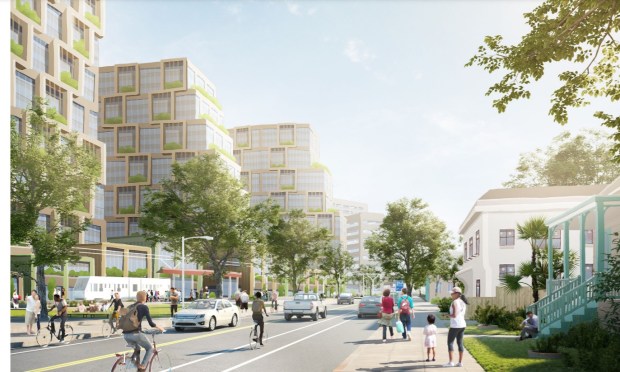 San Fernando Street area of Google’s proposed Downtown West transit-oriented neighborhood in downtown San Jose, showing buildings in the project near a light rail line and existing building, concept. (SITELAB urban studio, Google)
Google pledged as much as $200 million for community programs, but most of that money is released only as construction progresses. If the project never moves forward, Google would be required to contribute only about half of that amount.
The city also sold Google 16 publicly owned parcels that formed the core of the Downtown West site. Once the land was transferred, San Jose largely lost the leverage cities sometimes retain through phased land sales or development deadlines.
Urban planning experts say that means the city has little legal ability to compel Google to move forward with construction — or to force a timeline for development.
“Google doesn’t have to do anything,” said Kelly Snider, an urban planning expert at San Jose State University. “They own the property, and they’re paying property taxes. Legally, that’s all they have to do.”