
This column is a part of the Off Menu newsletter, our Wednesday dispatch of restaurant news, gossip, tips, and hot takes. Sign up for weekly emails here.
To want to tackle Dutch crunch — the most secretive sandwich bread in the Bay Area — you have to be either a madman or a romantic. Andrew McCormack, the owner and chef of the two-year-old daytime restaurant Early to Rise, is a bit of each.
With its signature, vaguely sweet, crackle-glazed top, classic Dutch crunch is the opposite of the highfalutin, wild-yeast risen sourdough loaves baked by the likes of Tartine and Josey Baker. It’s proudly proletarian, securely at home in SF’s best old-school delis, where it’s a noble vessel for countless hoagies. It’s definitely not on the menu of sit-down restaurants run by highly trained chefs.
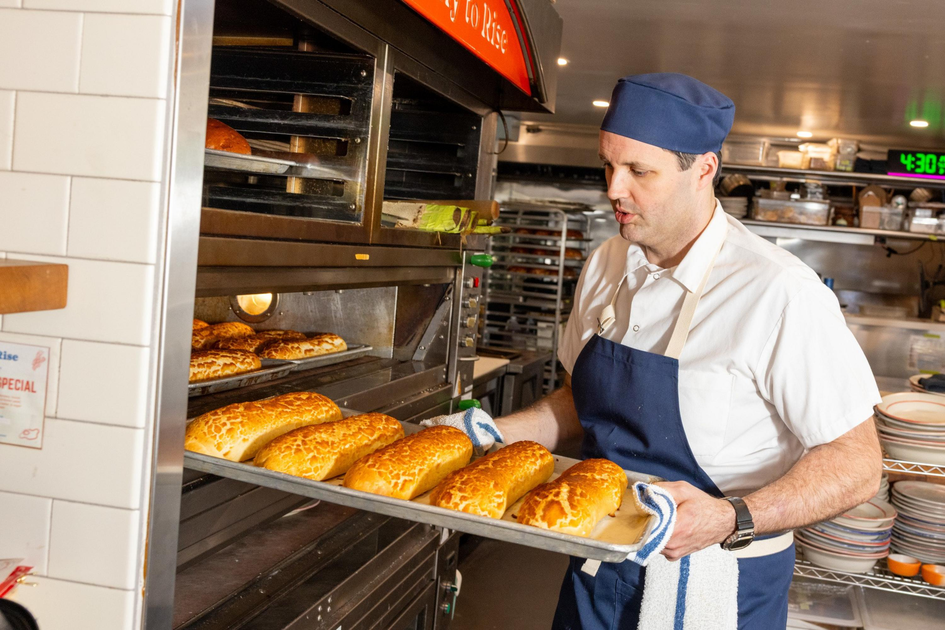
 Andrew McCormack removes finished Dutch crunch loaves at Early To Rise in NoPa. | Source: Morgan Ellis/The Standard
But for McCormack, who used to work at Quince and quotes William Blake in the kitchen, even the most everyday carb deserves some reverence.
At Early to Rise, the chef isn’t just baking his own Dutch crunch. Without a Michelin-starred kitchen to work in anymore, he’s putting some fine-dining precision into deli food, making his own bagels, curing and smoking his own bacon, even roasting his own turkey.
While San Franciscans would be hard-pressed to claim bagels as their own, Dutch crunch inspires a kind of microregional pride. Yes, the loaf supposedly originated in the Netherlands, where it’s called tijgerbrood, or tiger bread (though, if you ask me, the topping is more giraffe). But, like those other low-country imports, the Golden Gate Park windmills, Dutch crunch made its way here decades ago — and the Bay Area now claims it.
Knowledge of the bread can signal whether you’re a deep local — or not. (Case in point: When I mentioned the subject to The Standard’s editor-in-chief, Kevin Delaney, who recently relocated from Brooklyn, he looked at me blankly and asked: “What’s that?” Don’t worry: He is being indoctrinated.)

The bread’s secrets are fiercely protected. Adam Mesnick, owner of SoMa’s smash-hit sandwich shop Deli Board, is tight-lipped about his Dutch crunch’s recipe or provenance, revealing only that it “is proprietary for a handful of reasons.” In doing his research, McCormack asked the folks at Lou’s Sandwiches Cafe, one of his favorite SF spots, which bakery they use, to no avail: “They were hella shady about it.”
I arrived at Early to Rise a few weeks ago for the big moment: a tasting of the Dutch crunch McCormack has been working on for six months. The recipe, he warned me, is a work in progress. Wearing a dishwasher’s white snap-button-down, McCormack looked like he stepped out of the midcentury — hair parted and swept back into a little gelled curl. The native of South Carolina has big, sloping blue eyes that match his gentle drawl. For his prominence in a tough industry, he’s an unusually earnest guy.
Unsolicited, I arrived with four Dutch crunch loaves I’d gathered from popular delis to compare and contrast. Though McCormack was up for the test, he eschewed the notion that it was a competition. “I’ll be honest,” he said. “I’m a little over the culinary cage match everybody gets into over every damn thing. Like, I just want to make a good product and make people happy.”
Nevertheless, he humored me. We lined up the loaves used by popular local delis. There was a decidedly not-sweet, custom half-bake that The M Stop in the Excelsior buys from Raymond’s, a bakery in South San Francisco. “It’s got salt and a good complicated flavor,” McCormack noted.
A custom “soft Dutch” I picked up at Roxie’s, which may or may not come from Mazzetti’s Bakery in Pacifica, had a gentle topping, easier on the roof of the mouth.
McCormack and I both liked the Dutch from SF-based Boudin Bakery, which has a nice caramelized texture and slightly sweet top.
And then there was the one from Wedemeyer, also in South San Francisco, which is definitely the prettiest — though, as McCormack puts it, “a little Wonder bready.”
With the rivals tested, McCormack pulled his own loaves out of the oven. His version is made with a baguette-style dough, with a little sugar and malt. The magic comes from a slurry of rice flour, oil, sugar, and yeast that the chef pipes over the loaves before their final rise. Getting the topping just right — lacy but not roof-of-your-mouth shredding — is the goal. McCormack’s bread was tender, with the sharpest crunch of the group. It was great, though he admitted he’s still chasing the perfect balance.
Of course, no one eats Dutch crunch alone. It’s a vehicle — or maybe a tango —“a dance partner,” as McCormack puts it. “It matters what it’s with.”
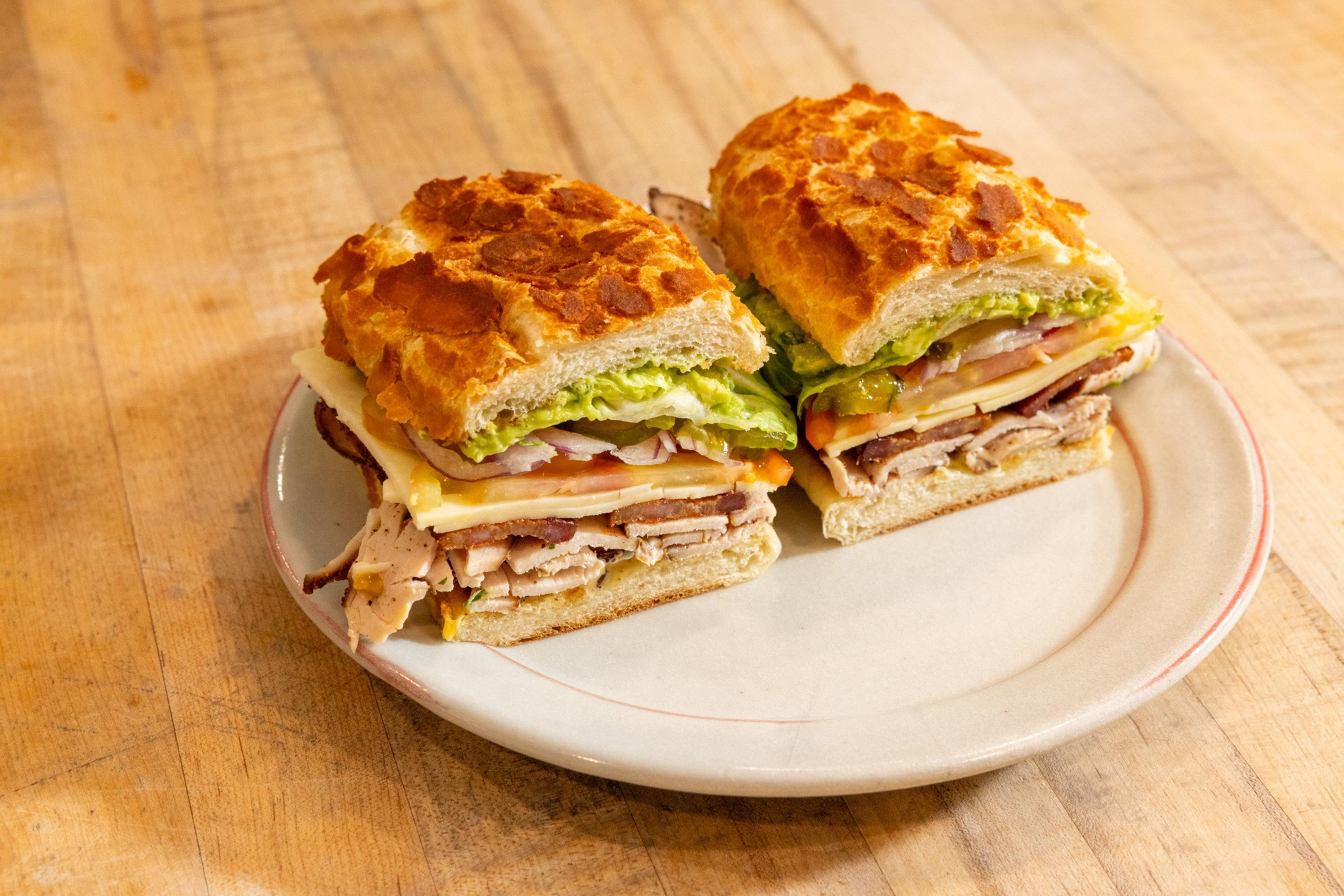

To demonstrate his point, he assembled what might be the most beautiful turkey sandwich I have ever been served. Called the All Star because it’s based on a California club he used to love from Allstar Donuts, it was heaped with turkey, white cheddar, avocado, tomato, red onion, bread-and-butter pickles (housemade, of course), little gem, and a healthy amount of aioli dripping down the sides. There’s the option to add bacon. The salty-creamy-crispy-piquant mix of ingredients was perfect with the slightly sweet, soft, and crunchy bread. The sandwich was huge. Though I could barely wrap my mouth around it, it was gone in minutes. (Weekend dining warriors, take heed: It is available only on weekdays.)
At one point, as we sat talking philosophically about sandwich rolls — something you can do with a guy like McCormack — I pressed him about why he was putting so much effort into this blue-collar bun, one he could clearly buy from a bakery. He turned to quote Blake: “To see the world in a grain of sand. And a heaven in a wildflower …”
Admittedly, it was a fanciful, if unhinged, thing to say about Dutch crunch, and he knew it. But his compulsion is what makes him the chef he is. Clearly, he loves the process. “It’s a real pleasure to zoom into the details,” he said.
McCormack isn’t trying to beat anyone’s Dutch crunch. A win for him is simple. If he gets it right, he just hopes it helps his customers fall even more in love with San Francisco.
Where is your favorite place to get Dutch crunch in San Francisco? And what makes a perfect roll? Let us know in the comments, a new feature exclusively for SF Standard subscribers.