
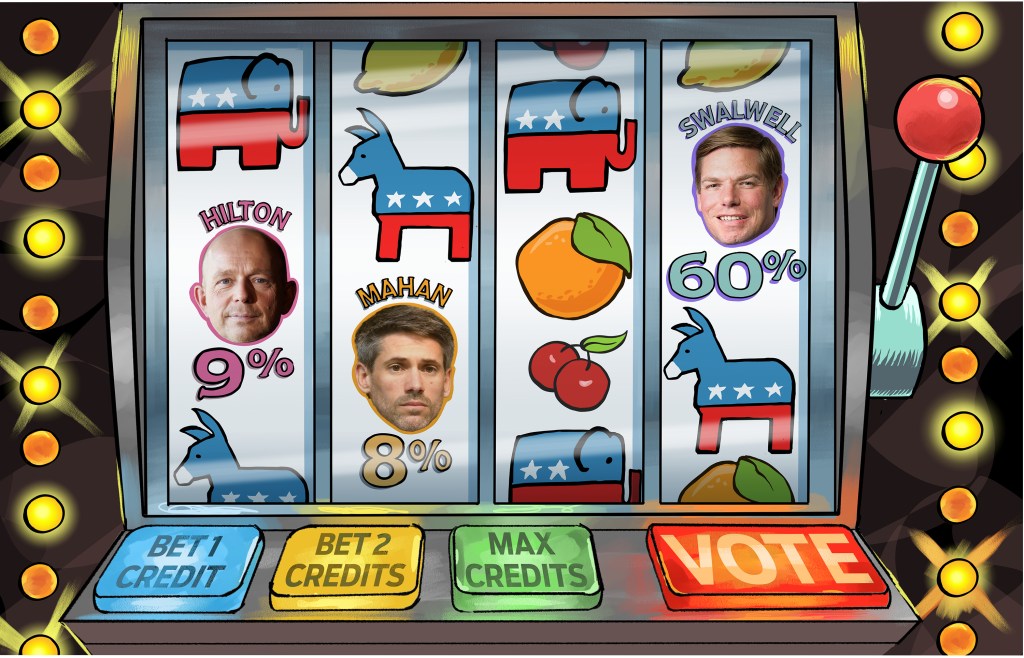
As it ticks closer to Election Day, the prediction markets have gotten more confident in East Bay Rep. Eric Swalwell’s chances to be the next governor of California. It’s a stark contrast compared to recent polling that shows the race to succeed Gov. Gavin Newsom is still wide open as many voters remain undecided or disengaged.
The Castro Valley Democrat has held the highest probability to win the governorship since his entrance into the race last November and has cleared 60% on Kalshi and Polymarket. Swalwell has frequently touted his performance in prediction markets on social media as a metric of his campaign’s success.
“I’m betting on Californians. And they’re predicting on @Kalshi that we win BIG,” he wrote in a Jan. 29 post on X.
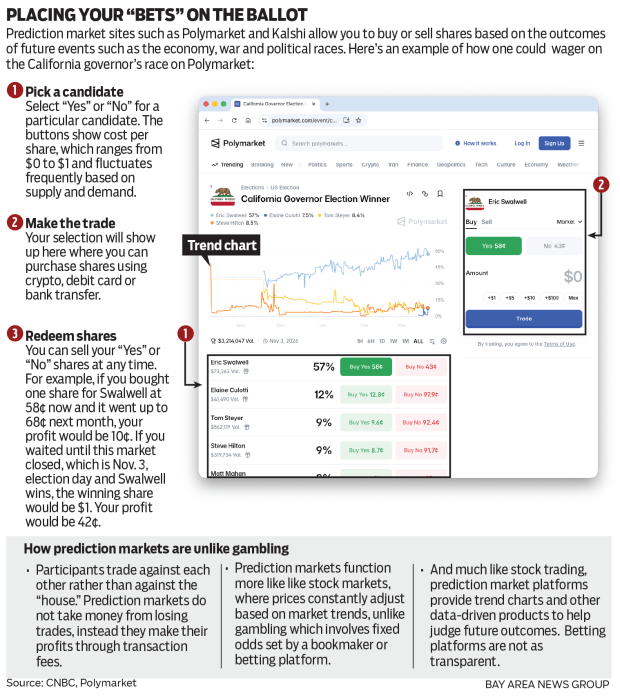
Prediction markets work by allowing users to buy or sell shares based on the outcome of an event. The odds are a balancing point of all trades on each candidate as users buy and sell “yes” or “no” on a candidate with another trader who has the opposing view.
In the last six months, traders have put more than $7 million combined into Kalshi and Polymarket bets for who the next governor of California will be. It’s part of a prediction market boom that’s sweeping the nation as users wager billions of dollars a week on everything from who will win March Madness to who the next Democratic nominee for president will be.
The markets’ growing popularity, though, has raised concerns for some California lawmakers and other critics who argue that prediction markets blur the lines between trading and gambling and worry that they could wield influence over election outcomes or be susceptible to manipulation if insiders try to cash in.
Assemblymember Maggy Krell, D-Sacramento, sent a letter earlier this month to the Fair Political Practices Commission expressing her concerns about “predictive market trading on the democratic process.”
“Political donors look to support a ‘winner,’” she said. “Increasing favorable odds through sites like Kalshi have the potential to generate more support for a candidate and simultaneously damage the candidacy of one or more opponents. Candidates often circulate polls showing their path to victory in order to persuade potential supporters to invest in the campaign. But such expenditures must be disclosed.”
Swalwell’s campaign did not respond to multiple requests for comment, but candidates like former Los Angeles Mayor Antonio Villaraigosa and former State Controller Betty Yee have denounced prediction markets and vowed to crack down on them if elected.
Placing wagers on election outcomes precedes modern-day statistical polling — the first of which was done by Elmer Gallup in the 1936 presidential election — according to Koleman Strumpf, an economics professor at Wake Forest University who studies prediction markets.
While the medium may have changed from the late 19th century or early 20th century markets that were held in poolrooms or on the curb exchange, the contracts mirror today’s markets and were extremely accurate, Strumpf said. His research found that between 1868 and 1940, there was only one race where a presidential candidate who was favored in the prediction markets the month before Election Day lost.
Strumpf maintains that today’s markets also tend to be largely accurate as “the people in the market are pretty clever because they are putting their money down.”
But political data expert Paul Mitchell said they can also have their biases.
San Jose Mayor Matt Mahan, who stems from tech and is being backed by the likes of Google co-founder Sergey Brin, Roblox CEO David Baszucki and Y Combinator CEO Gary Tan, has been performing considerably better in prediction markets than in independent polls. The mayor, one of eight prominent Democrats in the race, has often been the candidate with the second-highest probability after Swalwell. Mitchell attributes the discrepancy to a potential “overrepresentation” of Silicon Valley-types who might gravitate toward the mayor and be more inclined to make bets in prediction markets.
But the political data expert, who has included Polymarket information in a simulator he created to game out the chances of who will make it into the November runoff, said the prediction markets can capture things the polls can’t, such as Swalwell receiving an endorsement from SEIU — one of the most powerful unions in the state that represents 750,000 workers.
“Based on how the spending is done in elections about the influence of that endorsement, that should increase Eric Swalwell’s chances of getting elected governor at this point,” Mitchell said of prediction markets. “It will take weeks for a poll to recognize that because polls that are in the field right now aren’t going to capture any surge in viability because of the SEIU endorsement.”
While political and economic experts debate the accuracy of prediction markets, the platforms have come under fire from states and gambling interests as they face an onslaught of lawsuits.
Arizona last week was the latest state to take aim at Kalshi, filing criminal charges that allege it’s taking election bets and operating an illegal gambling business in the state without a license.
“Kalshi may brand itself as a ‘prediction market,’ but what it’s actually doing is running an illegal gambling operation and taking bets on Arizona elections, both of which violate Arizona law,” Attorney General Kris Mayes said in a news release. “No company gets to decide for itself which laws to follow.”
Prediction markets are regulated by the Commodity Futures Trading Commission, and up until late last year, Polymarket — one of the two largest markets — was barred from doing business in the United States. The company was previously forced to shut down its local operations in 2022 after it reached a $1.4 million settlement agreement with the Biden administration for operating as an unlicensed exchange.
I. Nelson Rose, a professor emeritus at Whittier College and an expert on gaming law, said that the prediction markets are “basically unregulated” as the CFTC “doesn’t have any expertise in sports betting or frankly doing anything outside of the financial monitoring of trades.”
“One of the reasons that my personal belief is that these are illegal is that they don’t meet sometimes strict standards for what is and what isn’t a commodity,” he said. “Almost every state makes it illegal to bet on elections for very good reasons, particularly in smaller elections where you could affect the outcome and you could bribe people.”
State legislators in California, where online gambling and sports betting are illegal, are quickly scrambling to put what checks they can on the industry. Recent legislation has been introduced to ban elected officials, candidates and lobbyists who might have insider information from making bets in prediction markets and bar the markets from advertising to or allowing minors on their platforms.
“I’ve definitely seen a keener interest by stakeholders, parents and lawmakers about this and want to ensure that we are ultimately monitoring and protecting minors and what the future of this looks like as with any other regulatory environment,” Assemblymember Patrick Ahrens, D-Sunnyvale, who co-chairs the California Technology and Innovation Caucus, said in an interview.
Attorney General Rob Bonta, whose office did not respond to a request for comment, has yet to wade into the debate, though he signed onto an amicus brief in a lawsuit against Kalshi last year that said that “many of the ‘contracts’ Kalshi lists are indistinguishable from sports betting.”
Platforms like Kalshi and Polymarket have continued to maintain that they are prediction markets and not gambling.
“If we are gambling, then I think you’re basically calling the entire financial market gambling,” Kalshi CEO Tarek Mansour told Axios in an interview last year.
CFTC Chairman Michael Selig, who was appointed by President Trump, has also come to the defense of prediction markets, arguing that state gambling laws don’t apply to CFTC-regulated events.
Kalshi and Polymarket have instituted rules that prohibit anyone under the age of 18 from placing a bet and Kalshi’s website says it blocks politicians from joining the platform and prohibits candidates and government employees from betting in markets where they might have nonpublic information. Stephen Cloobeck, a businessman and former candidate for California governor, recently said he was blocked from trading on Kalshi.
Strumpf, the Wake Forest University professor, dismissed concerns about market manipulation and influencing voter behavior, saying that there historically hasn’t been issues and that the concerns “aren’t grounded very deeply in fact.” Instead, he sees them as an “incredible resource for people interested in current events.
“I would say as part of a news diet, opening up Polymarket or opening up Kalshi at the beginning of the day and seeing what are the markets that are getting all of the activity, it tells you what are the big stories of the day,” he said.