
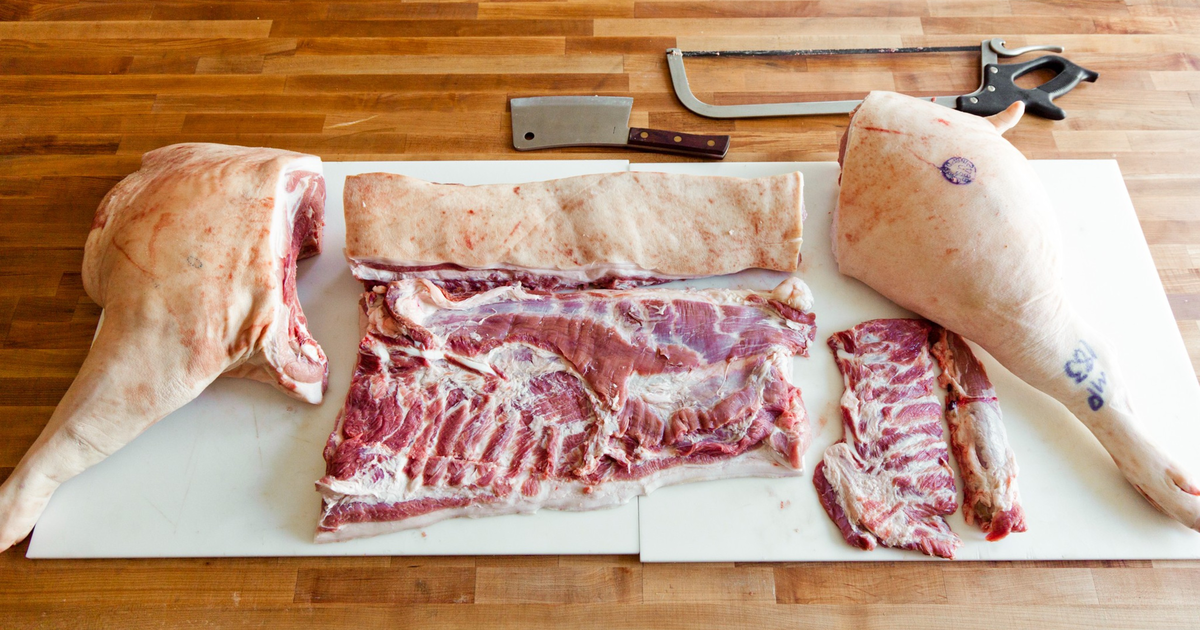
Chef Chris Yang of Piglet and Co is dedicated to working with whole pigs.
This column is a part of the Off Menu newsletter, our Wednesday dispatch of restaurant news, gossip, tips, and hot takes. Sign up for weekly emails here.
I would bet you anything that fewer chefs are getting pig tattoos today than they did in 2010. The once ubiquitous butcher’s diagram — an outline of a pig with the cuts mapped, tatted onto the tender flesh of an inner forearm — used to signal that you were a cook to be contended with: a lifer, dedicated to the nose-to-tail cookery modernized in the late ’90s by English chef Fergus Henderson of St. John.
These days, that tattoo would be aspirational. A stick-and-poke of a precut tomahawk steak is more representative of what is actually held in most restaurant walk-ins. Whole-animal menus haven’t vanished — there are still some if you know where to look — but the effort of bringing in and processing large animals has largely been outsourced, streamlined, and, in many kitchens, priced out.
I was covering the food scene in the early 2000s, when the nation’s cooks were literally going whole hog, sourcing from small family farms and proudly learning how to break down an animal and use all its parts. It was a creative and ambitious time, a natural leap from the pervading Alice Waters ethos — that one should know the exact provenance of everything that passes one’s lips. With it came a respect for land stewardship and the meat we eat. And, of course, a dash of virtue signaling. Making your own salumi wasn’t just about being resourceful; it was also a flex.
 Jhonny Chan Tun, butcher, and Gus Chavez, executive sous chef, break down a goat at State Bird Provisions. | Source: Sara Deseran/The Standard
In New York, April Bloomfield of the Spotted Pig wrapped a pig over her shoulders like a furless stole for the cover of her cookbook “A Girl and Her Pig (opens in new tab).” Cochon 555, a now-defunct roaming, pig-cooking competition, drew local chefs like Anthony Strong and Matthew Accarrino. And then there were the offal pushers; particularly, Chris Cosentino of Incanto and Cockscomb, who cooked up a carnivorific, in-your-face menu of the lesser-loved bits: beef heart made into tartare, pig skin into carbonara, and sweetbreads that were batter-fried like chicken.
And it wasn’t just restaurants driving the trend. Between 2007 and 2011, a handful of amazing independent butcher shops cropped up in San Francisco, including Avedano’s, Fatted Calf, Prather Ranch, and Olivier’s Butchery. These made local, responsibly sourced meat available to everyone.
For a decade or so, the philosophy was so embedded in the way we ate that even I didn’t notice our gradual shift away from it. It wasn’t until I had lunch at Kokkari Estiatorio the other day that I woke up to the change. There, watching a whole goat from Don Watson spinning over the fire in the dining room, I felt a pull back to the kind of cooking that defined a past era.
“Before the pandemic, I couldn’t roast enough to keep up with the demand — I’d cook up to five a week,” chef Erik Cosselmon says of his goat feast. “Now, I go through less than half of that.” Similarly, he has had a hard time selling a fantastic lamb’s tongue salad. A dish featuring tripe sold exactly zero. Cosselmon — who’s been working with whole animals since he cooked at Rose Pistola in the late ’90s — theorizes that comfort-obsessed post-pandemic diners are playing it safe.
At Flour + Water, co-executive chef Ryan Pollnow and founding partner chef Thomas McNaughton are other whole-animal holdouts. “Because we’re an Italian restaurant, we haven’t really been affected by the changing landscapes,” McNaughton says. “If a tongue ragu isn’t selling that well, we joke around that all we have to do is make it with a pappardelle — which everyone recognizes — and people will order it. Or ravioli. We used to do a lamb-brain ravioli.”
McNaughton has been a whole-animal proselytizer since Flour + Water opened in 2009. He used to offer his team the option to participate in a slaughter so they could fully reckon with what it means to take an animal’s life. They went as far as going to Chinatown to buy live birds — from quails to chickens — for the cooks to kill and clean. They also went to farms. “Some of our trips were a bit controversial,” he admits. “Once we went to slaughter two goats, and we didn’t realize we didn’t have a gun. We had to use a knife. That really divided the group.”
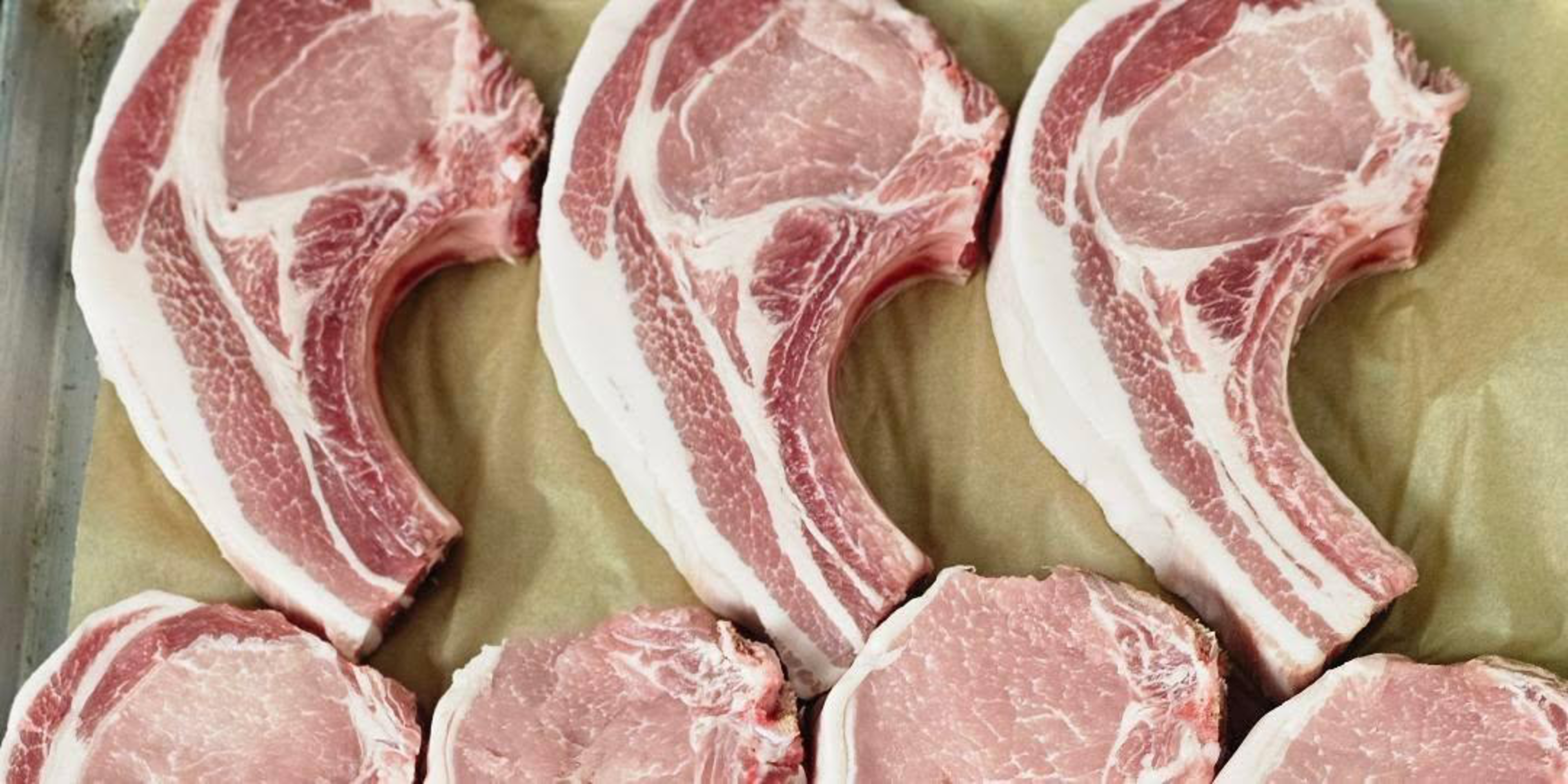 Pork chops at Piglet & Co. | Source: Courtesy Chris Yang
Stuart Brioza of State Bird Provisions, The Progress, and Anchovy Bar remembers his days at Rubicon when he went to a farm to participate in slaughtering a cow. “I don’t know if it was an obligation, but it was a valuable experience,” he says. “It evolved me as a chef — understanding everything matters.”
Brioza’s three restaurants continue to use whole animals. When I stopped by for a butchery demo one afternoon, the walk-in had a whole goat from Anderson Ranches in Oregon’s Willamette Valley and quarters of veal from Rossotti Ranch in Petaluma. For his cooks, learning to butcher is a privilege that must be earned. Brioza admits that the cooks coming up today aren’t typically trained in the art.
Kokkari, Flour + Water, and the State Bird family of restaurants all share something: They have the kitchen space to do the butchering, and, most important, they’re busy enough to make it work. Processing whole animals doesn’t require just skill — it requires time, labor, and a menu built around the limitations. There are only so many of the popular cuts. Writing a consistent menu around the kind of variability that comes with using everything from trotters to liver is a constant negotiation.
For newer restaurants, the math is harder. The cost of meat and labor has made whole-animal programs too risky for most fledgling kitchens. For small teams already stretched thin, whole-animal butchery often isn’t a wise economic choice.
This is where Oakland-based Cream Co. Meats (opens in new tab) has stepped in. Founded in 2016 by Cliff Pollard, the distributor buys animals from local, sustainable ranches, breaks them down, and delivers the parts as needed to restaurants, including San Francisco stars like Liholiho Yacht Club, Nari, and Rintaro.
Alex Jermasek, a Cream Co. plant manager and a former butcher, says it could be considered “a sad thing” that chefs aren’t doing more whole-animal butchery. But it’s also a good thing, because Cream Co., which takes on the responsibility of sourcing and labor — as well as making sure there’s no waste — makes it easier for chefs to have access to meat from regenerative ranches. “We’re trying to make it possible for chefs to support the use of whole animals without having to buy all of them,” he says.
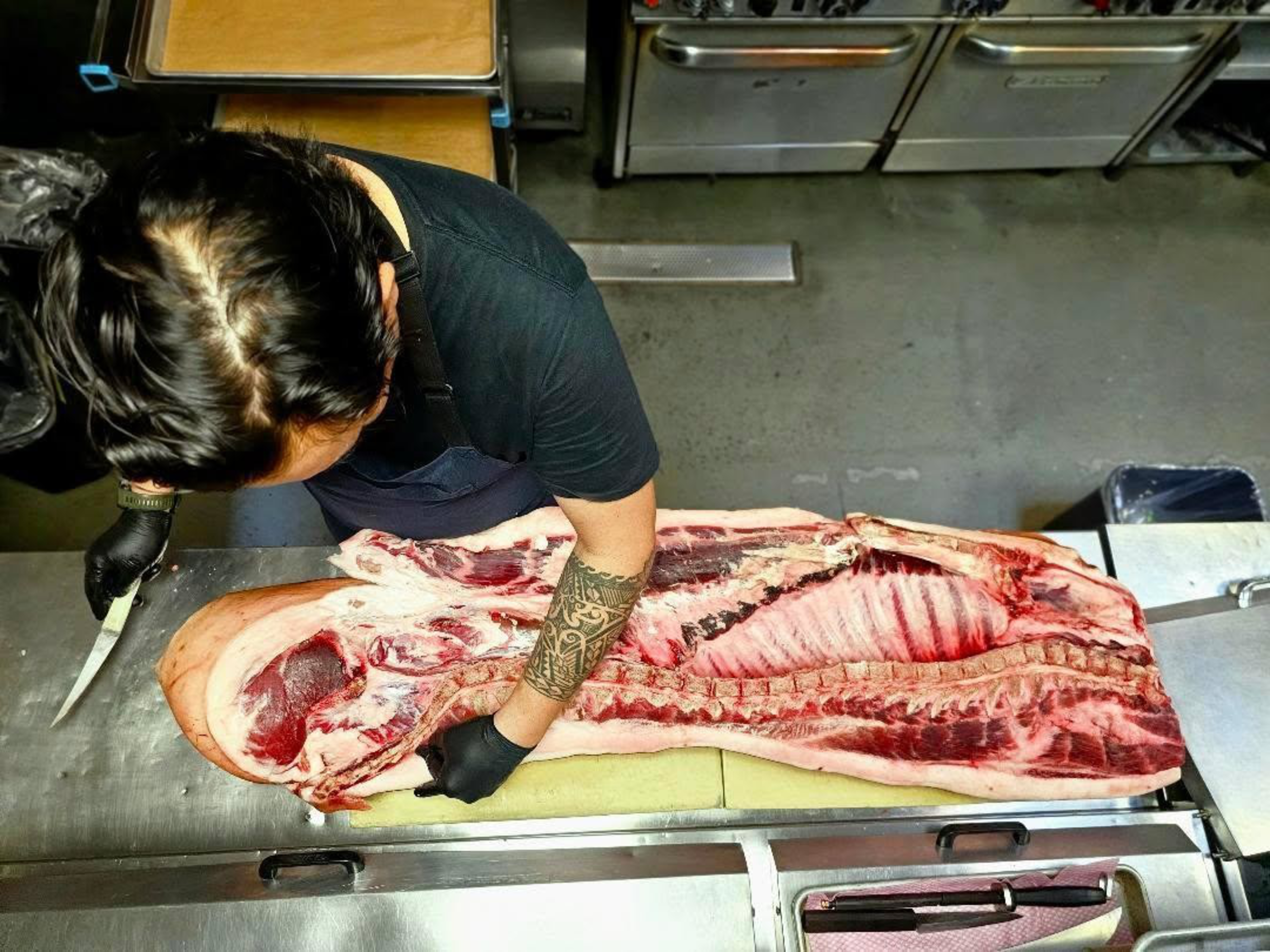 Yang at Piglet and Co. | Source: Courtesy Chris Yang
There are still the die-hards romantics, though — even some whose restaurants are newer to the scene. A few weeks ago, chef Chris Yang of Piglet & Co, which opened in 2023 in the Mission, restarted a whole-hog program after shelving it for a year. He uses pigs from Stemple Creek Ranch in West Marin. He makes panko-fried headcheese with Chinese hot mustard from the head and hocks, Taiwan-style cured bacon from the belly, a pork demiglace from the bones, house-made Spam from the shoulder, cracklings from the skin, and cabbage confit with doubanjiang glaze using the lard. He gives the scraps to his dog.
Though he’s fully aware it doesn’t make the best financial sense, Yang says mostly about a desire to stay connected to the source of what he serves. As a hunter, he understands the value of this connection. When he cooked in Hawaii, he practiced the tradition of saying a prayer before the hunt began and another after the animal was killed.
Maybe that’s what whole-animal cooking has always been about: It asks us to acknowledge our place in the life cycle — to look it in the face and express some gratitude. Which is a easier to do for a pig than a pork chop.