
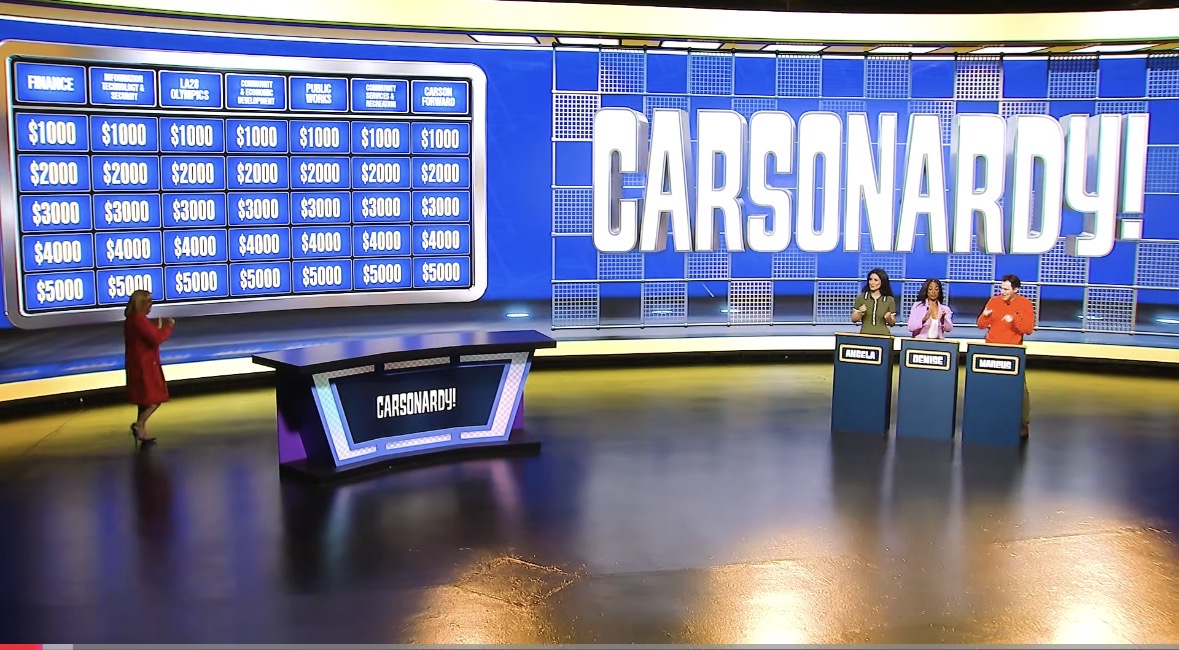
The City of Carson’s 2026 State of the City Address, held last Thursday, was more than just an annual update, it was a bold statement about identity, momentum, and vision. Branded creatively as “Carsonardy,” Mayor Lula Davis-Holmes delivered a presentation that blended entertainment with substance, transforming what is traditionally a formal civic report into an engaging, accessible, and community-centered experience.
The game show format was not just a stylistic choice, it symbolized a city confident enough in its progress to present it in a fresh, unconventional way.
From the outset, the tone was clear, Carson is not standing still. It is evolving, investing, and preparing for a future that is both locally grounded and globally connected. The categories ranging from finance and public works to technology, economic development, and the LA28 Olympics, highlighted the breadth of initiatives currently underway. What stood out most was how interconnected these efforts are. This is not a city pursuing isolated wins, it is building a comprehensive foundation for long-term sustainability and growth.
 Carson Mayor Lula Davis-Holmes
One of the strongest takeaways from last Thursday’s address was Carson’s financial stability. Maintaining a structurally balanced budget for five consecutive years, heading into a sixth with a general fund balance of approximately $252.5 million is no small accomplishment.
In an era where many cities struggle with budget deficits and uncertainty, Carson is demonstrating disciplined fiscal leadership. This level of financial strength provides the foundation for everything else discussed in the address. It shows that the city is not merely reacting to challenges but proactively planning for the future. The emphasis on transparency, reinforced by national financial reporting awards, also strengthens public trust.
Equally impressive is Carson’s commitment to infrastructure and public works. The mention of the much-discussed “roller coaster” conditions on Martin Luther King Jr. Street near Victoria Golf Course showed a willingness to acknowledge community concerns while offering concrete solutions. Allocating $6 million to improve that corridor reflects responsiveness and accountability. Beyond repairs, the broader streetscape master plan, including median renovations and beautification efforts, reveals a city focused not only on function but also on appearance, safety, and civic pride.
Economic development was another major highlight of the address, making it clear that Carson is positioning itself as a hub for growth in the South Bay. Projects like Envision Carson and the Carson Triangle represent transformative investments in housing and mixed-use development. With over 1,000 new homes, restaurant space, and publicly accessible open space planned, these developments signal a city preparing for future population growth and expanded economic activity. Importantly, the inclusion of affordable housing units demonstrates that Carson is not ignoring the importance of equity as it grows.
The redevelopment of key sites also reflects the city’s broader strategic thinking. The acquisition of the former Domenick’s Pizza House site and the ongoing planning surrounding the Phillips 66 refinery closure both point to major transition points for Carson. The refinery closure is significant. While it represents the end of a long-standing industrial chapter, it also creates an opportunity for large-scale redevelopment that could reshape Carson’s economic future. The city’s readiness to discuss this openly in last Thursday’s State of the City shows a leadership team that is looking ahead rather than dwelling on uncertainty.
Technology and innovation emerged as defining themes throughout the address. Carson’s ranking as one of the most innovative digital cities in the country, is a major achievement. The $27 million citywide fiber project is especially notable. By connecting parks, major facilities, smart homes, and Cal State Dominguez Hills, Carson is investing in the infrastructure necessary for a modern city. This is about more than internet speed, it is about opportunity, equity, efficiency, and preparing Carson to compete in a digital economy. The effort to bridge the digital divide while also creating potential revenue for the city reflects thoughtful, future-oriented leadership.
The city’s multimedia expansion and Carson TV app also reflect a more modern approach to government communication. By creating easier access to city programming and civic information, Carson is making local government more visible and approachable. That matters. In a time when many residents feel disconnected from municipal operations, Carson is finding ways to engage people where they already are, on mobile devices, streaming platforms, and social media.
Perhaps the most exciting piece of Carson’s future is its connection to the LA28 Olympic and Paralympic Games. Last Thursday’s address made it clear that Carson is preparing not just to participate, but to play a meaningful role on the global stage. The city’s hosting of international delegations and interest from Great Britain show that Carson is actively pursuing opportunities tied to the Olympics. This is bigger than sports. It is about economic development, international exposure, tourism, and long-term partnerships that can benefit the city well beyond 2028.
Community investment was another standout element of the presentation. Projects like the new Carson Amphitheater, the expansion of Carriage Crest Park, and improvements to Mills Park and Foisia Park highlight the city’s commitment to improving quality of life for residents. These projects are about more than construction, they are about creating spaces where families gather, young people play, and communities connect. The more than $10 million invested in the amphitheater alone reflects a city that understands the importance of public spaces in building civic identity.
Looking forward, the proposed Carson Civic Center Campus may be the clearest symbol of the city’s long-term ambitions. Plans for a new city hall, performing arts center, housing, and entertainment district show a city thinking boldly about what its future can look like. This project has the potential to become a true centerpiece for Carson and a visible reflection of the progress highlighted throughout the State of the City.
What everyone should take away is that Mayor Davis-Holmes does not ignore challenges. Instead, she presented them alongside practical solutions, investment plans, and a broader vision for what Carson can become. That approach builds credibility. It sends the message that progress is not accidental, it is intentional, strategic, and ongoing.
In the end, the “Carsonardy!” theme was more than creative branding. It served as a fitting metaphor for a city that tests its knowledge, showing its strengths, and preparing confidently for what comes next. Carson is demonstrating that it has the strategy, resources, and leadership to meet the moment.
The State of the City painted a clear picture of a city on the rise. Carson is leveraging financial strength, investing in infrastructure and technology, creating opportunities for development, and preparing for major global attention through LA28. At the same time, it remains rooted in community, quality of life, and inclusive growth. If the message from last Thursday was any indication, Carson is not just watching the future unfold, it is actively helping shape it.
Brent Page is a Southeast Louisiana native, a proud Southern University alum, and a Public Relations Commissioner in California’s South Bay. Passionate about storytelling and community engagement, Brent blends Southern roots with West Coast influence to share narratives that preserve tradition and inspire connection. Brent can be reached here.
Related