
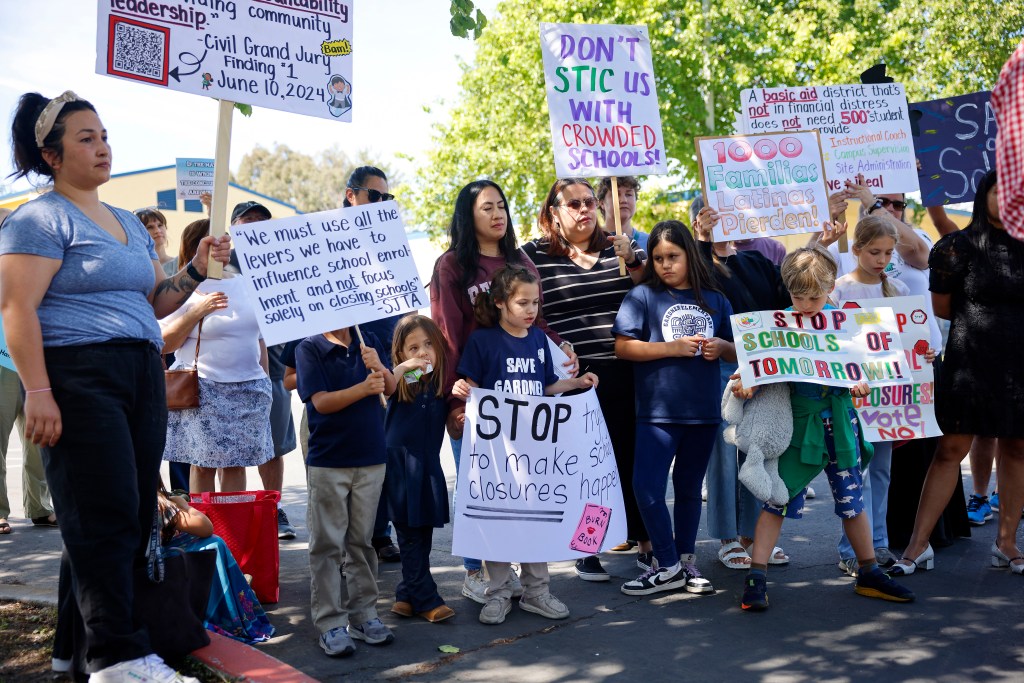
San Jose Unified School District will shutter five elementary schools and relocate another by the end of the school year in an effort to address widespread declining enrollment, the district’s board of education determined Thursday.
The board approved the closure of Canoas, Empire Gardens, Gardner, Lowell and Terrell elementary schools, and the relocation of the Hammer Montessori magnet program at Galarza to Gardner Elementary.
The board voted 3-2 on the plan, with board members Carla Collins, Teresa Castellanos and board president José Magaña voting yes and members Brian Wheatley and Nicole Gribstad voting no.
“We are in a situation where I know we are failing students,” Castellanos said, pointing out that the proposed school closures would provide additional resources to students, like counselors, instructional coaches and art and music classes. “The children in my community deserve the right to these things. They are not getting these things because the classes are so small and that is not equity.”
The move comes as dozens of Bay Area school districts have announced layoffs, budget cuts or school closures this year to address years of declining enrollment, as birth rates decline and families flee high-cost areas.
District superintendent Nancy Albarrán said the district’s elementary schools have been particularly impacted by declining enrollment. The district said elementary schools have seen a 17% decline in student enrollment since 2017, a loss of more than 2,000 students. Districtwide, San Jose Unified has seen a 20% decline in enrollment since 2017, a loss of roughly 6,000 students.
“As schools get smaller, it becomes harder to provide the level of programming, staffing stability, teacher collaboration, student support and enrichment opportunities that our students deserve,” Albarrán said Thursday. “That is the central issue before us tonight. … It is about whether we’re willing to act so that students have access to the kind of school experience we want every child in this district to have.”
The closures are part of the district’s “Schools of Tomorrow” initiative, which began in September and focused on evaluating the district’s elementary school enrollment, staffing and programs to determine which campuses to close or consolidate. A previous proposal had considered closing as many as nine campuses before the next school year.
District staff said under the approved plan, the number of elementary schools with fewer than 350 students will decrease from 12 campuses to three, with the average school serving 501 students, rather than the current average of 408 students.
But Thursday’s vote was a blow to families, students, staff and community members who have fought adamantly against the plan to close schools since the district first announced it last month.
In a meeting that ended in tears, outrage and chants of “shame,” hundreds of community members filled the district office Thursday night to protest the closures, with many wearing T-shirts or hats advocating for their local elementary school. Posters and whiteboards also crammed the room, including several that called for the removal of Albarrán and a recall vote of board members.
During two hours of public comment, nearly 50 parents, students and staff expressed concerns about the impact the closures would have on students’ academic and social well-being, as well as the impact on low-income and working families already struggling with challenges to find child care or transportation for their children.
Families also argued the closures would risk students’ safety by requiring dangerous transportation routes.
“(The plan) is way out of balance,” said Geoffrey Garen, a parent at the Hammer Montessori magnet program. “It creates dangerous walk zones … it closes schools and creates mega-schools, which research says will cause generational harm. It singles (low-income) schools out for closure.”
Community members argued the closure of the five campuses would disproportionately affect minority, low-income and special education students. Earlier this week, a coalition of at least 18 parents filed a legal complaint against the district alleging that the district’s plan to close schools violates state and federal anti-discrimination protections.
And residents across the district have repeatedly called for greater transparency and community engagement, including elected officials representing the city and county.
Silvia Scandar Mahan, the wife of San Jose Mayor Matt Mahan, was also in attendance Thursday. She read a statement from Mahan, who urged the district to halt the closures and include parents, especially minority and low-income families, in the decision-making process.
“San José’s public schools are one of our community’s most important institutions. Decisions that reshape them will affect families and neighborhoods for decades. This is why it’s essential that parents are meaningfully involved from the beginning,” Mahan said in his statement. “Families feel that this process has asked them to react to a plan rather than shape the solution. I respectfully urge the board not to move forward with this Schools of Tomorrow proposal and instead work directly with parents and educators who are most affected.”
Mahan sent a letter to Albarrán last week in which he encouraged her to ensure “that families feel heard, that the process remains transparent, and that the final decision reflect both fiscal responsibility and the value of strong neighborhood schools.”
State Sen. Dave Cortese, who represents San Jose, also sent a letter to the district’s board of education Thursday, urging the board to pause any vote on school closures “until the board has adequately engaged the community and sought guidance from the state.”
But despite officials’ urging, community pleas to delay a decision and threats of legal action, the board approved the closures.
District staff said impacted families will be alerted Friday, with school assignments finalized by May 1. Staff also said students living outside the walk zone of their new campus will be provided transportation for the entirety of their elementary school experience. The district reaffirmed that closing and receiving schools will get increased funding to support the transition, but did not specify where that funding would come from.