
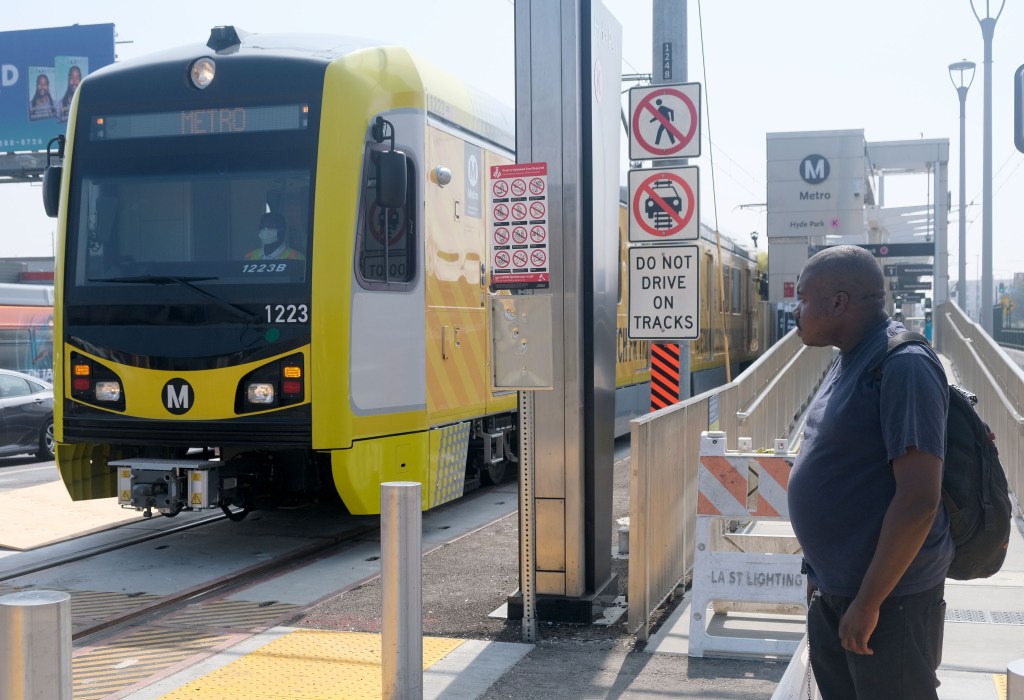
Los Angeles Metro’s Board of Directors unanimously approved a route for the northern extension of the K Line light rail project Thursday, advancing the 9.7-mile San Vicente-Fairfax alignment and pledging to address concerns from Mid-City residents without delaying the project.
Metro officials described the local preferred alignment as a game-changer that will move forward a project that aims to connect communities, reduce commute times and improve access to employment, housing and cultural institutions.
The matter was approved after an hour and a half of public comment, and with more than 900 people registered to provide comment.
“This is a transformational moment for Los Angeles. Today’s approval of the K Line Northern Extension San Vicente-Fairfax alignment will finally connect communities and make it possible to travel from LAX to the Hollywood Bowl on one line,” L.A. County Supervisor and Metro Board Member Lindsey Horvath said in a statement.
The K Line already connects the South Bay to Inglewood and LAX, with the project seeking to extend the rail from Expo/Crenshaw through Crenshaw, Mid-City and the Fairfax District to West Hollywood, Hollywood and a final stop at the Hollywood Bowl. A total of 10 stations would be built under this proposal, reaching destinations such as Cedars-Sinai Medical Center, Pacific Design Center and the Grove.
This alignment would link to four other major rail lines — including the under-construction D (Purple) Line — and six of the region’s busiest bus lines, according to Metro.
The board’s decision is part of the planning process initiated under an early project delivery framework for future planning, funding and coordination purposes. It is not a final approval of the project.
Metro staff have estimated this alignment cost is closer to $15 billion.
Metro’s board and staff approved this alignment, in part, due to advocacy from West Hollywood, which committed to fund 25% of capital costs through a so-called Enhanced Infrastructure Financing District. City officials say they would provide approximately $2.25 billion for the project.
“I’m thrilled that the Metro Board has voted affirmatively to move forward with the K Line Northern Extension,” said West Hollywood Mayor John Heilman in a statement. “The San Vicente-Fairfax alignment will serve the greatest number of people and connect with key east-west transit lines. It will be truly transformative for West Hollywood and communities across Los Angeles County.”
West Hollywood’s financial support will accelerate the project, with construction anticipated to begin in 2029. Without the city’s backing, Metro staff said construction would start in 2041, with a target opening between 2047 and 2049.
Metro’s board previously considered a second proposed alignment, called Fairfax, which was a 7.9-mile route with seven stations, and a third option, called La Brea, a 6.2-mile route with six stations.
The project has been opposed by some residents of LA’s Mid-City historic residential neighborhoods, including Lafayette Square and Wellington Square. They’ve expressed concerns about noise and vibration due to future tunnel construction activities, a lack of engagement, safety of tunnels below older homes and impacts to property values and businesses.
L.A. County Supervisor and Metro Board Member Holly Mitchell recused herself from Thursday’s vote, as did Metro Board Member and 1st Vice Chair Jacquelyn Dupont-Walker, because they have financial stakes related to the project. They both own properties in or nearby Lafayette Square, where tunneling of the project would occur.
Though the two recused themselves, there had been allegations that LA Mayor Karen Bass, also a Metro board member, and Dupont-Walker had been lobbying their colleagues behind closed doors to delay the project via a motion, calling for more studies.
Bass denied those allegations during the public meeting. She did introduce an amendment, which was approved by her colleagues, that requested Metro staff to further engage with residents in the impacted communities.
“Mid-City neighbors will receive additional independent technical review,” Bass said. “West Hollywood will have a firm cap — no more than 12 months of additional work after the EIFD is established, and let me be clear, within 12 months of the EIFD establishment, the route will be finalized and work will resume.”
Metro staff confirmed that the amendment will not delay the project nor jeopardize West Hollywood’s plan to create its Enhanced Infrastructure Financing District.
The amendment was created in collaboration between Bass, Horvath and Heilman.
“This amendment delivers both urgency and certainty. With the leadership of Mayor Bass and Mayor Heilman, we are investing intentionally in connection, community and opportunity, while answering the fierce urgency of a rising generation counting on us to get this right — and get the K Line North done now,” Horvath said in a statement.
Metro staff already reduced the project’s impact by selecting a tunneling path that would affect 22 homeowners vs. what could have been more than 140 homeowners.
About 18 months ago — at the request of Bass and Mitchell — the agency conducted more studies around impacts to homes in these areas, costing an additional $2.3 million.
The analysis found that modern tunneling techniques are safe with pre-construction studies, use of advanced tunnel-boring machines, mitigations and monitoring.
Tunnels are proposed at depths of 40 to 120 feet below the surface in the project area, and 80 to 120 feet below Mid-City — depths in which noise and vibration are estimated to be below the threshold of damage to structures and human perception, according to Metro.
Agency officials said similar tunneling has been completed in comparable ground conditions and at similar depths without damage to buildings. Staff added that tunnel easements would not affect properties, historic status, zoning, underground mineral rights or property values.
Mid-City residents have also criticized the project for potentially eliminating a grocery store in the area. Metro has pledged to relocate the businesses before construction begins.
The K Line Northern Extension is expected to serve approximately 100,000 riders each day, connect 125,000 jobs within walking distance of stations and serve more than 325,000 residents who rely on transit.
In addition to improving mobility, the project is projected to create more than 10,000 union construction jobs, generate $9.7 billion in union wages and generate over $22 billion in economic activity for Los Angeles County, according to Metro.
With sections 2 and 3 of the alignment approved, West Hollywood will begin the process of establishing an Enhanced Infrastructure Financing District — with a vote expected in April.