
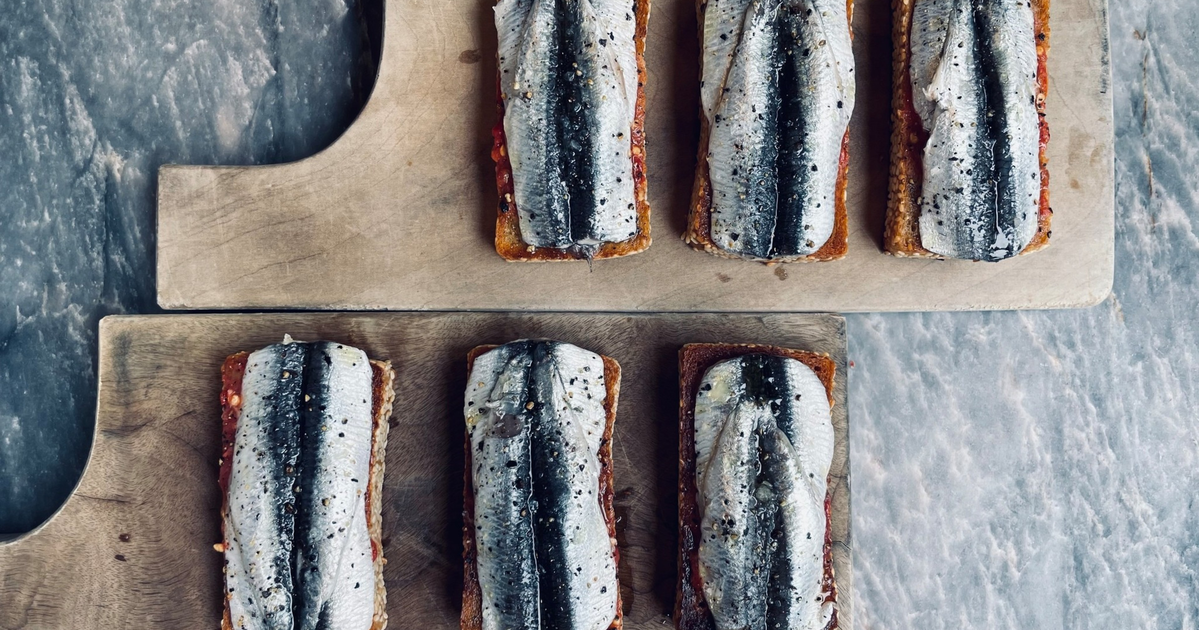
Anchovy toast at The Anchovy Bar. | Source: Courtesy The Anchovy Bar
This column is a part of the Off Menu newsletter, our Wednesday dispatch of restaurant news, gossip, tips, and hot takes. Sign up for weekly emails here.
After decades in Northern California, I’ve been trained to read spring in a certain way: As soon as the tree petals confetti the sidewalks, I know the markets will start to overflow with artichokes and fava beans, and menus will fill with strawberries, green garlic, and apricots. That’s the season. That’s what I’m supposed to get excited about.
But spring as the kickoff to anchovy season? I’m embarrassed to say, I had no idea.
The silvery local fish are just about to arrive — and they’ll be here through November. The abundant, relatively unrestricted schools of anchovy that swim in our bay are a shimmering, swirling glimmer of hope. Though stocks were down prior to 2015, we’re now in a boom: In 2022, California’s coast was home to an estimated 2 million metric tons (opens in new tab) of anchovies — roughly seven times (opens in new tab) the total of all other fish caught in the state’s waters that year.
 Sardines in the holding pens on Pier 47. | Source: Courtesy Erik Sandquist
Meanwhile, commercial wild salmon has been off limits for three years. Crab season is a tangled trap of whale savers and frustrated fishermen. And a while back, local sardines said “hasta luego” and headed off for San Diego.
The handwringing around the Bay Area’s struggling fisheries has been so constant that it’s been easy to miss the one variety that’s thriving — and that chefs are only just beginning to take seriously.
Stuart Brioza and Nicole Krasinski of State Bird Provisions have built an entire restaurant around them — The Anchovy Bar — but you’ll also find the little guys dusted in cornmeal for “fries with eyes” at Nopa Fish, used for jeotgal and fish sauce at San Ho Won, tempura-fried at Nisei, cured at Rich Table, and fried with preserved Meyer lemon aioli and fresh horseradish at Scoma’s.
All these restaurants get their anchovies delivered directly from Pier 47 (well, the cooks at Scoma’s just have to just walk a few feet). During the season, the eight underwater pens hold up to 20,000 pounds of live anchovies, according to Erik Sandquist and Sean Hodges, the fishermen who own J & P Bait (opens in new tab).

 The anchovy tartine with ’ndjua butter at Tartine Manufactory. | Source: Lauren Saria for The Standard
 A bevy of chovies at Nopa Fish. | Source: Sara Deseran/The Standard
The two are the only anchovy guys around here. If you’ve ever popped a local anchovy into your mouth, it came from them.
Sandquist, a lifelong fisherman, bought the docks at the entrepreneurially advanced age of 24. In 2010, he paired up with Hodges, who owns a 65-foot boat called the Cape Knox. The boat has four deep live wells, where thousands of anchovies are kept alive in circulating seawater.
It’s also equipped with a massive spool that holds a purse seine, a long, curtain-like net that unfurls behind the boat, circling anchovies before cinching shut beneath them. The net itself, some of which is knotted by hand by Sandquist, is like a Ruth Asawa artwork. It’s a craft he learned from a squid fisherman. “If you’re off by a 16th of an inch per knot all the way down, the net won’t hang right in the water,” he says.
If you want to understand anchovies, you have to start with how quickly they break down once they’re dead, due in part to their high oil content. Which is why they’re sold live. “They have, like, a 24- to 36-hour shelf life,” Sandquist says.
If you ask a chef like Brioza, however, the window is closer to two hours. When they are delivered to The Anchovy Bar — mostly DOA — the kitchen staff drop everything, treating the tiny fish with the frantic urgency of the ER docs on “The Pitt.” Scaled, deboned, and gutted, most of the fish are set to cure in Brioza’s California-style boquerones: lime juice spiked with basil, jalapeño, and garlic.
“A lot of restaurants don’t want to deal with the headache of them,” says Kenny Belov, owner of TwoXSea, a wholesaler committed to sustainability and transparency. (He also owns Fish restaurant and market in Sausalito.) Like every fish distributor in SF, Belov gets his anchovies from J & B and, from there, sells them to the city’s top restaurants — up to 200 pounds a day. “When I started, 20 pounds was a record.”
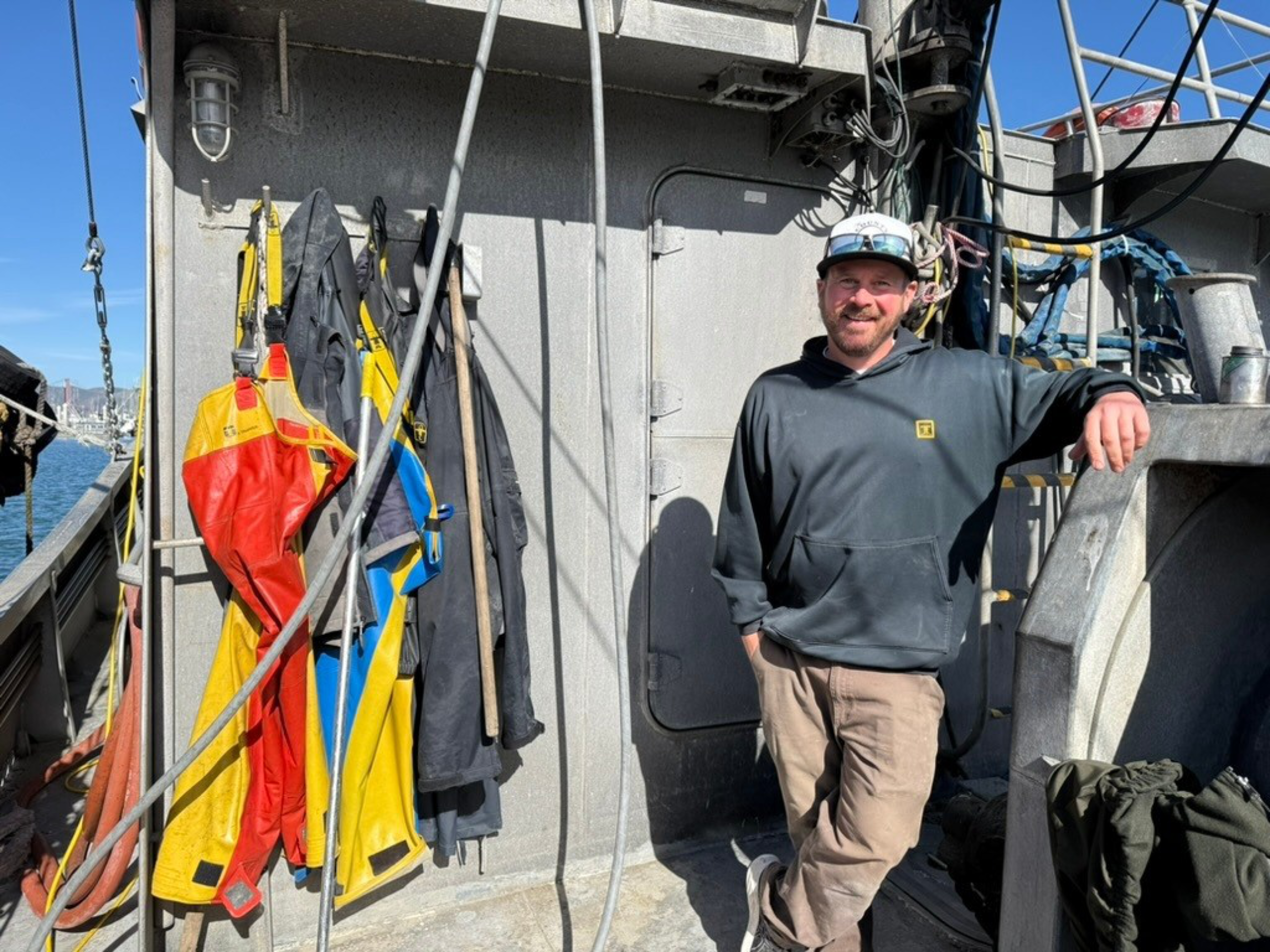 Erik Sandquist, fisherman and co-owner of J & P Bait. | Source: Sara Deseran/The Standard
There is some irony to all this fuss. Because most people still see anchovies as bait, used to catch the “real” fish, like striped bass and halibut. Even with all his restaurant clients, Sandquist estimates that only 35% of his anchovy catch is sold “for human consumption.”
Sometimes Brioza brings Sandquist and Hodges their own anchovies — cured and ready to eat — for an impromptu tailgate at the dock. “I go down a few times during the season,” Brioza said. “Usually with visiting chefs when I want to show it off.” Sandquist, unsurprisingly, appreciates it, proudly sending me a photo of Brioza’s silvery anchovies speared with basil and tomato, a ramekin of sea salt on the side.
I get why Brioza’s into it. Knowing that all our anchovies are pulled from our waters — somewhere between Alcatraz and Half Moon Bay — by two guys on one boat makes them singularly fresh and gloriously local. Despite their ubiquity, it’s the care that goes into preparing them that makes them feel rare. And definitely worth adding to the culinary calendar.
To get the freshest anchovies, stop by J & P Bait (opens in new tab), open to the public seven days a week. They’re $30 for “half a scoop” (6 pounds).