
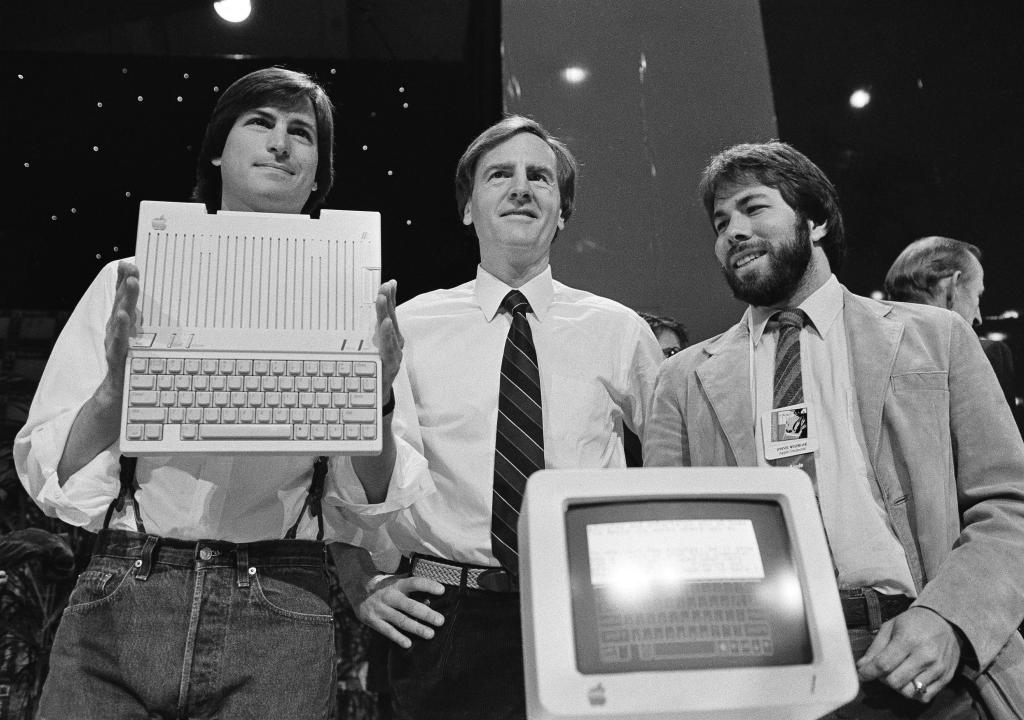
For the past 50 years, Apple has been changing the world. In a way, Apple created its own world — one of design-forward computers and accessories that anyone could use and just about everyone wanted to have — and invited us to live in it.
The $3.6 trillion tech titan, which was founded April 1, 1976, by Steve Jobs and Steve Wozniak, has been marking its golden anniversary with a series of events around the world over the past few weeks. Alicia Keys kicked things off performing at Apple Grand Central in New York City, Mumford & Sons entertained fans at Apple Battersea in London and the Sydney Opera House was illuminated with digital artwork.
The finale Tuesday night was one Jobs would have loved — a huge celebration for employees and invited guests at Apple Park in Cupertino with none other than Paul McCartney as the headliner.
RELATED: A farmer’s letter revealed what Apple would become: Inside a reporter’s first look at the company
“At Apple, we’re more focused on building tomorrow than remembering yesterday,” CEO Tim Cook wrote in a letter posted on Apple.com. “But we couldn’t let this milestone pass without thanking the millions of people who make Apple what it is today — our incredible teams around the world, our developer community, and every customer who has joined us on this journey.”
When Jobs recruited John Sculley to be Apple’s new CEO in 1983, he asked the PepsiCo executive if he wanted to spend the rest of his life selling “sugar water” or take Jobs’ offer to change the world.
And they did — many times. So in yet another way to celebrate the milestone, here’s a look back at five times Apple transformed the way we work, play and connect with each other.
June 10, 1977: The debut of the Apple II
Steve Wozniak’s Apple I was the company’s first product, and its finances were buoyed by an original purchase order of 50 computers at $500 a piece from Paul Terrell, owner of the Byte Shop in Mountain View. But it was the much more advanced Apple II released a year later that finally made personal computing a reality.
Unlike previous attempts, the Apple II was sold as a complete package, not a kit that would delight hobbyists to assemble but mystify the average consumer. Replacing the original cassette tape storage with an external floppy disk drive in 1978 only made it more popular — especially at schools, where many Generation X students of the 1980s got their first look at a computer.
“The Apple II computer was all of Apple’s revenues for the first 10 years. That one computer kept going,” Wozniak said in an interview at the Tech for Global Good ceremony in San Jose in January. “And then once the world discovered these personal computers, they were everywhere. And other companies wanted to come in and make it.”
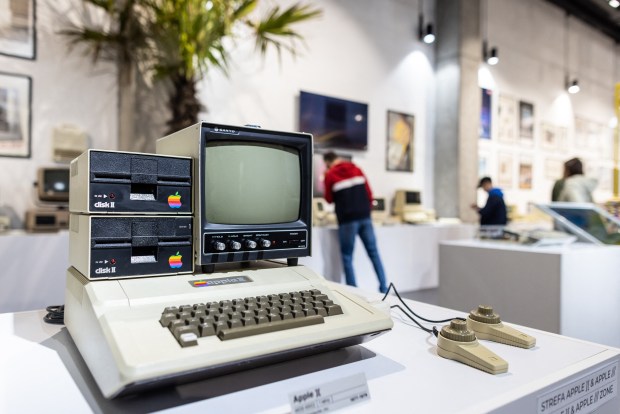 An Apple II computer is on display at the newly opened Apple Museum in Warsaw, Poland on May 29, 2022. (Photo by WOJTEK RADWANSKI/AFP via Getty Images)
Jan. 22, 1984: Macintosh ‘1984’ commercial
How does the company that started personal computing re-assert itself as an upstart revolutionary in the market? By painting its competition as bland, soulless drones and Apple as the avatar of freedom. Conceived by advertising firm Chiat/Day and directed by Ridley Scott, the commercial aired during the third quarter of Super Bowl XVIII and instantly became the most interesting thing about the game.
It was ostensibly an ad for the Macintosh, though the computer never appears in the spot. Jobs introduced it to incredible fanfare two days later at the Flint Center at De Anza College in Cupertino. The ad — which was entered into the Clio Hall of Fame in 1995 and can be found on YouTube — was never broadcast again, but it didn’t need to be: News stations ran it over and over, providing Apple with free publicity and cool cachet ahead of its product launch.
Chiat/Day would perform a similar feat in 1997, following Jobs’ return to Apple, with “Think Different,” a memorable campaign that again set Apple apart as one of “the crazy ones” that changes the world. The theme remains so entwined with Apple’s counterculture identity that it’s still echoed in the company’s 50th anniversary message, “50 Years of Thinking Different.”
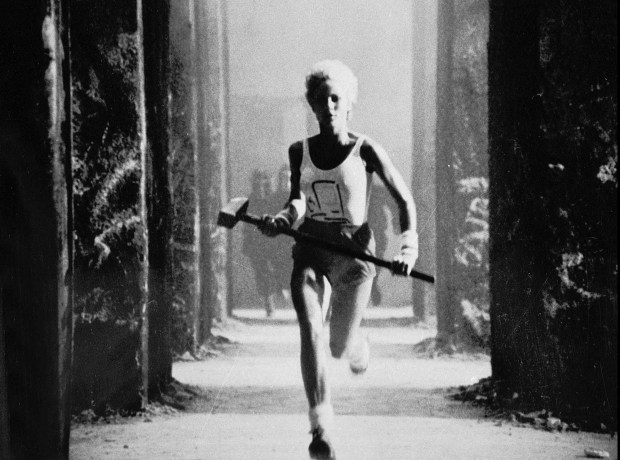 This is a still from video of Apple Computer’s famous “1984” commercial aired during the third quarter of Super Bowl XVIII, which introduced the Macintosh personal computer. (AP Photo/HO/Apple)
Aug. 15, 1998: The iMac makes Apple cool again
It was hard to know what to make of the iMac when it hit the market. People were used to computers shaped like boxes. This one, designed by Jony Ive, was more like an egg or a gumdrop, its futuristic look emphasized by its translucent case and aqua color (officially known as Bondi Blue). Instead of a disk drive, it had a USB port, something new for an Apple product that made lots of people buy adapters to connect their existing printers and drives.
But the dorm-ready computer was a hit, selling about 6.5 million units in its various colors in the next five years. As Apple would learn again and again in the next quarter-century, the design was a more appealing selling point than the RAM.
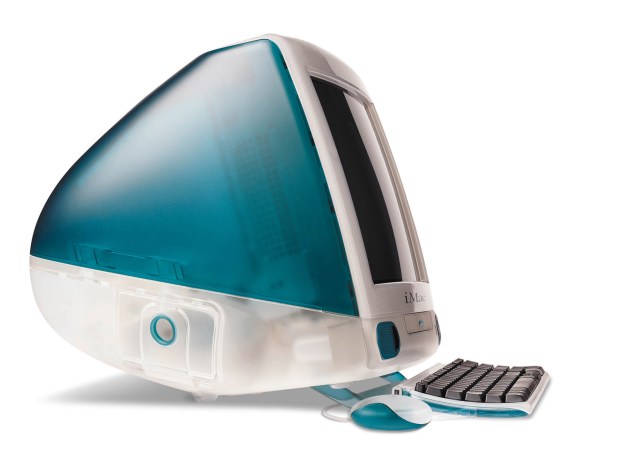 The iMac personal computer went on sale on Aug. 15, 1998. (Photo By Getty Images)
Oct. 23, 2001: ‘1,000 songs in your pocket’
Jobs and Apple didn’t invent the digital music player with the iPod, they just made it better than it had ever been. Jon Rubinstein, who was then Apple’s head of hardware engineering, recruited Tony Fadell — who went on to co-found Nest Labs — to design and lead production on the project. Vinnie Chieco, a San Francisco copywriter, is credited with coining the name because the device reminded him of the white space pods in Stanley Kubrick’s “2001: A Space Odyssey.”
Wozniak said it was a watershed moment for Apple and for Jobs, who had endured several product disappointments, including the Lisa and Apple III computers and NeXT’s expensive but unloved computer workstation.
“Then he had something else – iPod. Instantly sales doubled, revenues doubled, profits doubled. The iPod was his Apple II,” Wozniak said. “It wasn’t a computer, but he knew what people wanted. He knew people. He was really good at that.”
The iPod was discontinued in 2022, but its legacy lives on every time someone listens to a podcast.
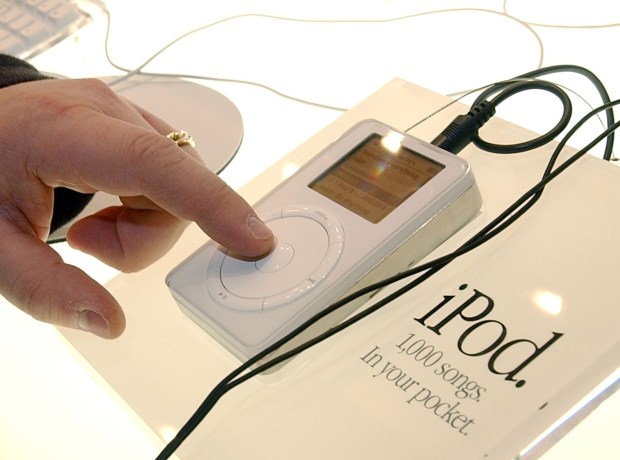 A man touches the Apple iPod mp3 music player on display during the Macworld Conference and Convention January 8, 2002 at the Moscone Center in San Francisco. (Photo by Justin Sullivan/Getty Images)
Jan. 9, 2007: Apple reinvents the phone
Again, Apple was late to the party on mobile phones, but it was worth the wait. The iPhone combined the recently introduced iPod Touch with a phone and an internet connection. The BlackBerry and Palm Treo — up until then the preferred gadgets of the C-suite class — didn’t stand a chance. Neither did flip phones, which went from being the cool accessory on campus to something that grandma used.
“Every once in a while a revolutionary product comes along that changes everything,” Jobs said during his keynote address at the annual Macworld Conference and Expo in San Francisco, where iPhone was introduced. “It’s very fortunate if you can work on just one of these in your career. … Apple’s been very fortunate in that it’s introduced a few of these.”
With the iPhone came endless apps (and app stores to sell them), video conferencing, personal GPS mapping and a photo application that made cameras practically obsolete for everyone but purists.
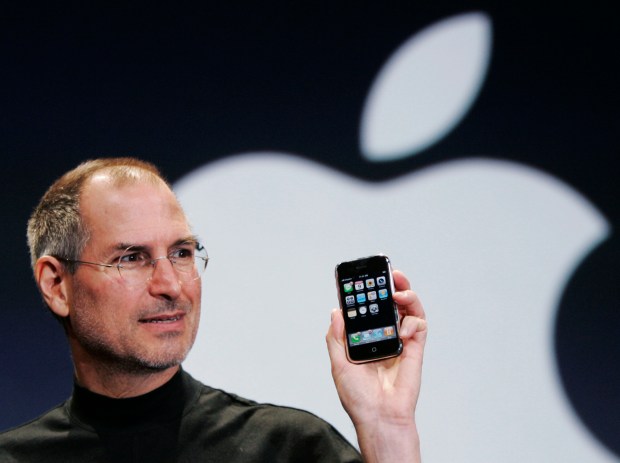 Apple CEO Steve Jobs holds up an Apple iPhone at the MacWorld Conference in San Francisco, in this Jan. 9, 2007, file photo. (AP Photo/Paul Sakuma, File)
Bonus revolution: The Apple store
In 2001, Apple — frustrated with how big-box retailers sold their products — took matters into its own hands and opened the first Apple stores in Tysons, Virginia, near Washington, D.C., and Glendale, California. Today, there are more than 500 stores, stylishly appointed in glass and light wood, in more than two dozen countries. Like car dealerships of the 1950s and ’60s, you went to Apple stores to “kick the tires” on new releases, trying to make up your mind — again — between the AirPods 3 Pro and the AirPods Max 2. Stopping by the Apple store became part of the shopping experience at Valley Fair or University Avenue.
The stores also became the epicenter for product launches, with people lining up for hours to get their hands on the newest iPhone or iPad like they were concert tickets. And the boldly named “Genius Bar” turned a normally frustrating task — learning to use a new tech gadget or dealing with a malfunctioning one — into something more akin to a salon appointment.
During an Apple 50th anniversary event in March at the Computer History Museum in Mountain View, Sculley, who was Apple’s CEO until he left in 1993, said Jobs had a phrase — “no compromises” — that became a primary principle for Apple.
“And that’s a principle that’s still there today,” he said. “Other people compromise. Apple doesn’t compromise.”
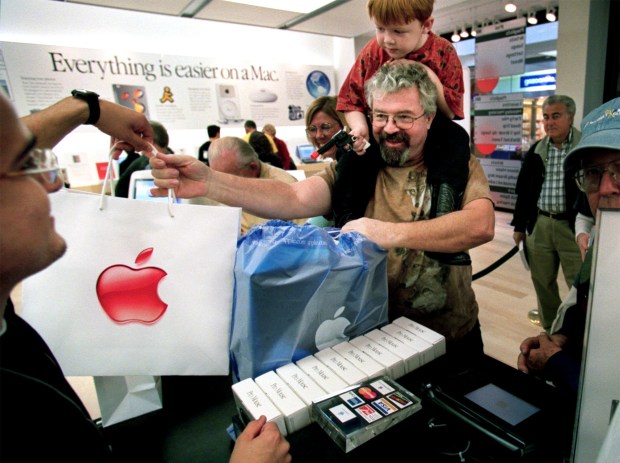 Ross McIntosh, along with his son, Ryan, 6, picks up his new Apple Titanium PowerBook on the opening day of the Apple Store at South Coast Plaza on Saturday, December 1, 2001. The opening drew over a thousand people and featured t-shirt giveaways, a Genius Bar where Mac users could get answers to their Mac questions, and demos in the Apple theater. (Bruce C. Strong/Orange County Register)