
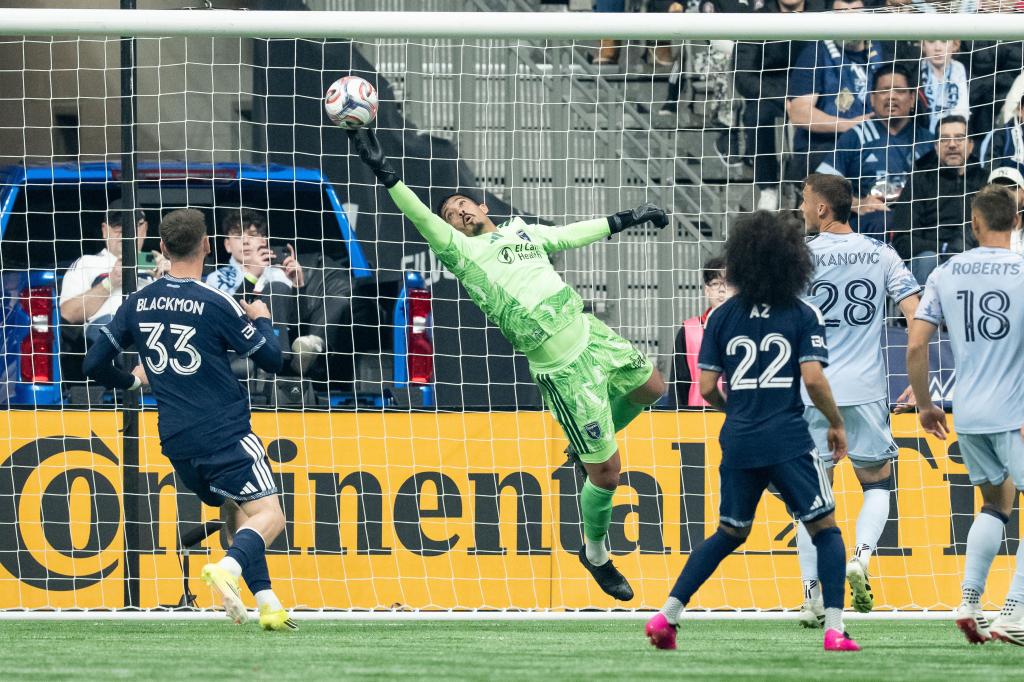
SAN JOSE – A subtle but significant change has reshaped the San Jose Earthquakes’ season.
In their second year under Bruce Arena, the winningest coach in MLS, the Quakes switched from last year’s three-man backline with wingbacks that sprinted up and down the field to a more traditional four-man backline.
Five matches into the season, the difference is striking. Despite having Daniel back in goal and all returning players on the backline from last year — when it allowed 63 goals in 34 games — San Jose has conceded just one goal this season.
The lone goal allowed marks a new club record for the fewest goals conceded over a five-game stretch, underscoring just how quickly the transformation has taken hold.
“We’ve developed a strong mentality when defending and when the opponent has possession,” Arena said. “That improvement isn’t just down to the back line and the goalkeeper. It’s a credit to the entire team.”
That collective buy-in has fueled a 4-1-0 record, tying the Earthquakes for second place in the Western Conference with 12 points and putting them on the cusp of the best start in club history. A win Saturday night against San Diego FC at PayPal Park would make this the first Quakes team to start 5-1.
The previous system created opportunities going forward but left gaps defensively. This season’s four-man structure has brought more balance — particularly for players like Benji Kikanović, who has embraced a new role at right back after beginning his professional career as a forward.
“Everyone’s bought into the system,” Kikanović said. “Everyone plays for each other. Everyone runs for each other. At the end of the day, if you can grind down your opponent, you’re probably going to win the game.”
Kikanović’s evolution mirrors that of the team. His pace remains an asset going forward, but his focus has shifted to positioning, defensive shape, and consistency against some of the league’s most dynamic wingers.
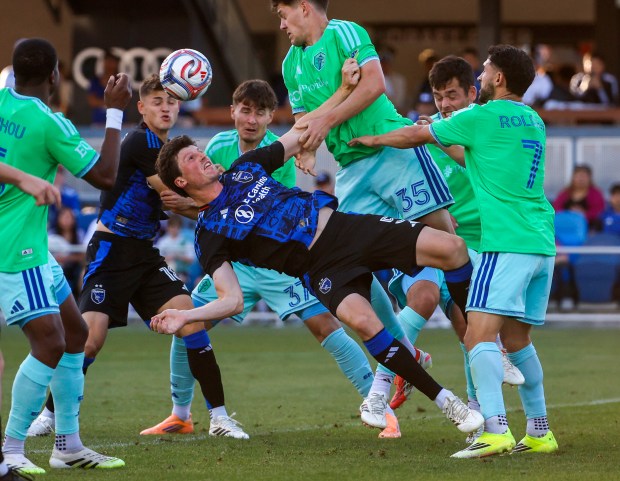 San Jose Earthquakes’ Daniel Munie (5) fights for the ball on a corner kick against Seattle Sounders FC in the second half at PayPal Park in San Jose, Calif., on Sunday, March 15, 2026. (Nhat V. Meyer/Bay Area News Group)
Behind him, center back Daniel Munie has seen the benefits of continuity and tactical clarity. With another year under the same coaching staff and a more defined system, the Quakes have established what he calls a clear defensive identity.
“We want to be a hard team to play against,” Munie said. “It takes all 11 guys on the field. It starts with pressing up top, the midfielders tracking runners, and then us keeping the play in front of us. We’ve done a really good job limiting chances.”
The four clean sheets this season are already one shy of matching last season’s total. Still, Saturday’s matchup presents a different kind of challenge. San Diego FC (3-0-2) boasts one of the league’s most productive attacks, tied for second in MLS with 13 goals scored. It’s a stark contrast in styles — and a measuring stick for just how sustainable San Jose’s defensive dominance can be.
There is also a new wrinkle. Left back DeJuan Jones, who started all five matches this season, suffered a season-ending Achilles injury in the last game. His absence will test the depth and adaptability of a back line that has so far been remarkably consistent, with Vitor Costa likely stepping into a larger role.
Even with that setback, the Quakes remain confident.
“I think as a collective, we’re all grinders, and we look to get the job done, which we have been doing, but it’s only the beginning,” Kikanović said. “So it’s not like you have to start celebrating anything right now, but hopefully we continue to win.”