
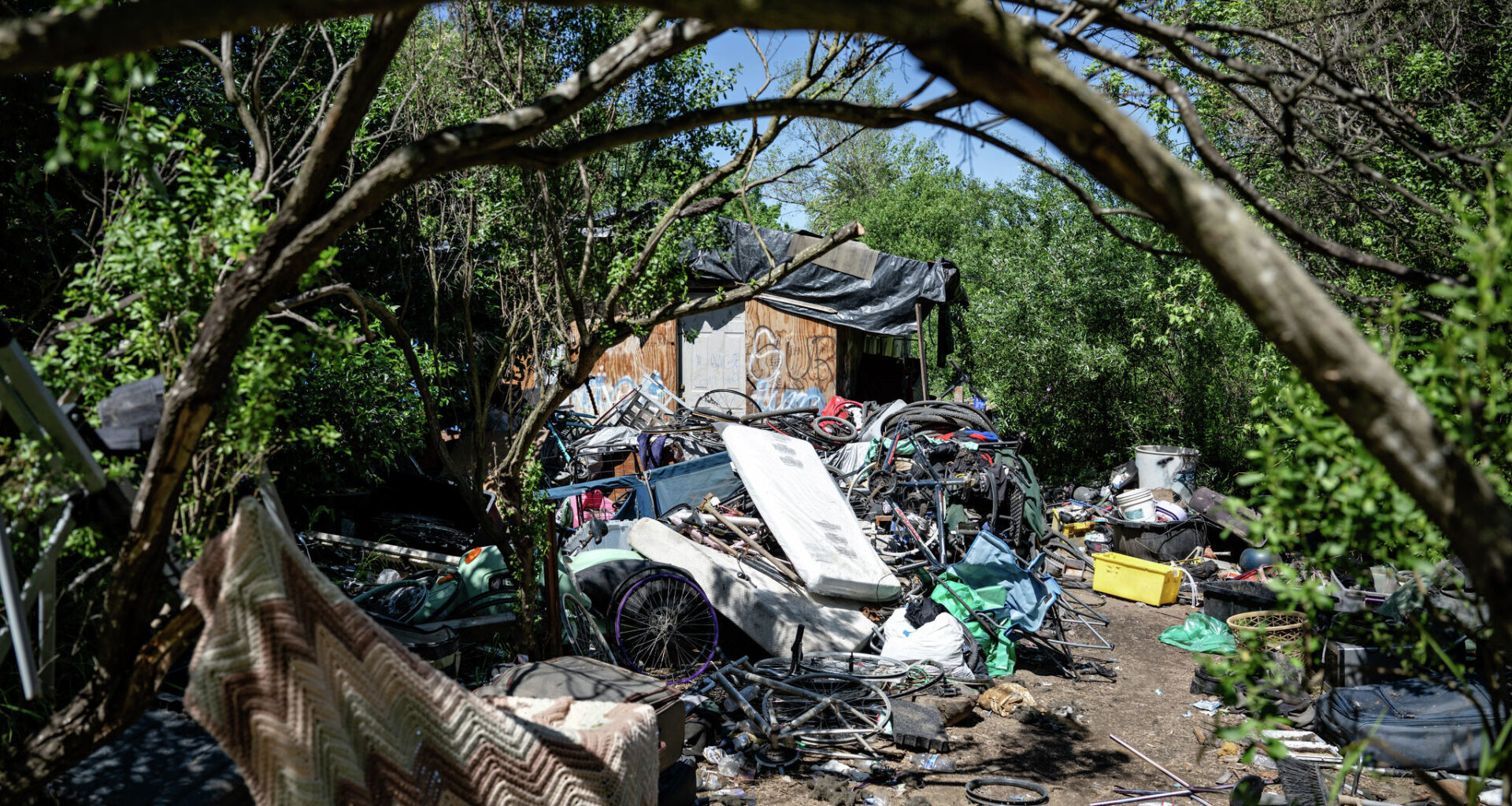
A view of a homeless encampment along Coyote Creek in San Jose that the city plans to sweep.
Thien-An Truong/For the S.F. Chronicle
San Jose Mayor Matt Mahan, left, talks to California gubernatorial candidates Betty Yee, center, and Tom Steyer, right, as they stand near Beatriz Ramos, chief program officer of HomeFirst, during a tour of a Dignity Homes tiny house village in San Jose.
Yalonda M. James/S.F. Chronicle
Kendra Greer, 33, poses for a portrait with her dog in front of her tent at a homeless encampment along Coyote Creek in San Jose.
Thien-An Truong/For the S.F. Chronicle
Luis Nunez, 54, fixes a bike at a homeless encampment along Coyote Creek, also know as, “Olinder” in San Jose, Thursday, April 2, 2026.
Thien-An Truong/For the S.F. Chronicle
Abatement notices are seen at a homeless encampment along Coyote Creek.
Thien-An Truong/For the S.F. Chronicle
Kendra Greer’s eyes were trained on her puppy as it ran circles around a makeshift campfire stove on the bank of Coyote Creek in San Jose.
Chiquito, a tiny black dog, is Greer’s shadow, following the 32-year-old wherever she goes. Soon that means leaving the encampment on the creek for a small room across town.
On April 15, the campsite Greer has known as home — on and off — for the last three years will be torn down by the city. Most residents are being pushed to leave their tents for what San Jose Mayor Matt Mahan calls “tiny homes communities.”
Article continues below this ad
The city’s newest shelter, located in northern San Jose, has a fleet of 70-square-foot rooms ready for about 100 people. Each factory-built dwelling has white walls and faux hardwood floors. Installation is fast and cheap.
“It didn’t feel homey,” Greer said after a tour. “But as long as I’m on the streets, I can’t really complain.”
San Francisco Chronicle Logo
Make us a Preferred Source to get more of our news when you search.
Add Preferred Source
The tiny homes are part of Mahan’s plan to expand the city’s transitional housing stock, which has grown by 1,200 beds since February 2025 and now totals about 2,150 beds. That number also includes parking sites, safe sleep sites and converted motels but the city’s ten “tiny home” communities have become a centerpiece of San Jose’s approach to the unhoused. Now, they’re also a centerpiece of Mahan’s campaign for California governor.
Mahan, a Democrat, is touting how he’s managed San Jose’s housing, addiction and mental health crises to sell how he’d manage those issues statewide. He argues that San Jose has reduced “unsheltered homelessness faster than any other city in the state” by moving people into shelters. He says his policies have saved lives and helped those struggling with addiction get into recovery.
Article continues below this ad
“And we could do a lot more if the state got every city and county to do the same,” he said on a recent debate stage.
Since becoming mayor in 2023, Mahan has focused on cleaning up the streets by moving people off of them. In his pitch for governor, he calls it “going back to basics.” And Silicon Valley’s wealthiest, at least, are listening. California billionaires have thrown more money behind Mahan than any of the other seven democrats running. In the crowded race for governor, only 4% of likely voters support him, according to a Berkeley IGS Poll released. Yet, as of Friday, he amassed about $11.7 million in direct support and another $13.6 million in third-party committee donations.
Critics call Mahan’s approach to San Jose too focused on temporary housing to the detriment of permanent homes. They point to the city’s decision to divert as much as 90% of funding earmarked for permanent affordable housing to instead help fund temporary housing. They say focusing mostly on the most visible parts of the crisis — encampments — at the expense of longer-term solutions isn’t the right approach. They also argue that a controversial 2025 law he pushed to potentially arrest homeless people who repeatedly refuse offers of shelter is draconian and cruel.
“He is not investing in the people,” said Shaunn Cartwright, a homeless advocate in Santa Clara County. “He is investing in a short-term solution … You can’t blame people for not cooperating with a system that invests so little long-term in them.”
She said the unhoused often feel warehoused; that regular run-ins with police over trespassing have eroded trust. After the Coyote Creek encampment is swept, police will enforce no-camping laws in the area, which the city already cleared in 2014.
Article continues below this ad
A new San Jose police unit charged with “neighborhood quality of life” tracks interactions with the unhoused, sometimes labeling people as resistant to help. Mahan has pushed back on what he calls “progressive” approaches and outlooks that allow “a culture of enablement” for those who “choose to live outside” when beds are open.
Mahan told the Chronicle that the state cannot wait for long-term solutions to materialize while “the immediate crisis” continues. In San Jose, that crisis has meant about 6,500 homeless residents, according to the most recent count in 2025, a slight increase over 2023. About 60% were living outside.
Homelessness and housing are top issues in the race for governor, which has more than two dozen candidates on the ballot. Cities are grappling with high rents and encampments while managing constrained budgets. Gov. Gavin Newsom’s state budget proposal slashes in half grants cities use to build shelters and fund other programs, which could make it more difficult to fund expensive, supportive housing rather than cheaper shelter options.
Mahan has pledged as governor that he’d keep the homelessness funding intact at $1 billion a year. It’s the source Mahan used to pay for 47 pallet homes at a cost of $12.7 million, which was secured in 2024.
While some homeless people embrace the tiny homes, others are wary. Layla Nicole Jackson Freeze, 48, has lived in a cabin with her husband for about three months at a site in south San Jose. She said he struggles with mental health issues that can make living in a smaller space a challenge.
Article continues below this ad
“It makes you feel like a criminal,” she said of her shelter site. “They wand you, they look in your bag, you have to wait for a security guard … there’s no sense of home.”
The units have a door that locks, making most people feel safe. Some communities’ dwellings include in-unit bathrooms while others have shared showers and toilets. Residents get two meals every day, and case managers are onsite.
San Jose’s early shelter expansions cut the number of people living outdoors by 23% between 2019 and 2025. Mahan says with the addition of beds since the count, that number has likely gone down more. He points to an annual city survey that asked residents if they “trust City Hall.” The number of people in the August survey who agreed went up 36.6% compared to the year before he took office.
The same survey found 10.5% or respondents rated the city as doing “good” or “excellent” on addressing homelessness, compared to 3.1% in 2022 before Mahan took office.
Tiny home communities for the unhoused picked up popularity nationwide following the pandemic. Barbara Poppe, an Ohio-based homelessness expert regularly hired by cities, fears branding modular units as “tiny homes” has helped oversell them to budget-conscious cities.
Article continues below this ad
“The things that actually solve and stop homelessness from happening are things that need to be at a scale of investment sufficient for this large pent-up demand because there’s just so many people in California who are living completely on the edge,” Poppe said.
Mahan has said that it would cost the city $5 billion to build permanent housing for homeless residents. Meanwhile, to build 5,000 temporary beds the city’s housing department has estimated about $234 million in annual operating costs and another $255 million in one-time building costs. Housing department estimates say the costs come out to about $100,000 per unit in building costs and $61,000 per unit in annual operations. The housing department also suggested costs closer to $575 million to the city to build permanent homes through a mix of grants, partnerships and debt financing.
“There is no question we need to get people off the streets,” said Dr. Margot Kushel, head of UCSF’s Benioff Homelessness Housing Initiative. “The problem is, if there’s no place to go, then people stack up (in temporary housing) and stay for a really long time. There’s a question of how long these shelters are even built to last. There’s a reason most of us don’t live in shipping containers.”
Kushel recommends a framework created by Bay Area nonprofit, All Home, that says for every one investment in shelter, a city should make two in permanent housing and four in prevention. Those investments aren’t necessarily in all new construction, she said, but could be in housing subsidies or other support networks, such as cash programs that keep people from missing rent.
Kushel said more emphasis needs to be placed on preventing people from landing on the streets at all, which can include funds to help with rent or legal support. Programs that show the most promise identify those at risk early, according to new research. San Jose supports similar cash programs through a nonprofit and county partnership, but Mahan’s current budget puts 10% of funds from a property tax pool toward prevention programs while the rest supports temporary housing.
Ideally, those units are truly temporary, experts said, but that’s a challenge in California, where housing is extraordinarily expensive.
The city says, on average, residents spend 200 days in its interim housing. Last year, the city’s temporary housing served 2,135 people, nearly 70% of whom the city says stayed in the program. Of those who exited — about 640 people — 30% went to another shelter system; 30% entered affordable housing; 8% an institutional setting; and 7% into unsubsidized homes.
Poppe and Kushel said it’s the steady flow of people out of shelters that shows sustainable progress.
Mahan has said he would expand federal Section 8 vouchers as governor, but his plan doesn’t specify how beyond lobbying in Washington.
“We have to tackle the problem from both sides of the equation,” he told the Chronicle. “We need the long term solution, which is expanding housing supply.”
The city recently created a voucher program, which targets middle-income earners making between $110,000 and $150,000 a year, to subsidize the rents in 197 apartments in a mostly vacant high rise. The cost to the city is about $11 million and the assistance gets stepped down over a decade.
Mahan’s plans as governor would require local governments to construct more shelters and mental health beds and encourage them to cut fees to fast-track building permits. He’s also pitching a two-year tax holiday for new construction, which would cut into local revenue.
Under Mahan, the city has kept its annual funding for affordable housing at about $50 million.
Mahan said the city will eventually shift the tiny home sites into permanent housing, but those plans will take several years to play out. Currently, a 160-unit low-income apartment complex is underway using city-financed loans.
San Jose’s wave of tiny homes haven’t been without issue. The city recently fired the operator of a 168-unit community after one worker was arrested on charges they intended to sell drugs to residents. Now, the city has voted to speed up plans to convert the complex to supportive permanent housing — though the timeline is unclear.
Already, the $60-million complex had been marred by structural issues that caused sewage backup. Even so, many are desperate for one of the city’s spots. Some of Greer’s campsite neighbors fear they won’t get one. Need still outpaces supply by more than 3,000 people city wide.
Laura Pichardo, 45, is recently sober from methamphetamine and alcohol and fears staying on the streets will threaten her progress. She isn’t sure where she’ll go after the sweep if the tiny homes are full. As of Thursday, she heard that she hadn’t been selected yet.
“I’m hoping for anything, anywhere they want to put me,” she said.