
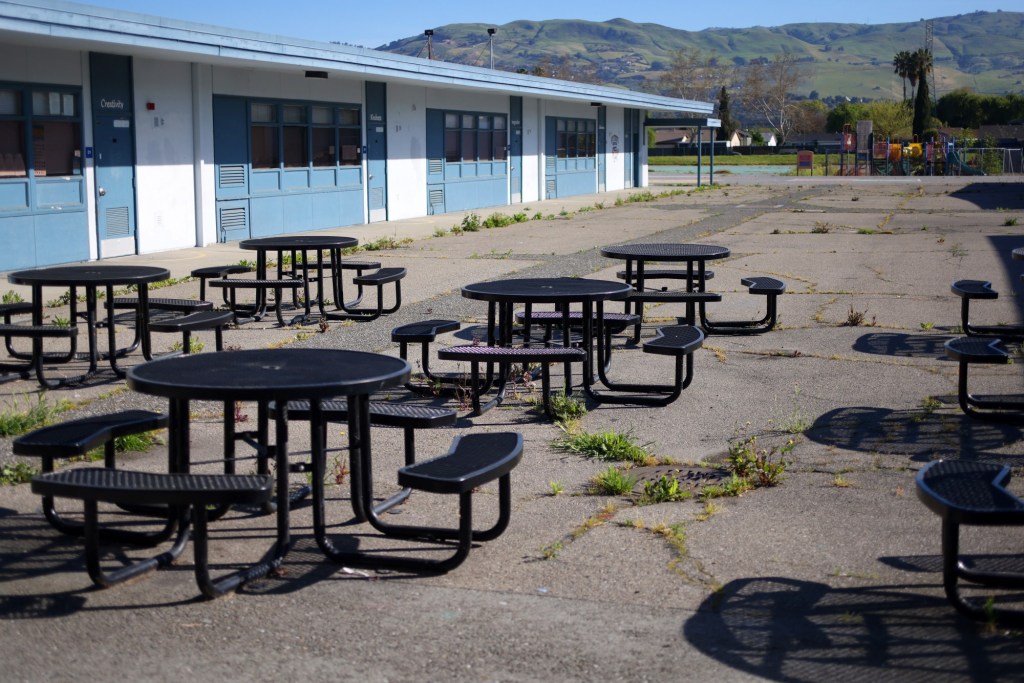
After the state signaled it would not overhaul how schools are funded, districts across the Bay Area warned that failure to address school budget shortfalls will do irreparable harm to students.
They urged state leaders to reject a controversial proposal by Gov. Gavin Newsom which would withhold $5.6 billion in constitutionally mandated school funding, and to consider how the rising cost of living in California is affecting its education system.
In a first-of-its-kind coalition, leaders from San Jose, Fremont, Oakland, Antioch, West Contra Costa, San Ramon Valley, San Francisco and Napa districts joined with Los Angeles school officials to sign a formal letter to California’s state elected leaders calling for immediate state intervention to address what they see as major funding issues facing public schools across the state.
“We face common fiscal challenges,” the districts’ school board members said. “These cannot be fixed only at the local level because they are caused by systemic misalignments at the state level. In the 4th largest economy in the world, it is unacceptable that the proposed budget is balanced on the backs of children.”
The school board members said that while there have been significant increases in school funding in recent years — Newsom’s latest budget proposal would increase overall education spending by more than $10 billion for the 2026-27 state budget — those increases fall short of meeting the needs of students and the costs of operating schools.
At the same time, Newsom has proposed deferring funding guaranteed under Proposition 98, the 1988 ballot measure that requires roughly 40 percent of the state’s general fund go to K-12 schools and community colleges. It’s the second time Newsom has attempted to defer school funding due to state budget shortfalls — he proposed withholding $8.8 billion in 2024, which prompted a lawsuit by the California School Boards Association.
But district leaders said the $5.6 billion Newsom plans to withhold represents “tens of millions of dollars” from each of their districts, and “will directly harm our schools and the students they serve as soon as next school year.”
The letter also urged state lawmakers to locally account for the cost of living in each school district across the state to better address increased costs for health and retirement benefits, energy, transportation and general inflation.
School leaders also urged state lawmakers to consider fundamentally changing the way schools are funded.
California is one of seven states that fund schools based on average daily attendance, or how many students are in class each day throughout the year. But while districts must staff and operate schools based on student enrollment, they are only funded for how many students attend class, school leaders said in the letter.
“Since attendance is never 100%, average daily attendance sets our districts up to never be fully funded to serve the students we enroll,” the leaders said.
But California seems poised to pivot away from a shift to enrollment-based funding, after a January report from the Legislative Analyst’s Office found that the shift could have unexpected consequences, including further reducing student attendance and exacerbating learning loss, despite increasing school funding by more than $5 billion.
The letter from district school board members was addressed to legislators heading the education and budget committees, including Sen. John Laird (D-Santa Cruz), Sen. Sasha Renée Pérez (D-Pasadena), Assemblymember Jesse Gabriel (D-Encino) and Assemblymember Darshana Patel (D-San Diego).
It comes as dozens of Bay Area school districts face financial crisis, stemming from rising costs, declining enrollment and a loss of one-time federal funding.
In the last year, several Bay Area school districts have announced layoffs, budget cuts or school closures this year in an effort to repair gaping budget deficits ranging from $6 million to over $100 million — including many of the districts that signed the joint letter.
In February, Oakland Unified School District voted to lay off more than 400 staff to address a $100 million budget deficit, while the West Contra Costa Unified School District approved nearly 200 staff layoffs and the merger of two schools to address its $87 million budget deficit.
East Side Union High School District also moved to cut 85 staff positions earlier this year, as the district faces a $25 million budget deficit.
The San Ramon Valley Unified School District said it has implemented more than $37.5 million in “painful budget cuts” over the last three years to address “volatile state funding.”
San Jose Unified school board member Brian Wheatly also signed the letter. The district recently approved a plan to close five elementary schools and relocate another due to declining enrollment. The district has repeatedly stated that the school closures are not in response to financial distress.
“I am in full support of school district leaders across the Bay Area urging state lawmakers to protect and reform California’s public school funding,” Wheatley said. “Despite being the fourth largest economy in the world, California continues to fund its public schools in the bottom 10 states in the nation. It is a political choice, not an economic decision. Our students are our future. Now is the time to make a change for the better.”