
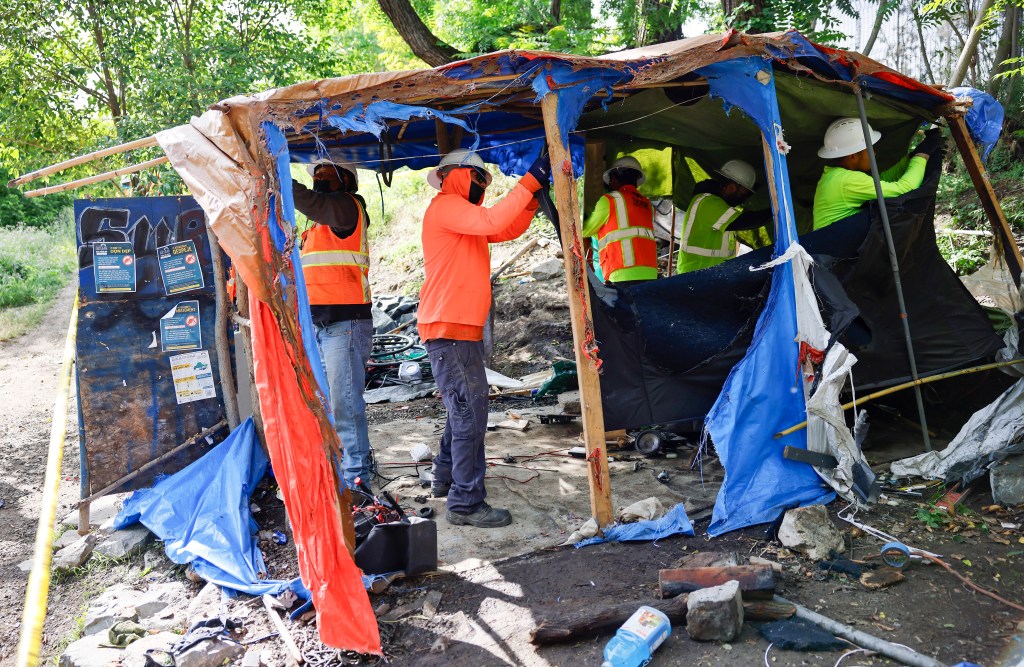
A makeshift shelter of wood and tarps crashed down the embankment of Coyote Creek, one of dozens demolished by work crews Wednesday as the city of San Jose began tearing down the Jungle, the last major homeless camp in city limits.
Nearby, three men scrambled across a makeshift footbridge over the creek, hauling away crates of belongings before the demolition crew arrived.
About 100 people had lived in the Jungle, off the beaten path and largely hidden from view beneath a forest canopy. While San Jose Mayor Matt Mahan and city officials cracked down on homelessness in other parts of the city, they allowed the community to persist.
No longer. In San Jose, leaders say they’re removing the camp to help restore water quality in Coyote Creek, an important waterway in Silicon Valley polluted by the encampment and other sources. It’s the culmination of Mahan’s strategy to break up encampments, direct residents to the city’s expanded shelter network and prevent their return. He’s a champion of that tougher approach in the Bay Area, where other cities are following suit.
At the Jungle, outreach workers have canvassed the camp for weeks to warn residents of the impending sweep and to sign them up for slots at tiny homes or motels. After every resident is moved — willingly or forcibly — police and city staff will patrol the site to prevent people from returning. After that, it could take months more to clean the site, a steep, muddy riparian zone filled with trash and waste.
The clean-up began with less drama than the last major operation in the Jungle, in 2014. Then, residents and nonprofit staff were so overwhelmed by human suffering that they wept, and protesters gathered to condemn the sweep. City officials placed some residents in permanent housing, but others were given vouchers and dispersed throughout San Jose.
Vanessa Butera, now San Jose’s acting division manager for homelessness response, remembers the misery that day. She worked for a homeless service provider at the time.
“It was cold, rainy, wet. People were distraught. There was not a lot of organization. People were scattered and not sure what they were going to do,” she said.
Now, Butera said, “This has gotten much more organized and methodical about where we place people, what we offer people.”
On Wednesday, most residents said they were destined to move into a new tiny home village in north San Jose, the city’s newest shelter option. But not everyone.
While some residents sat and waited for transportation to their tiny homes, Martin Nava stood heartbroken at a friend’s shelter.
Outreach staff had promised him a tiny home, and he had already given away everything “but the clothes on my back,” Nava said. Then, they mixed up his paperwork, he said.
Two outreach staffers with PATH, a nonprofit service provider, trundled down the dirt road in an SUV. They saw Nava and briefly apologized.
“I’m really sorry that happened to you,” one said, adding that she’d work to find him a temporary home at a motel.
“But I can’t make any guarantees,” she said, before driving away.
That obliterated any trust Nava had left. He had no plan, no income, no place to go, and no hope, he said.
“That’s why I don’t depend on nobody,” he said. “That’s why I don’t trust nobody. Because of this shit.”
His thoughts turned dark.
“They’re putting me back on the streets,” Nava added. “I can terrorize the streets and be a really terrible person. I don’t want to do that anymore.”
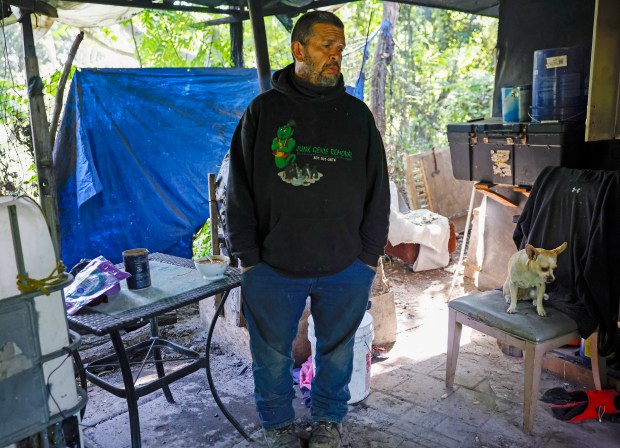 Martin Nava talks about his living situation in a friends structure in the homeless encampment known as the Jungle in San Jose, Calif., on Wednesday, April 15, 2026. (Nhat V. Meyer/Bay Area News Group)
About 30 other residents had already moved to the tiny home site as of Tuesday afternoon, said San Jose Housing Director Erik Soliván. In February, outreach workers wrote a list of 109 residents and offered them shelter. As of Tuesday, all had accepted, Soliván said.
But he acknowledged the concerns of advocates, who said not everyone had been offered shelter.
“At the moment, we don’t have beds for the thousands of other people who could potentially come to the site,” Soliván said.
Pedro Reyes, who lived in the Jungle for about a year, said he was offered a tiny home, which he visited on Tuesday. He said it lived up to its name as he picked through his old home, a plywood structure at the creek’s edge.
“The rooms are hella small,” he said.
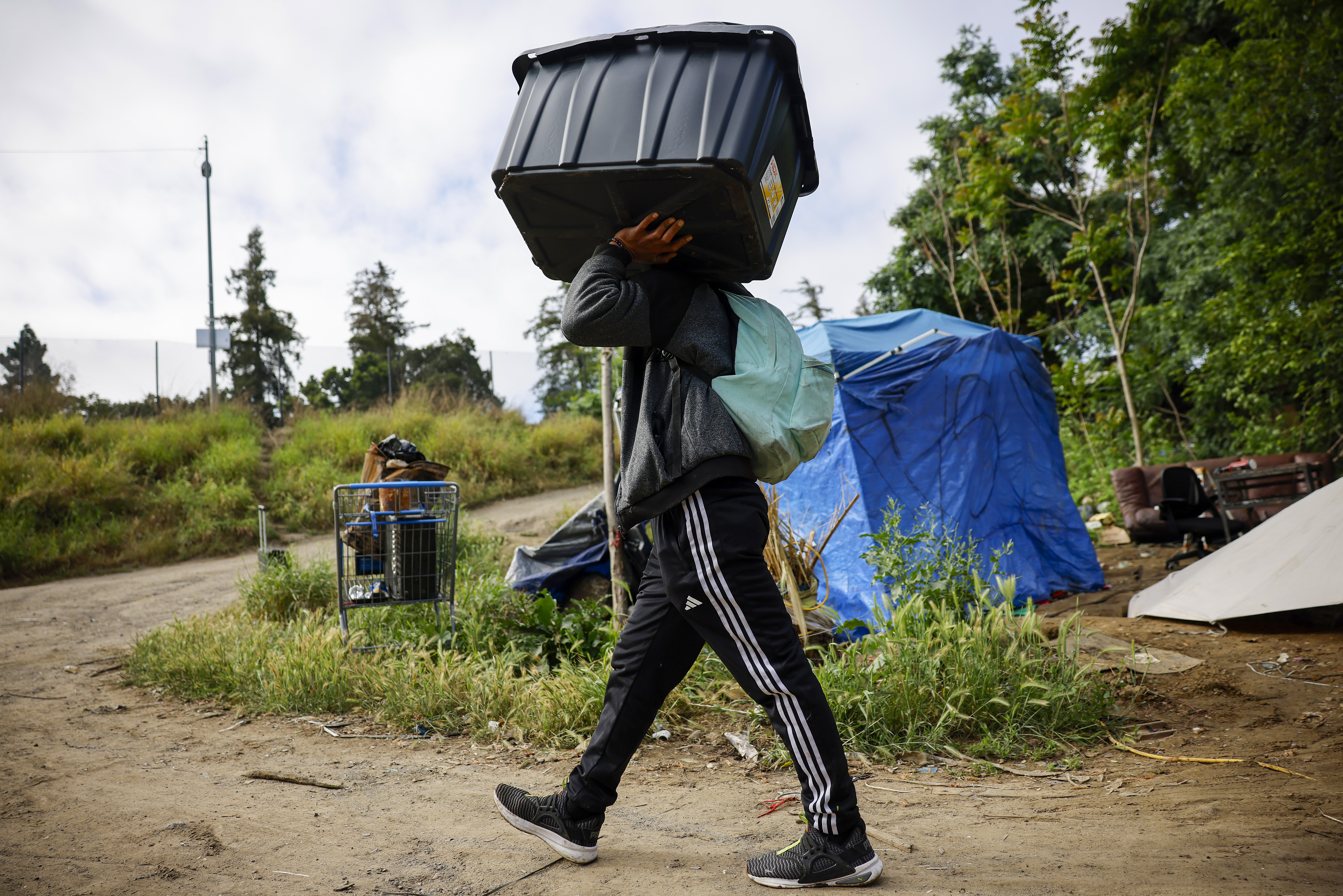
A man carries a bin of items out of the homeless encampment known as the Jungle in San Jose, Calif., on Wednesday, April 15, 2026. (Nhat V. Meyer/Bay Area News Group)

Workers from Tucker Construction clear campsites in the homeless encampment known as the Jungle in San Jose, Calif., on Wednesday, April 15, 2026. (Nhat V. Meyer/Bay Area News Group)

Workers from Tucker Construction clear campsites in the homeless encampment known as the Jungle in San Jose, Calif., on Wednesday, April 15, 2026. (Nhat V. Meyer/Bay Area News Group)
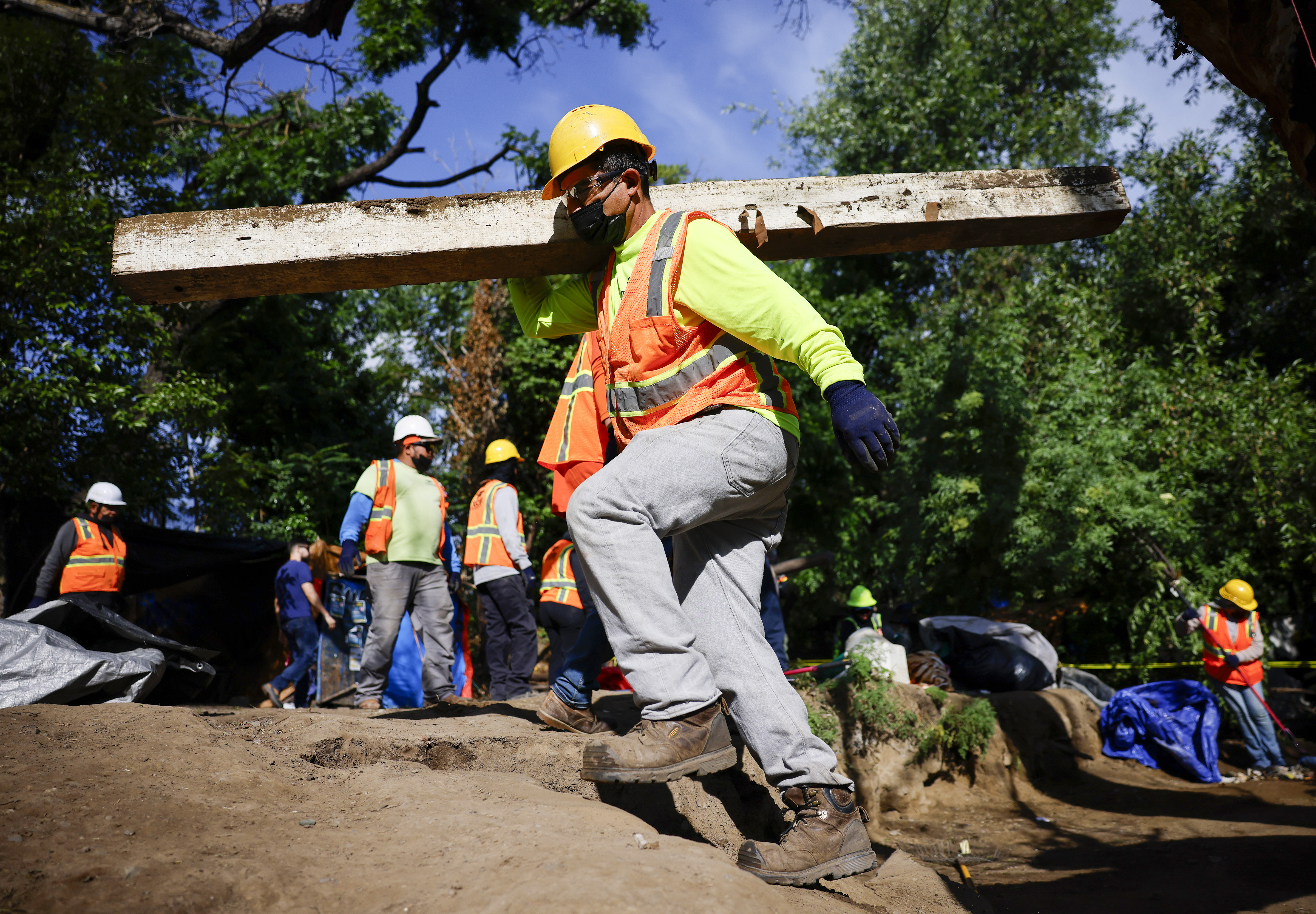
Workers from Tucker Construction clear campsites in the homeless encampment known as the Jungle in San Jose, Calif., on Wednesday, April 15, 2026. (Nhat V. Meyer/Bay Area News Group)
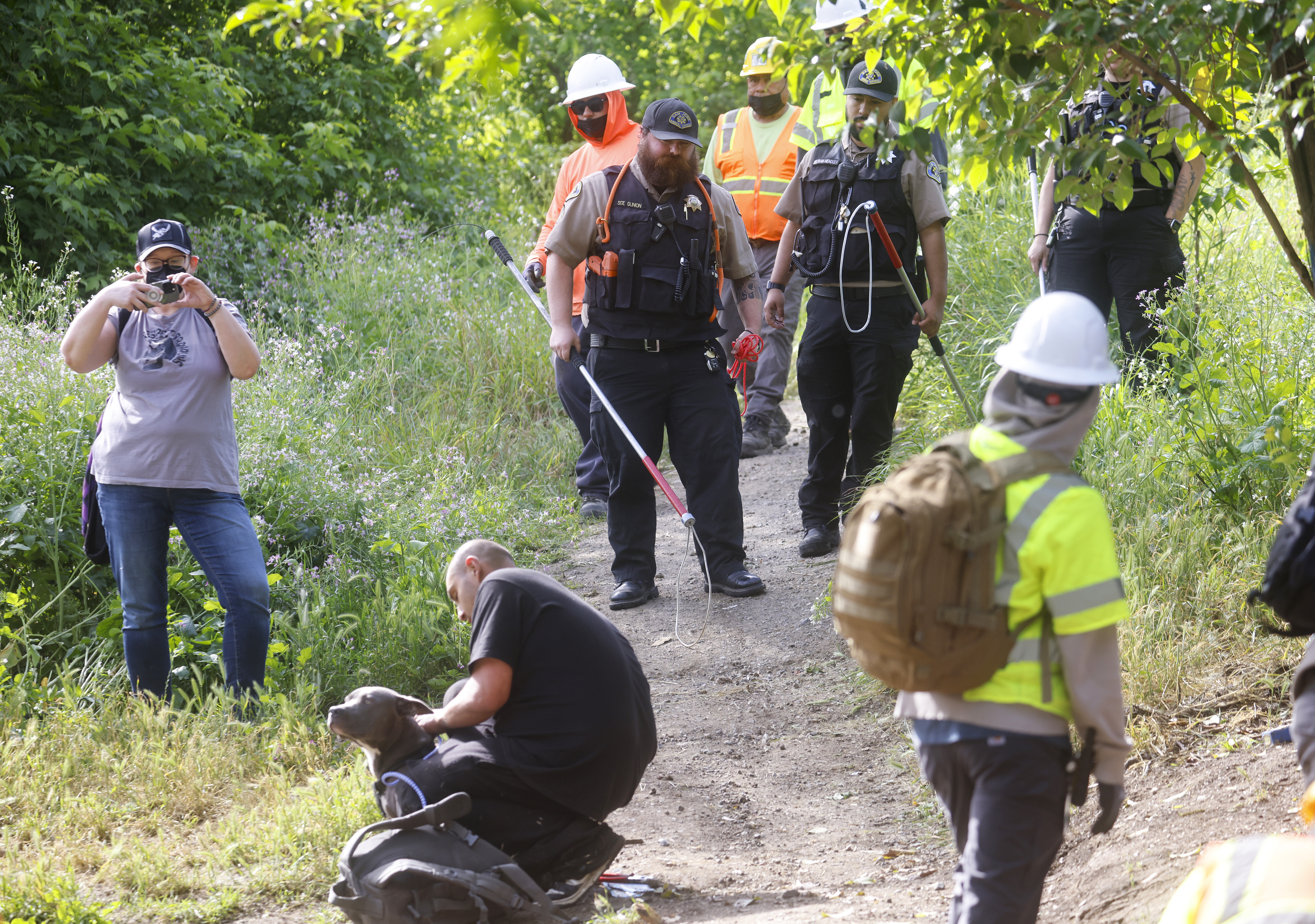
San Jose Animal Care & Services workers keep an eye on a dog as campsites are cleared in the homeless encampment known as the Jungle in San Jose, Calif., on Wednesday, April 15, 2026. (Nhat V. Meyer/Bay Area News Group)
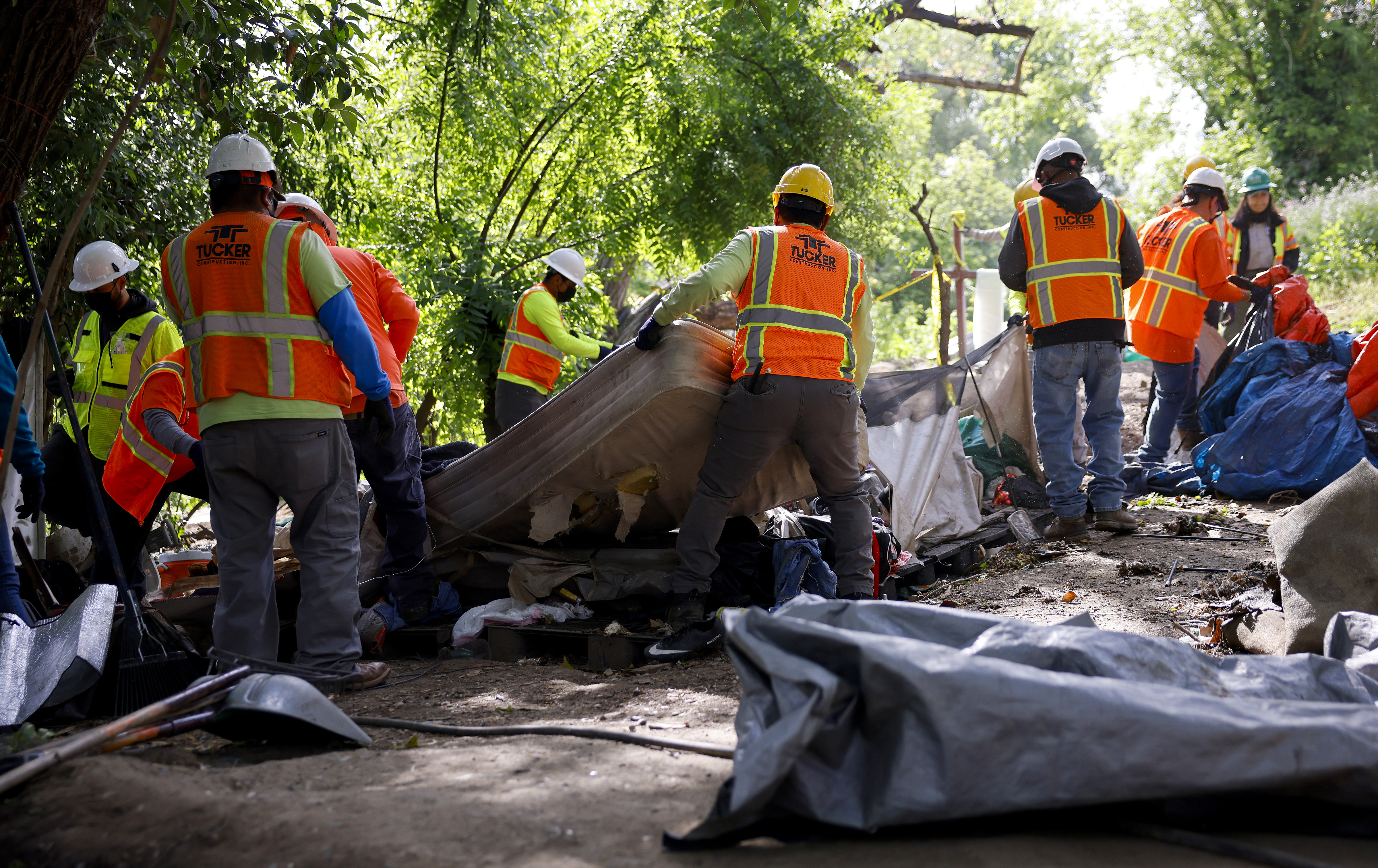
Workers from Tucker Construction clear campsites in the homeless encampment known as the Jungle in San Jose, Calif., on Wednesday, April 15, 2026. (Nhat V. Meyer/Bay Area News Group)
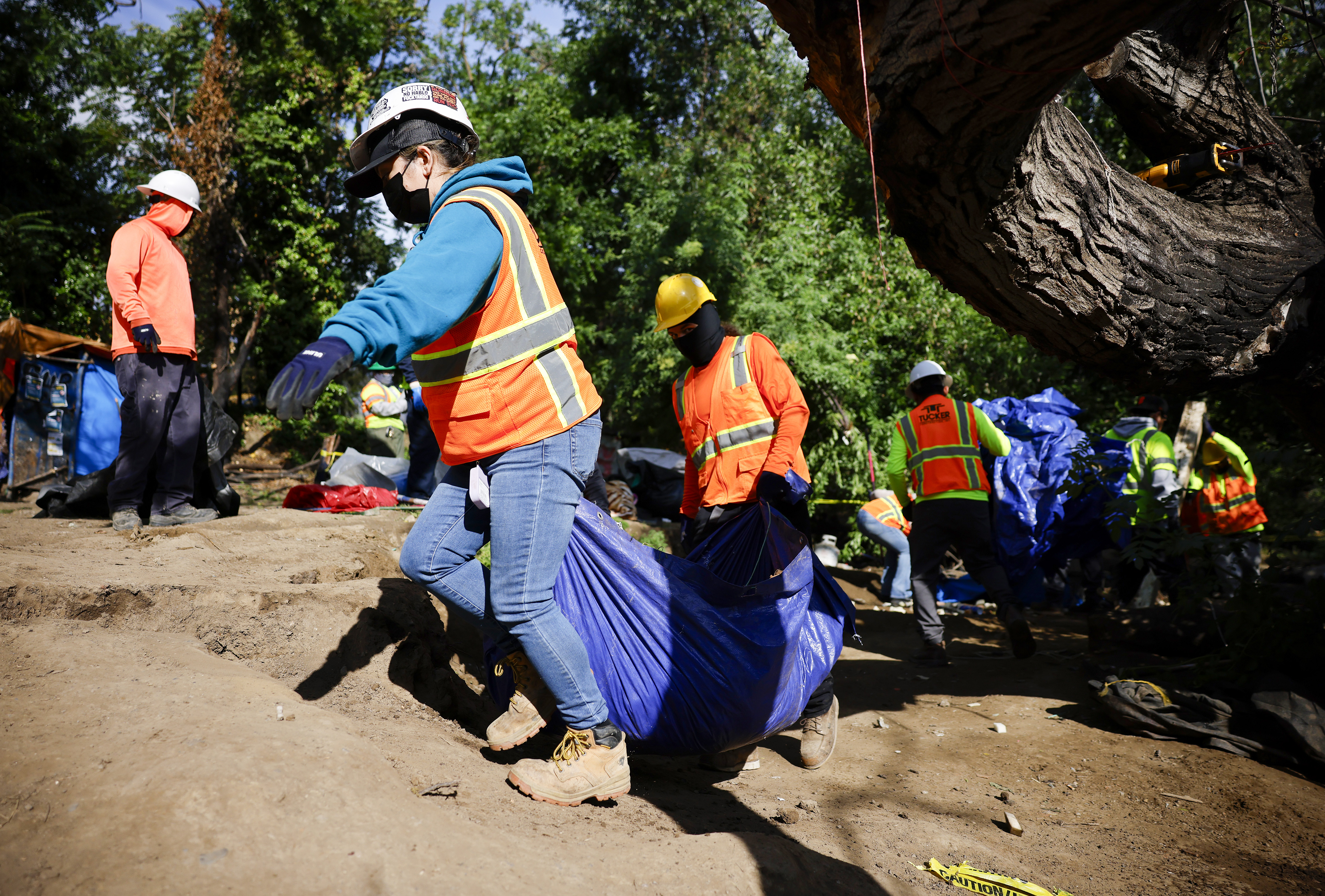
Workers from Tucker Construction clear campsites in the homeless encampment known as the Jungle in San Jose, Calif., on Wednesday, April 15, 2026. (Nhat V. Meyer/Bay Area News Group)
Show Caption
1 of 7
A man carries a bin of items out of the homeless encampment known as the Jungle in San Jose, Calif., on Wednesday, April 15, 2026. (Nhat V. Meyer/Bay Area News Group)
City crews had not yet arrived to demolish his old dwelling. He summed up the scene matter-of-factly.
“People aren’t upset,” he said. “We have to move. It’s an obligation.”
Many residents interviewed by this news organization consider the tiny homes a downgrade, and none were thrilled with the forced migration there. At the tiny home site, residents will live in close proximity, use shared bathrooms, and have to abide by community rules. They will have much less space and likely less privacy. In the Jungle, people tend to live privately in wide lots, shaded by trees, in homes of salvaged wood and tarps.
As the sweep unfolded, dozens of laborers moved methodically through the forest’s steep and muddy terrain. They tore and chainsawed structures into heaps, then collected their remains in tarps and truckbeds. Many of the workers clad in hard hats and yellow vests were contractors working for Tucker Construction.
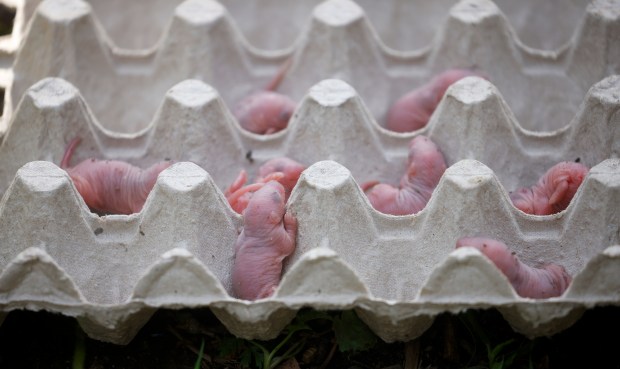 Newly-born rats lay in an egg carton in the homeless encampment known as the Jungle in San Jose, Calif., on Wednesday, April 15, 2026. A San Jose Animal Care & Services worker took the animals. (Nhat V. Meyer/Bay Area News Group)
Their task is gargantuan. The site has whole hillsides of trash. In one, an empty egg crate was filled with newborn rats.
Unhoused residents rounded up their missing animals. Two or three pets will be allowed in the tiny homes, Soliván said. Cats meowed in travel crates. Badged animal control agents hunted for strays with catch poles, and chickens roamed freely.
For Nava and others promised no shelter, officials are adamant they won’t be able to return to this swath of Coyote Creek.
On Wednesday morning, officials added the Jungle to San Jose’s list of no-camping zones, alongside 20 others. Police plan to patrol the densely wooded area, along with outreach workers and city staff, to prevent anyone from moving back.