
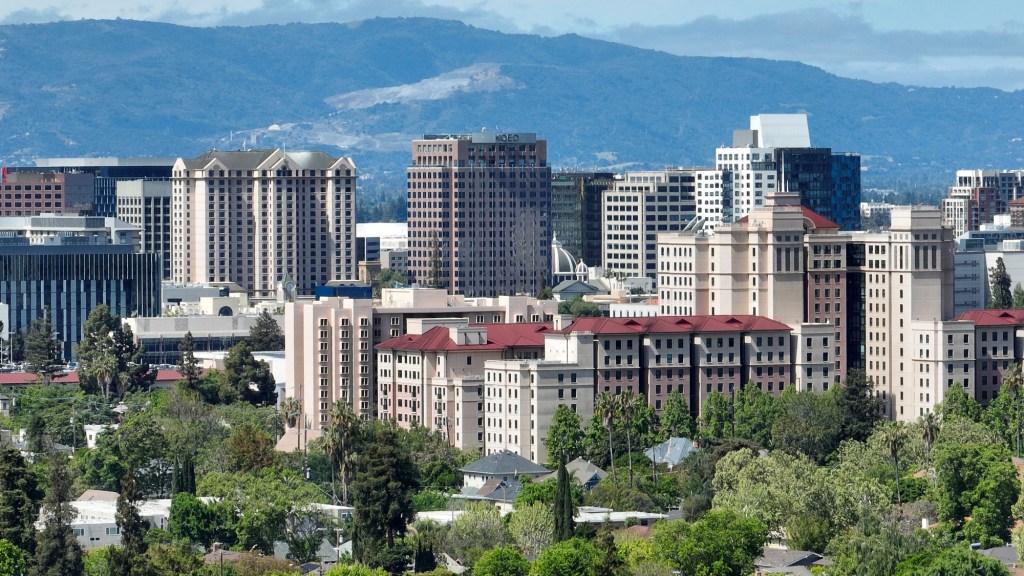
Despite a burst of recent high-profile tech leases in Silicon Valley, downtowns in the Bay Area’s three largest cities continue to be plagued by high vacancy rates, a new report shows.
More than 30% of commercial space in the central business districts of San Jose, Oakland and San Francisco is still sitting empty, according to the report by commercial real estate firm Cushman & Wakefield.
It’s the latest sign that the post-pandemic recovery of the Bay Area’s urban centers has not materialized in the way that many experts anticipated.
“The return to office seems to be stalled,” said Mark Ritchie, president of San Jose-based real estate firm Ritchie Commercial. “Companies are not rushing to get everybody back into the office.”
At the end of the January-through-March first quarter of 2026, the office vacancy rate was 30.8% in downtown San Jose, 31.1% in San Francisco, and 37.8% in downtown Oakland, Cushman & Wakefield reported. A year ago in the same quarter, the office vacancy rate was 31% in downtown San Jose, 32.8% in San Francisco, and 34.2% in downtown Oakland, statistics that Cushman & Wakefield provided to this news organization show.
“We have to come to terms with the reality that we have an endemic office vacancy in these three downtowns,” said Ritchie. “The only good news is no one is constructing new office buildings.”
Prior to the COVID-19 pandemic, in the October-through-December fourth quarter of 2019, San Francisco had a 5.4% vacancy rate, downtown Oakland was at 10.8%, and downtown San Jose at 12.8%.
For downtown San Jose, the major challenge for commercial landlords has been to find a way to compete with mixed-use neighborhoods such as Santana Row in West San Jose and Cityline in downtown Sunnyvale, both which offer significant amenities in the form of restaurants and retail stores.
Downtown San Jose offers top-notch restaurants, nightlife, unique entertainment hubs and live-performance venues, but not nearly as much destination retail as its nearby rivals.
“Downtown San Jose definitely has more competition from other submarkets than is the case with the San Francisco central business district,” Robert Sammons, a senior research director with Cushman & Wakefield, said. “San Jose is not really a 24/7 downtown. It is more of an 18/7 downtown.”
However, the city’s fortunes could be buoyed by a recent decision to market the office tower at 200 Park Ave. to tenants willing to take as few as one or two floors in the 19-story building.
Previously, building owner Jay Paul Co. and its marketing team from commercial real estate firm Newmark had focused on convincing one tenant to lease the entire building, which totals 971,000 square feet of office space.
“This move might cast the net wider,” Sammons said. “There are usually more small tenants in the market than large tenants. This could spur more activity in downtown San Jose.”
In a conference call with Wall Street analysts in February, executives with the principal developer of Santana Row said the new One Santana office building was fully leased.
“One Santana is 100% committed,” Daniel Guglielmone, Federal Realty’s chief financial officer, said during the conference call.
Artificial intelligence tech firms Etched, Securiti.ai, and Couchbase, along with professional services firm PwC U.S. Group, have leased space in the modern office building.
In downtown Sunnyvale, two brand-new office buildings in the Cityline neighborhood are now completely full following lease deals and expansions by artificial intelligence companies Databricks and Crowdstrike.
Cushman & Wakefield’s report notes that the current vacancy levels for San Francisco’s central business district are greatly improved from a recent peak of 33.8% in the July-through-September quarter of 2024.
“San Francisco is making some progress, but San Francisco is improving from a very high vacancy level,” Sammons said. “Leasing activity from artificial intelligence companies has helped.”
A recovery for the San Francisco market might eventually spill over to downtown Oakland.
“Downtown Oakland is lagging behind, but that happens in every cycle,” Sammons said. “When San Francisco improves, Oakland usually follows in about a year or so.”
Despite stubbornly high vacancy levels, Sammons said the trio of urban cores will enjoy healthier occupancy levels in the coming years.
“I’m very bullish on downtowns and on transit-oriented development,” Sammons said. “In the long term, all three will perform very well.”
Even with optimistic prospects, a full recovery could continue to remain elusive, Ritchie warned.
“It’s going to take five years to get the vacancy rates back down to where they were” before the COVID-19 pandemic, Ritchie said.