
SAN JOSE – Sharks coach Ryan Warsofsky addressed his players after the team’s season-ending victory over the Winnipeg Jets on April 16 and thanked them for the way they helped the organization become relevant once again after several down years.
“I didn’t do anything. They were the reasons why we got respect back,” Warsofsky said of the players. “The team will change, as we know, in this business. But I wanted them to know that we appreciate that, whether you’re here or not, you’ll be remembered as one of the guys that helped really get us out of this rebuild and give his team some hope and the respect back in the league.”
The Sharks, in a memorable season, went from finishing last in the NHL standings for two straight years to falling four points short of a playoff spot this spring.
Going into next season, the Sharks look like they have a lot of pieces in place up front and in net, but still have several holes to fill in their defense corps. The rebuild might be nearing completion, but the hardest work is still ahead.
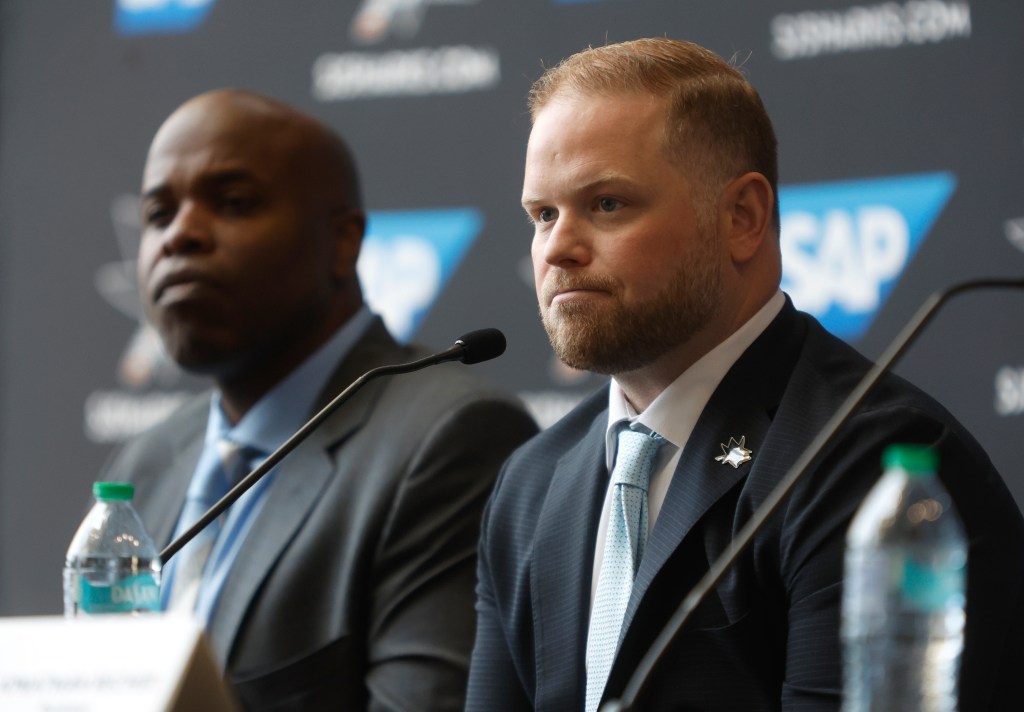
“I think we’re still a long way away from getting to where we want to go,” general manager Mike Grier said. “It’s not just being wild card two and losing in the first round. There’s a bigger prize here that we’re after, so we’re kind of still in the baby steps of that.
“Hopefully, we’re starting to come out of the rebuild and take positive steps forward.”
Here are our grades — relative to expectations –– for players, coaches, and management.
FORWARDS
Macklin Celebrini: Set a new franchise record for points in a season with 115, and overall, did things few teenagers have ever done in the over 100-year history of the NHL. The star pupil who will likely only get better. Grade: A+
Collin Graf: Not only established himself as a full-time NHL player, but one who can play up and down the lineup and be trusted to be on the ice in all situations. Was second on the Sharks with 19 even-strength goals, and third with 21 goals overall. Grade: A.
Alexander Wennberg: Continued to be matched up against the opposition’s top line but, as the Sharks’ second-line center, had his best offensive season in years with 18 goals and 55 points. A pro’s pro. Grade: A
Igor Chernyshov: Looking like a draft day steal at 33rd overall in 2024, Chernyshov not only shone offensively with 19 points in 28 games but is a heady player with strong two-way instincts. Tough to ask for much more from a 20-year-old. Grade: B+
Adam Gaudette: Was sixth on the Sharks with 17 goals despite playing just 66 games and mostly being in a third- or fourth-line role. Was a solid addition. Grade: B
Michael Misa: Had 21 points in 45 games and played his best hockey toward the end of the season, showing he can still positively impact games even when he’s not scoring. Grade: B
Kiefer Sherwood: Didn’t quite produce at the same level with the Sharks as he did in Vancouver, but still led San Jose with an xGF% of 53.55 during 5-on-5 play while providing needed physicality to the top nine group. Grade: B
Will Smith: Was the Sharks’ second-leading scorer with 59 points in 69 games, and when he and Celebrini were at their best, it was magical. Still, Smith was help without a point in 31 games this season, and the Sharks went 8-19-4 in those games. His HDCF%, per Natural Stat Trick, was an unsightly 42.74. Consistency was an issue. Grade: B.
Barclay Goodrow: Played all 82 games and did the things he was expected to do for the Sharks this season: Help form an effective fourth line, kill penalties, be a leader, and drag his teammates into the fight. Grade: B-
Zack Ostapchuk: Established himself as the Sharks’ fourth-line center. Was also a top penalty killer, and proved to be a tremendous skater, and not afraid to drop the gloves. Can he learn to finish more of his chances? Grade: B-
Ryan Reaves: Fell out of favor with the Toronto Maple Leafs last season but was welcomed by the Sharks, who benefited from having him on the roster and in the room. Still one of the toughest customers in the NHL. Grade. B-
Tyler Toffoli: Saw his ice time dip by nearly two minutes per game this season as he became more of a middle-six forward. That cut into his shot total, as he went from 30 goals in 2024-25 to 19 this season. Still had 49 points, just five fewer than last season. Grade: B-.
Ty Dellandrea: Carved out a role as a penalty killer while taking a good percentage of the Sharks’ defensive zone faceoffs before his knee injury in early January. Still, he had an unsightly expected goals for percentage (xGF%) of 38.37. Grade: C+
William Eklund: Experienced a dip in production as he had extended goal-scoring droughts of 19 and 10 games this season. He’s a better two-way player than his team-worst -31 rating would indicate, but his offensive game needs to grow. Grade: C.
Pavol Regenda: Set new NHL career highs in games (24), goals (9), and points (10), but was often a healthy scratch in the second half of the season, squeezed out by the additions of fellow wingers Chernyshov and Sherwood. The Sharks’ coaching staff, too, wanted Regenda to be a more physical presence. Grade: C-
Philipp Kurashev: Had 15 points in 31 games before he was sidelined for close to seven weeks with a lower-body injury. After a 3-2 overtime loss to the St. Louis Blues on March 6, played in just four of the Sharks’ final 22 games, a signal that his time in San Jose is ending: Grade: C-
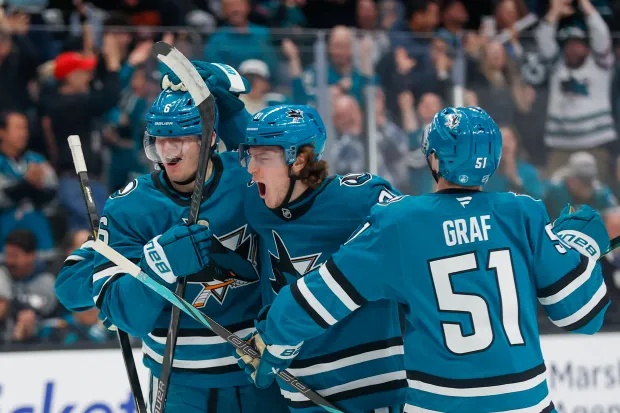 The San Jose Sharks celebrate a goal scored by San Jose Sharks’ Sam Dickinson (6) against the Dallas Stars during the third period at SAP Center in San Jose, Calif., on Saturday, Jan. 10, 2026. (Shae Hammond/Bay Area News Group)
DEFENSEMEN
Vincent Desharnais: Proved to be an effective penalty killer and was playing top-pair minutes at the end of the season. Led all Sharks defensemen with a 50% xGF% during 5-on-5. Re-signing him should be a no-brainer. Grade: B+
Sam Dickinson: Faced nightly challenges as a 19-year-old defenseman in the NHL, and offense was often hard to come by. It was also an adventure for him at times in the defensive zone. Still, there was enough growth from start to finish to say he had a positive season. Grade: B-
Mario Ferraro: Less is more for Ferraro, as he’s a more effective defenseman with a little less ice time on his plate. He still led the Sharks in penalty kill time and blocked shots, and set career highs in games (82), goals (7), and points (23). Grade: B-
Dmitry Orlov: The Sharks’ highest-paid player was also the team’s most-used defenseman in terms of ice time. He played all 82 games and set a new career high with 37 points. Still, he was on the ice for a team-high 72 goals against during 5-on-5 play. Grade: B-
Shakir Mukhamadullin: Through a mix of injuries and healthy scratches, Mukhamadullin only played 50 games this season. Showed some promise as he got more consistent ice time later in the season, but a challenging year, nonetheless. Did he develop enough? Grade: C.
John Klingberg: The season got off to a rocky start with too many mistakes and giveaways as he went on to lose his spot as the quarterback of the top power play unit. Was at his best when he played a simple game and didn’t try to do too much. Had 27 points in 56 games and averaged over 20 minutes in ice time, but the year was a disappointment. Grade. D
Nick Leddy: Had his season derailed by an upper-body injury in October, had trouble getting back into the lineup on a regular basis, and was waived in January. Returned to play a bigger role in March, but it’s tough to call it a successful season. Grade: D
GOALTENDERS
Alex Nedeljkovic: Was brought in to push Yaroslav Askarov, but he ended up being the more consistent goalie in the second half of the season and maybe had his best year overall since 2021-22, when he was with the Detroit Red Wings. He deserved the two-year extension he received in March. Grade: B+.
Yaroslav Askarov: Was brilliant in November as he helped the Sharks erase a brutal start to the season, but had bouts of inconsistency and lost his final four starts behind a spotty defense corps. What version of Askarov were the Sharks going to see on any given night? Still, at just 23 and in his first full NHL season, some turbulence was expected. Grade: B-
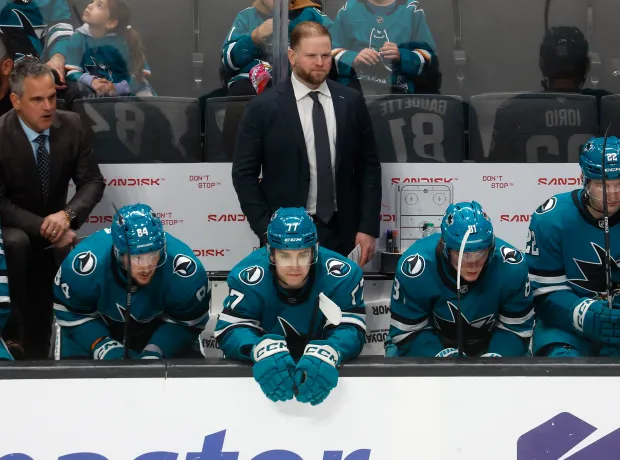 San Jose Sharks head coach Ryan Warsofsky keeps an eye on the game against the Vegas Golden Knights in the second period at the SAP Center in San Jose, Calif., on Sunday, Jan. 11, 2026. (Nhat V. Meyer/Bay Area News Group)
COACHES
Warsofsky was hardly perfect, but he showed some growth in his second season as an NHL head coach, as the Sharks improved from 52 to 86 points, remaining alive for a playoff spot until the final week.
It was a mixed bag year: the Sharks improved from 32nd to 17th in scoring but were 30th in goals allowed. The Sharks also ranked 16th on the power play and 26th on the penalty kill. Some lineup decisions were head-scratchers, but there was a mandate to try to develop the young guys as much as possible, and Warsofsky gave them a longer leash.
The expectations will be higher next season, and Warsofsky and his staff will face greater scrutiny. Grade: B-
MANAGEMENT
After a three-year teardown, Grier spent last offseason rebuilding the roster. Some moves were better than others, as the acquisitions of Orlov, Gaudette, Nedeljkovic, Sherwood, and Reaves were generally positive, while bringing in Klingberg, Kurashev, and Jeff Skinner didn’t work out, even with Klingberg and Skinner being placeholders.
Re-signing Wennberg, considering the lack of quality centermen in free agency, to a reasonable three-year, $18 million deal was a savvy move. Eklund’s deal, which begins next season, also will not break the bank. Inking Dellandrea to a two-year, $3.25 million extension was a low-risk signing, although it raises questions as to whether any roster spots will be up for grabs for Barracuda players during training camp in the fall.
Grier took a conservative approach to the trade deadline, only sending out defenseman Timothy Liljegren while keeping his other pending unrestricted free agents. Perhaps, more than anything, that was an indication of the lack of quality offers.
Grier’s next task this summer is improving his defense corps and signing Celebrini and Smith to extensions. Grade: B+