
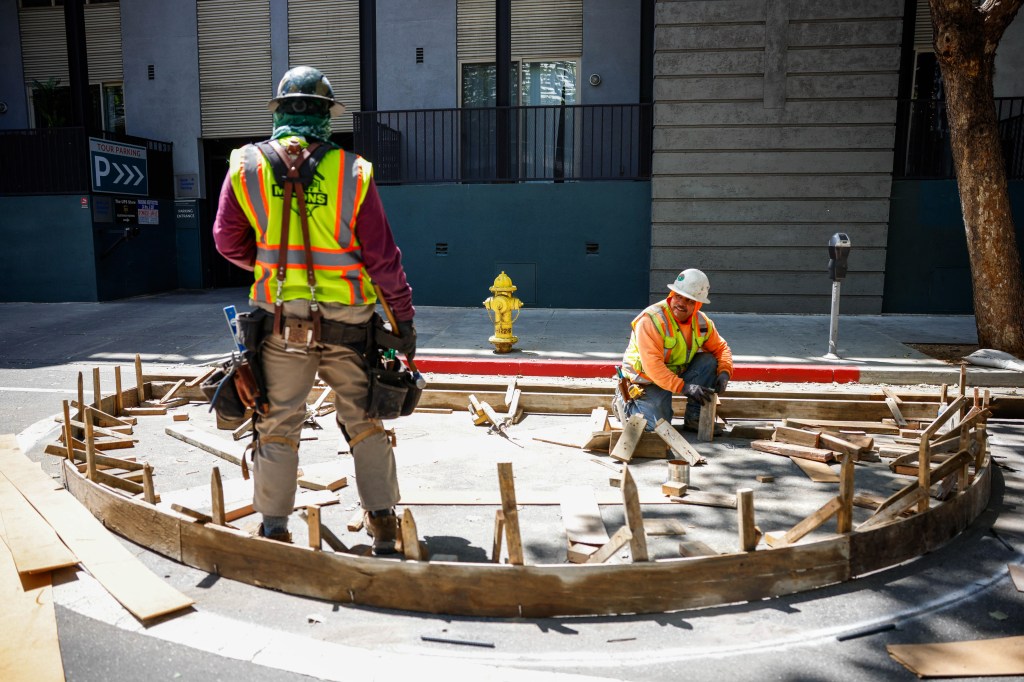
SAN JOSE — The city is moving forward with the next phase of a project started in 2018 to improve safety for bicycle riders, installing long, raised concrete platforms along the city’s bike lanes to replace the plastic bollards that stood there before.
The new installations are part of the second phase of San Jose’s Better Bikeways project, aiming to create and enhance a system of bike lanes running throughout downtown, said Colin Heyne, public information manager for the city’s Department of Transportation. Many of these lanes were installed throughout the city in phase one of the plan, which began in 2018, and are now undergoing improvements — from the concrete installations to implementing frontage lanes.
“We’re doing what we’ve told the public we were going to do all along,” Heyne said. “The whole time we told the public, these (bollards) are temporary. … These are not going to last forever. They will let us put down these more ambitious bike lanes, see how it works, see if it causes confusion and calamity on the streets, see how safe it makes things, and then once we’re happy with the designs, we will start upgrading them to more permanent infrastructure.”
On Tuesday afternoon, several bicyclists riding through the intersection of Santa Clara Street and Third Street, the site of some of the new concrete installations, rode in the bike lanes, though just as many rode on the sidewalk or in the street. Orange cones still lined the barriers, which have hexagonal pavers laid on the interior section.
David Lopez, a 52-year-old resident of San Jose, rides his bike downtown every day, both for transportation and for exercise, and often with his dog Jimmy strapped in a carrier on his back, he said. Lopez was previously struck by a vehicle while riding his bike in a crosswalk on 10th Street and could not find his dog for five hours after the collision.
Lopez said he thinks that the bike lanes are a good addition — and that they may help prevent other incidents like his.
“A lot of drivers should be more careful, too, and cautious for people who are biking out here,” he said.
Lopez specifically chose to ride on Third Street so he could use the protected bike lane.
“It’s like the bikes have their own car lane,” he said.
Minh Vu, a 73-year-old resident of San Jose, said that the addition of concrete barriers along the bike lane makes him feel safer on his rides — but noted that come with new issues, as well.
“It’s a little bit safer but it’s causing traffic jams,” he said.
The concrete barriers provide several benefits over the plastic bollards, Heyne said. Though bollards allow the city to build quickly, they can be an eyesore — and they do not block cars from easily driving or parking over them. The bollards also accumulate debris and will eventually break if cars continue driving over them, he added.
“The changes we’re making now are … for the most part, just solidifying those street designs that were made back then,” Heyne said.
Construction for the second phase of the plan began in late 2025, said Scott Karoly, who works for DOT’s bike team.
This downtown section of this phase aims to enhance existing bike lanes, primarily though upgrading the plastic bollards to permanent concrete installations, according to the city’s outline of the Better Bike Plan. The concrete barriers will be installed on Third and Fourth streets between Julian and Reed streets, on San Salvador Street from Fourth to Eighth streets and on the bikeway connecting the Berryessa BART station with Taylor and Mabury roads, city officials said. The city is also installing frontage lanes on Second and Third streets.
City workers will also install the concrete barriers on San Fernando Street from Almaden Boulevard to 11th Street. That project also includes alterations to traffic signals to be more conveniently timed for bikers and the installation of protected intersections. Construction for this section is set to begin soon and will last through February 2027, Karoly said.
The third section of the project will upgrade bike lanes on 10th and 11th streets through the installation of bikeway frontage lanes and protected bikeways.
Though these projects are all funded by separate grants, the city is treating them as “one big improvement for the public,” Heyne added.
The first phase of Better Bikeways implemented several miles of protected bikeways installed downtown, Heyne said, largely beginning with lanes separated from the street by plastic bollards in a “quick build approach.” That allowed the project to make it to the streets more quickly — in about 18 months from conception to installation — than if it followed the timeline of a typical capital improvement project.
The project supports goals outlined in several city initiatives, including the Better Bike Plan 2025, Vision Zero San Jose, Climate Smart San Jose, Envision San Jose 2040 General Plan and Move San Jose. Vision Zero aims to eliminate all fatal and severe injury collisions in the city; within that category, pedestrians are the most vulnerable user and bicyclists are the second most vulnerable user, Heyne said.
“This is really where we’re concentrating that approach in downtown because we have a street network that is built like a grid because it’s the old part of the city,” Heyne added. “Because it’s full of destinations and origins and people, it’s the place that really makes sense for us to focus this kind of ambitious bike infrastructure and try to meet those goals.”