
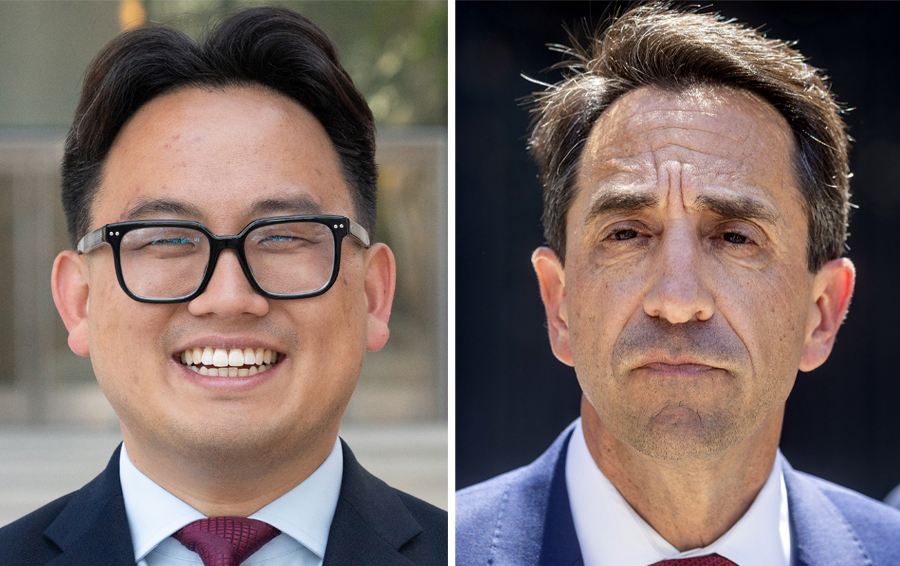
SAN JOSE — In the race for Santa Clara County district attorney, incumbent District Attorney Jeff Rosen‘s quest for a fifth term is once again being challenged by Daniel Chung — a prosecutor he employs but has barred from working — and who has turned their personal clash into both litigation fuel and a second run to unseat his boss, citing differences in leadership style.
Rosen touts 30 years of prosecutor experience, more than half of them running the largest district attorney’s office in Northern California. The office under him has become a state leader with red-flag laws meant to temporarily disarm people who have exhibited threatening behavior and prevent mass shootings.
He is also part of a movement of prosecutors seeking murder charges against reputed fentanyl dealers linked to fatal overdoses, and parents — or perhaps child-welfare officials in the near future — whose neglect is alleged to have caused a child’s death.
“My feeling every morning when I get up is, ‘What can I do to make crime even lower, to help crime victims, to make the criminal justice system more fair,’” Rosen said in an interview. “It’s been the honor of my lifetime to have the opportunity to do that for this community.”
Chung, a Bay Area native and two-time Ivy League graduate, was once a rising attorney in Rosen’s office who fell out of favor not long after he wrote a 2021 op-ed in The Mercury News criticizing criminal justice reforms for diluting public safety, bypassing and angering his chain of command.
That spurred an ongoing legal battle that has now encompassed years of civil litigation and two terminations. Arbitration rulings have kept Chung on the payroll, but Rosen has barred him from working in the office.
Facing a veteran incumbent co-signed by much of the South Bay’s political might, Chung has sought to make the June primary a referendum on his boss and galvanize his critics.
Chung’s second run at the office was partly seeded in the June 2022 primary election — which Rosen won outright — when he unexpectedly placed second in a three-person race that included a well-backed deputy public defender positioned as Rosen’s main foil.
“We are on track to just continually meeting with our community and making sure that their voices are heard and that they feel seen, represented, and actually respected in this process as well, rather than just steamrolled as, oh, the incumbent is getting another four-year term,” Chung said.
In this electoral rematch, Chung says his work status and unplanned political career are an indictment of Rosen’s leadership.
“Instead of calling out defendants’ bad behaviors, I’m calling out prosecutors’ bad behaviors. When I see (Rosen) in public, he avoids me like I’m a ghost,” he said. “It’s just embarrassing and shocking. And that kind of image is just seared into my mind, of how dysfunctional that office is right now.”
Rosen sees the prospect of Chung returning to work as a serious problem.
“It would be dangerous to the public to give him the enormous power to prosecute crimes. … This person does not have the judgment or the temperament to prosecute cases,” Rosen said of Chung. “He can get a job someplace else. He’s choosing to do this.”
Chung is unmoved: “It’s a fight worth fighting. I could always go away to another prosecutor’s office, but for me, this is the community I care about.”
Some of the more contentious issues that have recently faced the DA’s office offer a glimpse into Rosen’s priorities and how Chung is trying to find cracks to win over voters.
Rosen sparked controversy by prosecuting a group of pro-Palestinian activists who two years ago commandeered executive offices at Stanford University to demand the school divest from entities that support Israeli military actions. Five of the original 12 defendants opted for trial to fight felony vandalism and conspiracy charges, leading to a mistrial in which jurors deadlocked 9-3 and 8-4 in favor of guilt, with a retrial pending.
Chung has pointed to the case as a political prosecution conducted at the cost of an impacted caseload of lesser-profile crimes that have languished in the courts.
The case is one of the most serious criminal prosecutions in the country involving college civil disobedience over the Gaza conflict. Rosen says he is strictly seeking accountability for the estimated hundreds of thousands of dollars in property damage.
“To walk away from the case at this point … would be me giving in to a small number of loud voices,” he said. “I’m not looking to send somebody to prison … what you should do is accept responsibility for what you did, apologize for it, and make restitution.”
Chung says the case is emblematic of Rosen’s leadership: “Is Jeff more interested in winning political battles right now?” he said. “If his mind is really focused on victims in the community, I don’t think his prosecution priorities would be the way they are right now, and the zeal that he is using in some of these cases is very unfair and inconsistent.”
Rosen has also roiled a small but loud opposing force with his landmark policy decision to resentence about a dozen condemned men, convicted of some of the most heinous killings in county history, off death row to life-without-parole terms. He has said the initiative reflected a change in philosophy inspired by historical racial injustice and a state moratorium regarding capital punishment.
Last month, Erik Chatman, initially condemned for stabbing Rosellina LoBue 51 times in a San Jose photo kiosk in 1987, was further resentenced from life to a 25-year prison term and immediate parole eligibility. That followed prosecutors’ second attempt to head off a potential retrial, stemming from claims of racially prejudicial characterizations made during Chatman’s original 1993 trial.
That outcome left LoBue’s surviving brother and sister apoplectic and calling for Rosen’s ouster. They are supporting Chung’s campaign, as is Libby Williams Allen, whose husband Buddy Williams was killed by Richard Wade Farley in the notorious 1988 ESL mass shooting in Sunnyvale.
Farley is the sole South Bay death row inmate who agreed to resentencing but was denied by a judge. Allen said her experience fighting the effort, and standing with families like the LoBues, have her aggressively opposing Rosen’s reelection.
“He’s removed the worst killers, the worst murderers from death row where they belonged. Why is he aiding and abetting murderers, the vicious ones?” Allen said. “I would like to know where the adults are. Where are they? … There won’t be any sort of consequence of any kind.”
Again, Rosen is steadfast, voicing sympathy for the victims’ families but pointing to the larger objective.
“The pain of a victim’s family cannot be the only factor that the district attorney looks at, because then I’m not doing my job,” he said. “I respect their grief. I respect their feelings, but I need to do what’s right by the whole community. And I think that’s what I’m trying to do here.”
His office is currently awaiting a decision on whether the California Supreme Court will review the reversed kidnapping and murder convictions of Antolin Garcia Torres in the infamous disappearance of Sierra LaMar in 2012. An appellate court found that the bundling of her presumed death — Sierra’s remains have never been recovered — with previous attempted kidnapping claims against Garcia Torres unfairly tilted a jury.
“I think the case was tried appropriately,” he said. “If the Supreme Court or the appellate court says no … we’ll do it again in a different way to make sure that Garcia Torres is held fully accountable and never gets out of prison.”
Rosen is quick to assert that as high-profile as some of the more fraught cases have been, they are relative outliers in his office’s larger body of work.
“These are … examples of more than a couple thousand trials we’ve had in the last 10 years. I wish nothing was overturned,” Rosen said. “What I wish for even more is that the trials were absolutely fair and absolutely appropriate. And if the court thinks they weren’t, then whether I agree or disagree with that, the next time we try it, we’re going to do an even better job.”
Rosen has the backing of the broader political and law enforcement establishment, including most of the Bay Area’s congressional and assembly delegations, San Jose Mayor Matt Mahan, the county’s police and firefighter unions, and four-fifths of the county Board of Supervisors.
Chung is backed by a coalition of progressive figures, including several associated with Asian American rights, minority-led legal equality groups, and a handful of South Bay city council members. His most prominent official endorser is perhaps Sean Allen, a former county correctional officer and president of the San Jose-Silicon Valley NAACP chapter, in his individual capacity.
Allen has said Rosen has not met with his organization in recent memory, and that he is supporting Chung to inject a fresh perspective into a legal system that continues to unjustly criminalize minorities and unhoused people.
“Santa Clara County can do much better in its policing practices as well as its prosecution practices. There’s a price to pay for being one of the safest counties in the country, but it shouldn’t be at the expense of human rights and the civil rights of people who are vulnerable,” Allen said. “I think Daniel recognizes that.
Rosen’s ground-level support includes Claudia Rossi, a South Santa Clara County nurse who has praised the DA’s office support for resources in her area to help crime victims prepare for court closer to where they live. She sees Rosen as a prosecutor who carefully weighs punishment and rehabilitation in his decision-making.
“Having a district attorney that balances all of that is a herculean task,” Rossi said, “but I feel confident that Jeff Rosen is up to that herculean task.”