
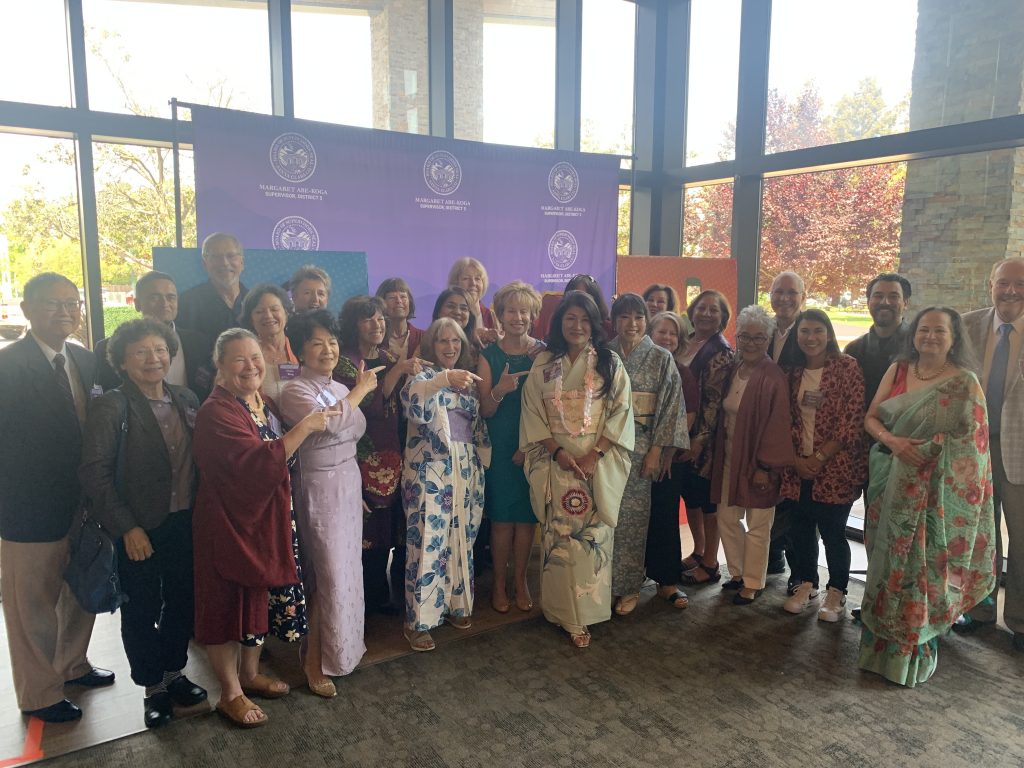
Fresh off the Cupertino Cherry Blossom Festival she helped organize the previous weekend, Alysa Sakkas donned a kimono on May 1 to accept the People’s Flame Award from Santa Clara County Supervisor Margaret Abe-Koga.
Sakkas was one of five residents of Abe-Koga’s District 5 to be honored at an awards luncheon held in celebration of Asian American, Native Hawaiian and Pacific Islander (AANHPI) Heritage Month. While her award recognized her work as president of Cupertino-Toyokawa Sister Cities, Inc., which puts on the annual blossom festival, and as past president of the Cupertino Rotary Club, Sakkas said she couldn’t do it alone.
“Each of us is one small spark, and together we’re able to create something bigger,” she told those assembled for the luncheon at the Mountain View Community Center. “The blossom festival is what that looks like.”
Abe-Koga, who started the awards program last year, is the first Japanese American woman to serve on the Santa Clara County Board of Supervisors and the first Asian American woman to serve as mayor and vice mayor of Mountain View.
Mountain View filmmaker John Kim, who received the Truth Seeker’s Light Award, said seeing Abe-Koga’s photo in the Mountain View Library during her tenure as mayor made an impression.
“There was something enlightening about seeing an Asian American face on the wall,” he recalled. “Seeing her as mayor of our city meant a lot to us.”
Abe-Koga was equally impressed by Kim’s film “Reunion,” which she saw when it screened at the Cinequest Film and Creativity Festival in March. “Reunion” follows Guy (Jake Choi), an Asian American funeral home worker who goes to his high school reunion with the hope of jump-starting his life, only to be mistaken for the most successful alumnus of another school—a mysterious Asian billionaire who no one has seen since graduation.
The supervisor said she found the film “illuminating” and appreciated that Kim avoided tropes in telling Guy’s story.
“When I was growing up, there weren’t many people who looked like us in TV and movies,” she added. “That’s changed.”
Another award recipient expressed concern that recent hate crimes against Asian Americans are a return to form. Connie Young Yu, a fourth generation Chinese American who writes extensively about Asian American issues, is also a trustee of Saratoga’s Hakone Foundation. Her family co-owned Hakone Estate and Gardens in the early 1960s until it was sold to the City of Saratoga in 1966.
Yu’s grandfather came to San Jose in 1881, a year before the Chinese Exclusion Act went into effect, banning Chinese laborers from entering the country for 10 years and prohibiting them from becoming citizens. Her grandfather lived with his uncle in San Jose’s Chinatown until it was destroyed by arsonists in 1887.
“It’s important for people to know about the anti-Asian hate that burned down San Jose’s Chinatown,” said Yu, who received the Guardian of Heritage Award. “We still have freedom of speech. We must continue to speak out and resist.”
The awards luncheon also honored AANHPI community members who work in the health and legal professions. Paul Jhin, who received the Bridge of Justice Award, is the second Asian American appointed as assistant district attorney in Santa Clara County. Dr. Shashank Joshi, associate professor of psychiatry, pediatrics and education at Stanford University and director of school mental health at Lucile Packard Children’s Hospital, was given the Healer’s Heart Award for his work in mental health promotion and suicide prevention.