
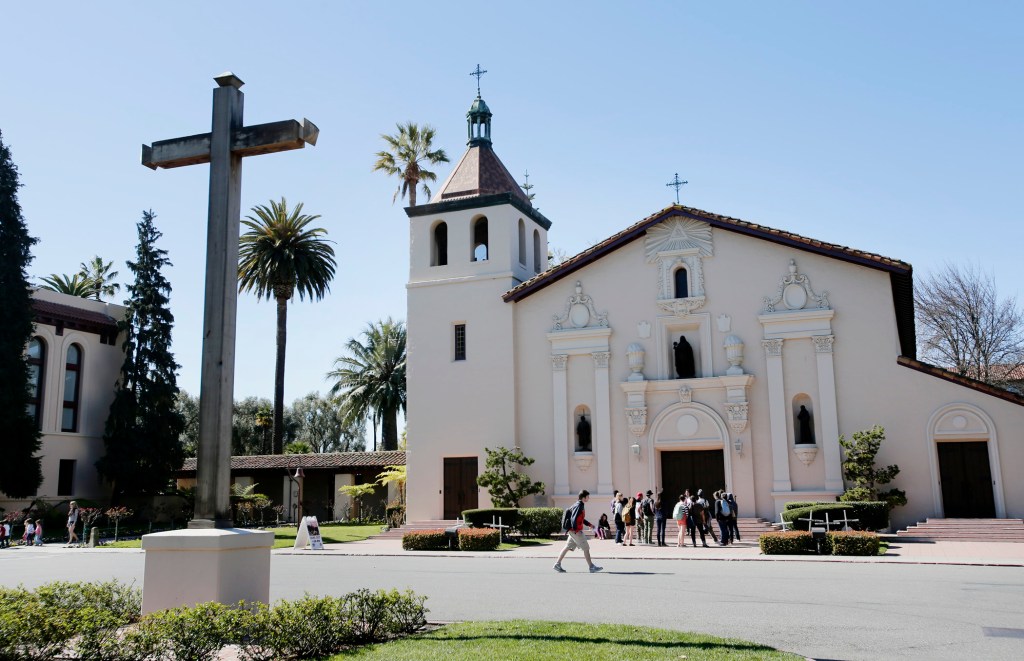
A new medical school announced Friday — the Bay Area’s first in more than a century — aims to help remedy California’s shortage of doctors and programs to train them.
The Mark & Mary Stevens School of Medicine at Santa Clara University will be funded by a $175 million donation announced Friday from billionaire venture capitalist Mark Stevens and his wife Mary Stevens, a 1984 Santa Clara University alum and university Board of Trustees member. Sutter Health will also partner with the university in the development of the school.
The project comes at a time when more physicians are desperately needed in California, the couple said in an interview with Bay Area News Group.
An estimated 7 million Californians live in areas without adequate access to primary, dental or mental healthcare providers, according to data from the California Future Health Workforce Commission, a statewide group of leaders aimed at improving California’s health workforce.
That statewide shortage of healthcare providers is further exacerbated by the “silver tsunami” of aging Californians who are more reliant on health and social services, with data showing 1 in 5 of Californian residents will be 65 or older by 2040.
But California doesn’t currently have enough medical education and residency capacity to meet that long-term demand, said Sutter Health CEO Warner Thomas.
“More than half of physicians who complete residency training ultimately practice in the state where they trained and California continues to face significant physician training capacity challenges,” Thomas said.
California’s medical school enrollment is the third lowest in the country, ranking 43rd among the 46 states with medical schools, according to data from the University of California.
Facing a lack of available medical school seats and residency programs, about 60% of Californians looking to pursue a medical degree have to move to other states for medical school, the California Future Health Workforce Commission says, meaning California’s public and private health systems must compete to lure them back.
Thomas said that’s why Santa Clara’s new medical school is needed now more than ever.
“This is all about keeping people in California … This is all building a pipeline, building an ecosystem of physicians who can come into our residencies and fellowships and then stay at Sutter Health and stay in California,” he said. “There’s plenty of students, we just don’t have the positions in medical school or in residencies to train them.”
The Stevens — who reside in Steamboat Springs, Colorado, after several decades living in Silicon Valley — are long-time donors to Sutter Health and Santa Clara University, with nearly $40 million in contributions to the university for athletics facilities and programs, the student center and an endowed scholarship. They’ve also donated millions to expand cancer care and medical research in the state and Silicon Valley, including $1.5 million to Sutter’s Palo Alto Medical Foundation for cancer research and $50 million to the University of Southern California for neurological research.
“I think our goal is to give back and make a difference while we’re still here, that we see we’ve left the place better,” Mary Stevens said.
Santa Clara University President Julie Sullivan said about 700 of the university’s 6,695 undergraduates are interested in pursuing healthcare graduate programs — degrees the university doesn’t currently offer. She said Santa Clara University hopes the new medical school will allow the university to expand graduate healthcare education.
Sullivan said the accreditation process is “arduous” and the first cohort of students is still at least three to four years out, but she looks forward to welcoming the “physician leaders of the future.”
“You don’t get to start a new school very often, and it’s a huge opportunity to start with a clean slate,” Sullivan said. “To only think about physicians of the future and how to create a better healthcare system for the future and how to better prepare those people that will be leaders in that healthcare system — that’s a rare opportunity.”
The new medical school will also be rooted in emerging technologies revolutionizing the healthcare industry, including artificial intelligence, Sullivan said.
Earlier this month, Mark and Mary Stevens donated $200 million to the University of Southern California, Mark Stevens’ alma mater, for artificial intelligence research and advancements.
The couple said the new Santa Clara medical school is the perfect opportunity to integrate Silicon Valley’s “AI explosion” and healthcare to make the medical profession more efficient and accurate.
“AI is the fourth industrial revolution … In 10 years from now, the world will be unrecognizable to all of us because of the impact of AI that will have on society,” Mark Stevens said. “So AI as applied to the whole healthcare industry and supply chain is a tremendous opportunity.”
Faculty and students at the new medical school will have the opportunity to collaborate with Santa Clara University’s new Cunningham Shoquist Center for Applied AI and Human Potential and Sutter Health’s Innovation Center, as well as other university departments. Students will spend the first two years in the classroom and the last two years getting clinical training at Sutter Health.
“We think it’s a great time to be creating a new model,” Sullivan said. “We want to ensure that technology does penetrate the healthcare sector, but doesn’t replace that trusted human connection that the patient and their family have to their physician.”
In a statement, Gov. Gavin Newsom praised the new school project as a vision for the future.
“California doesn’t wait for the future — we build it,” said Newsom, a 1989 SCU alum. “And that’s exactly what this partnership between Sutter Health and my alma mater, Santa Clara University, represents: a new model for medical education built to support a more innovative, connected healthcare ecosystem.”