
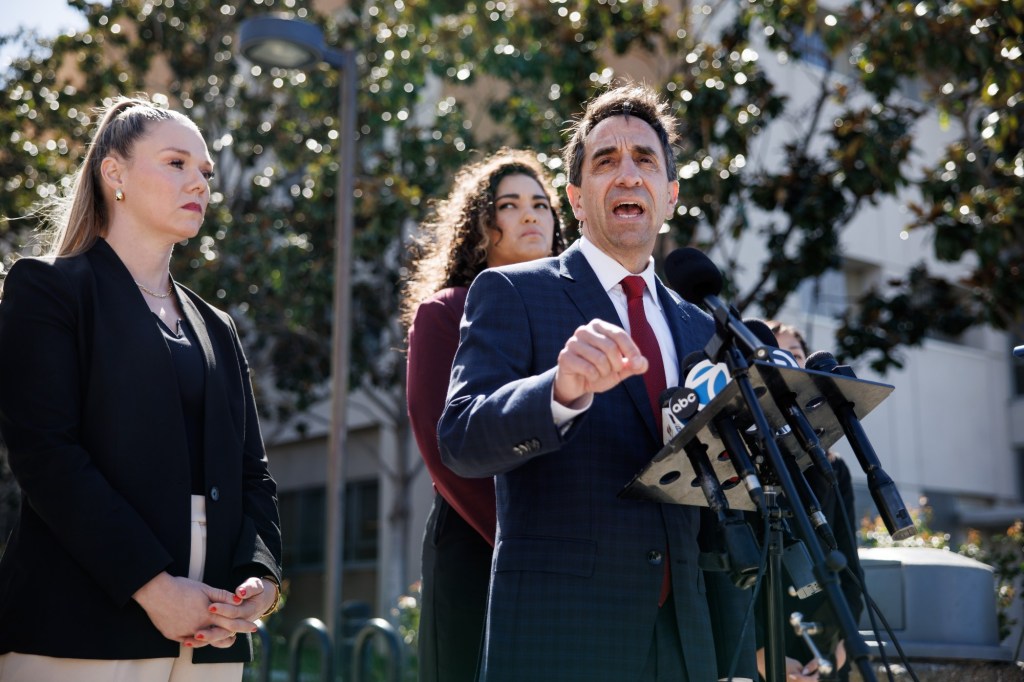
It has long been routine for elected district attorneys to promote the work of their offices when campaigning for reelection. But when Santa Clara County Superior Court Judge Kelley Paul recently disqualified District Attorney Jeff Rosen and his office from retrying the closely watched Stanford vandalism case, she drew a legal and ethical line around citing active prosecutions in political messaging.
Paul’s May 7 ruling marked a rare kind of forced recusal, removing Rosen’s office from the prosecution of five pro-Palestinian activists accused of damaging university property during an office takeover two years ago. Such removals more often involve conflicts self-declared by prosecutors.
“Caution and care need to be taken when utilizing an active prosecution in campaign fundraising efforts,” Paul said in her decision.
In recusal reviews, judges draw on case law and precedent, and they are not just looking for tangible bias; they also weigh whether a prosecutor’s public statements create a conflict or the appearance of one.
What happened in the Stanford case?
Paul sided with a defense recusal motion, arguing that Rosen’s references to the case in his fundraising for reelection, and linking it to combating antisemitism, were troubling. The defendants were demanding Stanford divestment from entities supporting Israeli military action in Gaza, but Paul pointed out the charges were for felony vandalism and conspiracy, not any hate crimes.
The judge concluded that Rosen violated his obligation to impartiality as a prosecutor and, by extension, his office. The state Attorney General’s Office, which represented the DA’s office in the motion arguments, is now the designated prosecutor for any retrial and is weighing whether to appeal Paul’s ruling, which has been stayed pending that decision.
Why would a judge say this crossed a line?
Davina Hurt, director of government ethics at the Markkula Center for Applied Ethics at Santa Clara University, said the public might be understandably confused about why a district attorney would be violating any boundaries by promoting his office’s prosecution of a case, since their charging decisions signal their belief in guilt.
But while prosecutors pursue charges and convictions, she said, they are still obligated to pursue cases objectively, which includes pulling back charging severity, negotiating plea deals for lesser charges, or reaching nonconviction resolutions when the facts and circumstances justify it. In the Stanford case, seven other defendants settled their cases prior to trial in the form of misdemeanor pleas or nonconviction outcomes, including pretrial diversion and youth diversion agreements.
“Their duty is justice, not just winning,” Hurt said. “Every defendant deserves a prosecutor whose decisions are based on evidence and law and not about political benefit.”
Where does the district attorney’s office stand?
Rosen’s office said after Paul’s ruling that they disagreed with but respected her decision. Throughout the investigation, charging and initial trial — which ended in February with a jury deadlocked 9-3 and 8-4 in favor of conviction for the vandalism and conspiracy counts — Rosen has insisted that this was not a political prosecution, but strictly a pursuit of accountability for the damage done to the offices during the June 2024 office occupation.
When are recusal motions likely to be filed?
While successful recusal motions are rare, they tend to cluster around similar circumstances, namely a politically charged case in which a district attorney has offered extensive public comment.
Michael Rains, a veteran Bay Area criminal-defense attorney, secured the forced recusal of former Alameda County District Attorney Pamela Price in 2024 while representing former San Leandro police officer Jason Fletcher over a manslaughter charge in a fatal on-duty shooting, in part citing Price’s public advocacy and alliance with shooting victim Steven Taylor’s family. The case was dismissed a year later at the recommendation of Price’s successor, Ursula Jones Dickson, with a judge agreeing that the chances of conviction were slim.
In the Stanford recusal, Rains said Paul’s decision demonstrates just how fraught these decisions can be. He recalled how he sought a recusal while defending Johannes Mehserle, the former BART police officer convicted of involuntary manslaughter in the high-profile 2009 fatal shooting of Oscar Grant at the Fruitvale Plaza station in Oakland — making similar arguments as he did 15 years later — but was denied.
“I don’t quarrel with Mr. Rosen’s attitude about how he wants to secure accountability because of the hundreds of thousands of dollars of property damage that was reported as a result of this protest. That makes perfect sense,” Rains said. “But there is that other issue here of the philosophical issues that are at play in this case, and I think the judge wanted to err on the side of caution, and keeping the appearances of fairness on the up and up.”
“She wanted to make sure there was not a ruling that would potentially deny the defendants the opportunity to fair treatment at every stage,” he added, “and I think that’s what the judge did.”
Hurt built on that idea by highlighting the weight of public perception in these decisions.
“It’s not only about actual bias, the appearance of impartiality is critical,” she said. “(Even) if he acted in complete good faith, a reasonable person might question whether that campaign messaging and fundraising tied to the case would influence its outcome.”
What precedent was cited in the Stanford recusal decision?
The Stanford recusal motion, and the judge’s agreement with it, are built on the 2020 Lastra decision out of San Luis Obispo County, which also involved a district attorney accused of leveraging a politically charged vandalism case for election fundraising. That motion scrutinized DA Dan Dow’s media appearances disparaging the Black Lives Matter movement — of which the defendants were part — and soliciting donors with a stance of “leading the fight” against similar causes. The trial-court judge’s ruling stated that Dow “sought political and professional benefit and campaign contributions in conjunction with the prosecution,” and was later upheld by an appellate court.
Paul said in her recent ruling that fundraising emails and public comments Rosen made to supporters and prospective donors improperly associated the Stanford prosecution with combating antisemitism and “runs afoul of Lastra.”
What are the broader takeaways?
Both Hurt and Rains believe that the Stanford recusal is indicative of the increasingly narrow line between the administration of justice and the political obligations that an elected district attorney has to navigate. They both alluded to the national political landscape and waning faith in government to illustrate the stakes of the matter.
Hurt said the case reflects the pressure on democratic institutions to preserve public trust, and the role district attorneys have in carrying that burden.
“The power of not only the pen, but the power of his words,” she said. “It’s just a huge and heavy responsibility to remember the inherent tension of his job, and the amount of trust that we as the public have in DAs to keep politics out of justice, out of the courtrooms.”
She added, “Because of the high visibility role … the risk should really be considered and in the end may not be worth it as a way to campaign and raise money.”
Rains said the case could portend things to come.
“Given the politics of today and the volatile nature of those politics, and the emotion that it brings to the forefront,” he said, “you may see more motions of this nature in future cases.”