
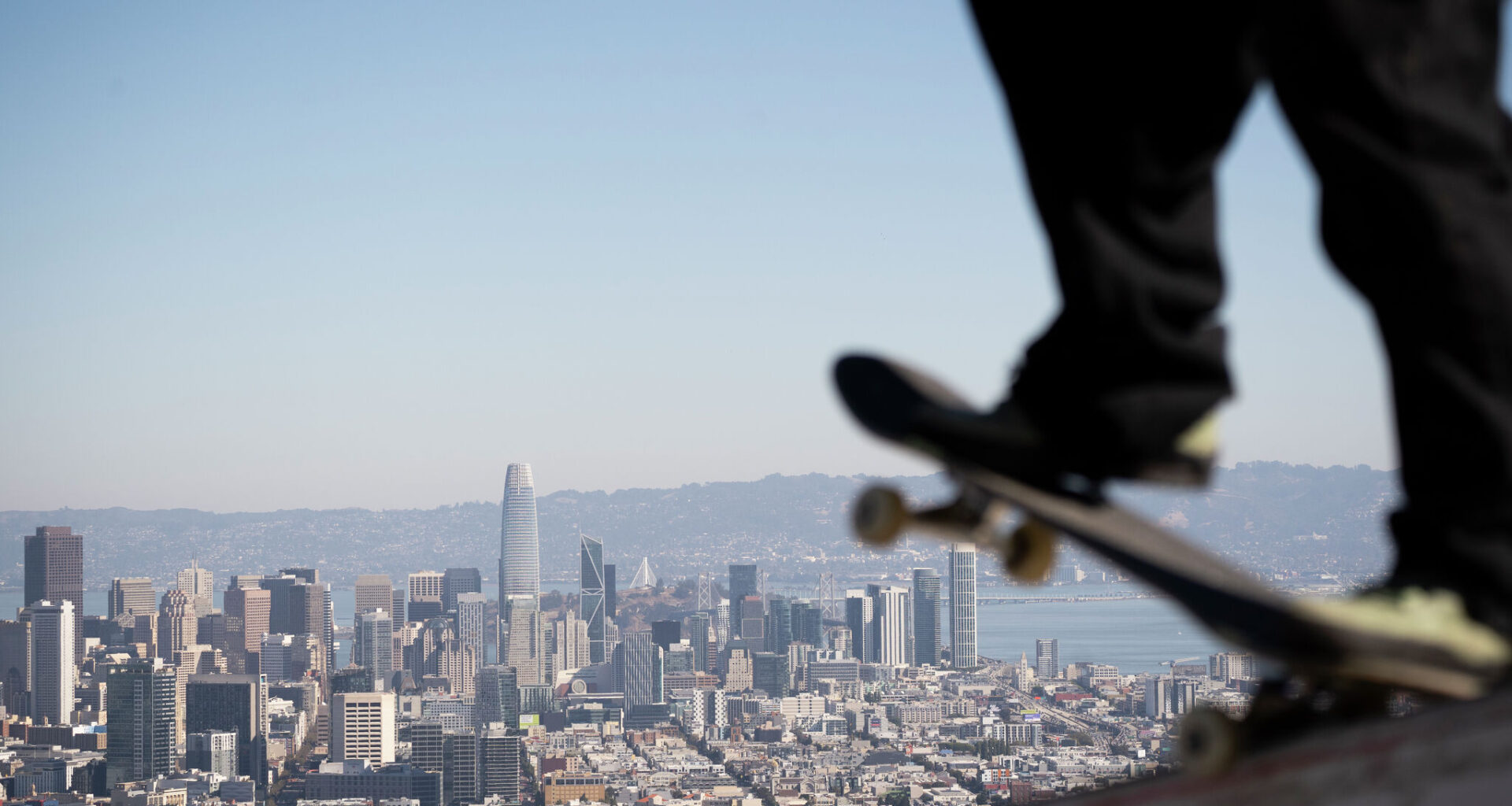
A skateboarder hovers over the San Francisco skyline in San Francisco. Marc Johnson, the influential professional skateboarder whose creative street skating helped shape San Jose’s Tilt Mode Army scene, has died at 49, according to Thrasher Magazine.
Minh Connors/The Chronicle
Marc Johnson, the influential professional skateboarder whose inventive street skating and deep San Jose ties helped shape Bay Area skate culture, has died, according to Thrasher Magazine. He was 49.
Johnson’s death was announced Tuesday, May 26, in a tribute attributed to longtime friend and fellow pro skateboarder Louie Barletta. A cause of death was not immediately disclosed.
“He was one of the most talented and creative people to ever step on or off a skateboard,” Barletta wrote in the statement shared by Thrasher.
Article continues below this ad
Johnson was part of the San Jose scene that produced the Tilt Mode Army, a loose crew of skateboarders and filmmakers whose videos mixed technical street skating with humor, personality and a distinctly Northern California sensibility.
The crew’s work helped give San Jose a lasting place in skateboarding history.
San Francisco Chronicle Logo
Make us a Preferred Source to get more of our news when you search.
Add Preferred Source
Barletta wrote that Johnson had visited San Jose less than a month ago and appeared “sober, healthy, and full of life.”
During the visit, Barletta said, the two reminisced about the old days and Johnson seemed excited about the future.
Article continues below this ad
Johnson was born Jan. 6, 1977, in Winston-Salem, N.C., and rose from a difficult childhood to become one of street skateboarding’s most influential figures. He was known for technical precision, unusual trick selection and video parts that skaters studied frame by frame.
On The Nine Club podcast, Johnson discussed leaving North Carolina for California, becoming pro for Maple and later starting Enjoi, one of the most recognizable skate brands of the early 2000s.
Johnson’s national profile peaked in 2007, when Thrasher named him Skater of the Year, one of skateboarding’s most coveted honors. That same year, his part in Lakai’s “Fully Flared” became one of the defining video sections of its era.
But Johnson was also unusually open about the emotional and financial pressures of professional skateboarding.
In a 2013 interview with Jenkem Magazine, he spoke bluntly about the skate industry, the short careers of many professional skaters and the need for skateboarders to have more control over the companies and culture built around them.
Article continues below this ad
He also spoke about recovery. Asked in that interview about alcohol, Johnson said, “I’ve been clean for a long time.”
Barletta’s tribute alluded to Johnson’s struggles.
“He told me he wanted to be remembered for his skateboarding, not for his failures or shortcomings,” Barletta wrote. “He was just a poor kid from Winston-Salem, North Carolina, who grew up in a trailer at the end of a dirt road. Yet he made it out, traveled the world, and touched so many lives.”
Johnson helped open doors for younger skaters from outside skateboarding’s usual power centers.
Article continues below this ad
News of Johnson’s death spread quickly through the skateboarding world Tuesday, hitting particularly hard in Northern California, where his name remains tied to an era when San Jose’s ledges, schoolyards and oddball street spots became part of skateboarding’s visual language.
“Without a shadow of a doubt, Marc Johnson was the single most influential person in my life,” Barletta wrote. “Everything he did was art.”