
Local and state authorities seeking to halt plans for a U.S. Immigration and Customs Enforcement detention facility near Gilroy face an uncertain battle, and in one of two possible scenarios, experts say the Trump administration holds all the cards.
Key to the fight will be whether the facility is run by the federal government or a private contractor.
If it’s the government, that’s bad news for Santa Clara County, and for the California Attorney General’s office, which has said it is working with county officials to oppose the ICE plan, said UC Davis School of Law professor Vikram Amar, a constitutional law expert.
The U.S. Constitution’s “supremacy clause” allows federal authorities to override state or local laws, Amar said, adding that under the Constitution, state and local governments are both treated as “state” authorities.
“If the federal government sets up its own facility, run by federal employees, federal agencies, there’s precious little the state can do to interfere with that,” Amar said.
Should a private company operate the facility for the federal government, legal options expand, opening the way for county or state authorities to apply existing laws, or pass new laws, to fight the project, Amar said.
If the federal government doesn’t reveal who would run the facility until it’s completed, stopping construction would be difficult, Amar added.
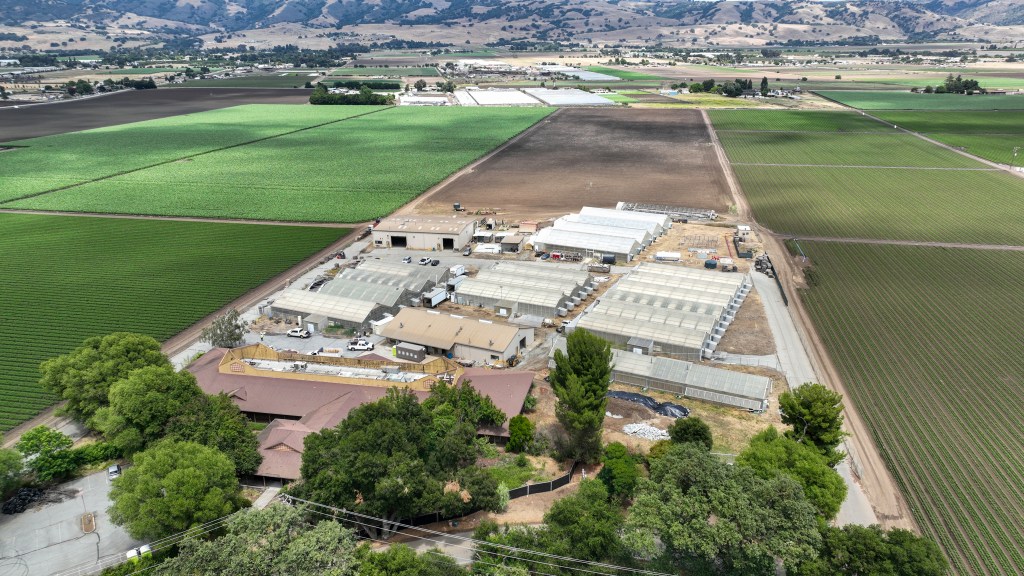
Federal government leasing documents show plans for the ICE detention facility at 7240 Holsclaw Road, just east of Gilroy’s city limits. It would need a “sally port” that would “accommodate a large passenger bus,” the documents said.
The U.S. Department of Homeland Security, which includes ICE, declined this week to answer questions including about who would run the facility. The agency said in an emailed statement that it didn’t have new detention centers to announce, but that “ICE will be making arrests in states across the U.S. and is actively working to expand detention space.”
How important an ICE detention center near Gilroy would be for the federal government is debatable, said Juliette Kayyem, who served as Homeland Security’s assistant secretary for intergovernmental affairs under former President Barack Obama.
Trump’s tax and spending bill that passed in July provided $45 billion for building new immigration detention centers, and ICE currently has around 66,000 people in detention, Kayyem said.
“Unless you’re envisioning that detention is going to increase nine-fold, or multiples we’re not seeing right now, the building of these facilities strikes me as more about spending money that has already been authorized than about immigration detention facilities,” Kayyem said. “The secretive nature of it rightfully raises suspicion about who’s gaining from this.”
Putting the center in heavily Latino southern Santa Clara County would help the federal government achieve its goal of getting undocumented people to self-deport, or drive out documented people and Latino U.S. citizens fearful of getting swept up and detained by ICE, Kayyem said.
“The goal is to create that apprehension,” Kayyem said. “More ICE agents will be deployed to those areas, more ICE agents will be eating in the restaurants. They’ll be walking on the sidewalks.”
Work at the 25-acre site, just east of Highway 101 and just north of Highway 152, started early last month, Gilroy Mayor Greg Bozzo said earlier.
Santa Clara County’s top lawyer, County Counsel Tony LoPresti, has vowed to battle the federal government over the plan.
“The immigrant community is really impacted by this, impacted even by the very proposal of it, and would be impacted by the operation of it,” LoPresti said Thursday. “We’re committed to putting forward the strongest possible legal claims, whether those be in court or elsewhere.”
His office is “feverishly” exploring options and pursuing them “expeditiously,” LoPresti said. “Part of the problem is we don’t have a solid understanding of what is actually in store there. One of the things that isn’t entirely clear at this point is who the heck … is going to operate this thing.”
LoPresti declined to discuss any options or legal strategies officials may be considering. The California Attorney General’s office said Friday it was continuing to work with LoPresti’s office and was “unable to preview any potential legal strategy.”
On May 19, Monterey County supervisors unanimously passed a resolution to oppose the ICE facility and join any lawsuits filed by Santa Clara County or California’s Department of Justice. Supervisor Luis Alejo said the facility’s effects would be felt beyond Santa Clara County, boosting fear among immigrants.
“Our local communities, our workforce, our families and local economies deeply depend on our immigrant communities,” Alejo said before the vote on the resolution.
As of April, all eight of ICE’s California detention facilities were privately operated, CalMatters reported.
If the federal government hires a contractor to run the facility near Gilroy, the County or State of California could impose regulations such as environmental or zoning laws on the contractor — as long as the regulation and enforcement were neutral and didn’t single out and target federal contractors “to throw sand in the federal government’s gears,” or substantially hamper the federal government’s mission, Amar said.
In passing any new law, state or county governments would have to “be very careful to avoid saying things in the legislative process that make it look like they’re trying to thwart what the Trump administration is trying to do in particular,” Amar said.
The federal government could sue in response to regulation and seek a court order allowing it to continue the project while the lawsuit proceeds. Or if the federal government pursued or operated the project despite regulatory action, state or local government could sue and seek a court order to prevent construction or operation of the facility while the lawsuit proceeds, Amar said.
Under either case, the matter would likely end up in court for years, Amar said.
A legal fight could push the dispute past the end of the administration of President Donald Trump and his mass-deportation agenda.
“The decision to even move forward with the development could shift,” LoPresti said. “That’s certainly something we have to be and are thinking about.”
Still, LoPresti said, “It would be foolish to think that we can bank on a future administration pulling back on a development like this.”
LoPresti said he couldn’t divulge when the county would take concrete steps against the facility.
But, he said, “You’ll see some of that materialize soon.”