
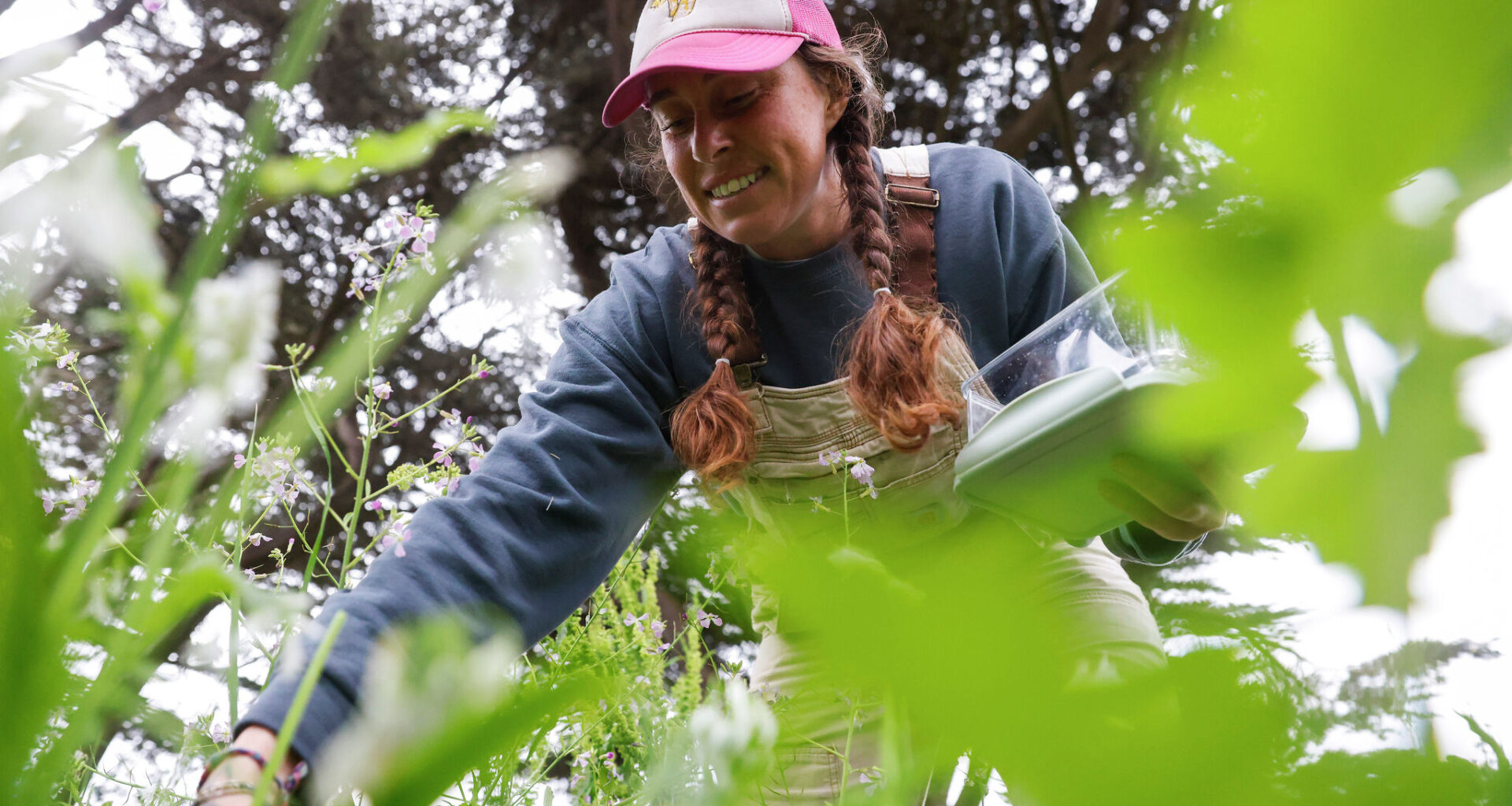
At 6:30 a.m. on a bright Tuesday morning in San Francisco in May, Karley Webb crouched down in a semi-abandoned lot. She was there to collect New Zealand spinach, one of a dozen wild edible plants and herbs a chef in Menlo Park had tasked her with collecting. As Ocean Beach roared below, she harvested the wild green — unrelated to common spinach, it grows in sandy soil — leaf by leaf.
“Right now it’s kind of easy, because there’s stuff everywhere,” said Webb, dressed in knee-stained overalls and a pink ball cap embroidered with a golden chanterelle. “Everywhere you look there’s mustard and roses and radish.” But that springtime abundance could also make chefs more demanding, she said, ticking off the long list of elderflower, nasturtium, baby sun rose, wood oxalis, honeysuckle and other herbs and flowers that Nico Russell of Café Vivant had requested.
Webb, 34, is a bounty hunter for tiny wild things that Bay Area fine dining chefs love to use as garnishes. The delicate blossoms add color and luxury, creating miniature landscapes that evoke coastal California on the plate. She documents her days on Instagram, holding up each haul at different time stamps, often starting before 7 a.m. with an enthusiastic, “Let’s go foraging!”
Webb devotes at least one day a week to scouting new locations for foraging, such as this strip of land near a golf course in Pacifica.
Photos by Jessica Christian/S.F. Chronicle
Webb devotes at least one day a week to scouting new locations for foraging, such as this strip of land near a golf course in Pacifica.
Photos by Jessica Christian/S.F. Chronicle
Some days she hikes 4 miles to a favorite fuchsia bush for Nisei in San Francisco, a Michelin-starred kaiseki restaurant that fills the bell-shaped magenta flowers with salmon roe. She braves poison oak, ticks and reptiles — a garter snake bit her in the face once while she waded through watercress. But the work pays the rent, at around $1 dollar per fuchsia and $15 per quart of radish flowers. “Even if I wasn’t making money, I’d probably still be doing it,” she said. “It’s just so cool that you can eat things. You can find things and eat them yourself. I’ve been obsessed with that my whole life.”
Article continues below this ad
Webb started her company, Particular Hands, in February. She previously worked for another foraging company as well as the acclaimed restaurant Lazy Bear.
Jessica Christian/S.F. Chronicle
Companies that specialize in finding wild mushrooms and huckleberries have been around for several decades, while lesser-known edible greens and flowers started to become more popular in the late 2000s. New foraging companies sprang up, and interest in their products hasn’t seemed to slow down.
San Francisco Chronicle Logo
Make us a Preferred Source to get more of our news when you search.
Add Preferred Source
“California is such an incredible agricultural region. But also from a wild foods perspective, so much grows here,” said Russell, who recently returned to his native Bay Area after working in New York restaurants, including Place des Fêtes and Oxalis, named for a type of flowering plant that Webb finds for him. He uses her New Zealand spinach in a salad to top gigante beans and sugar snap peas.
Webb grew up in New Jersey and learned to forage in West Virginia, where her mother took her to visit family during weekends and summers. “It was something we would do for food,” she said.
Article continues below this ad
She studied microbiology and chemistry at college in Hawaii, where she worked on a coffee research farm after graduation. She headed to the Bay Area to work with coffee companies, but it was hard to get roasters to listen “to a young female,” she said, so she began consulting with high-end restaurants on their coffee programs. She ended up working the front of the house at San Francisco’s two-Michelin-star Lazy Bear, and from there found her way to foraging for such restaurants. After working for another foraging company for a year, she started her own business, called Particular Hands, in February.
Ingredients foraged by Karley Webb are used in dishes such as, left, a mushroom canape with morels and white and purple alyssum, and, right, an artichoke custard with wild pea shoots, radish flowers, nasturtium and red miners’ lettuce. Both dishes are from Matt Hall at Sorrel restaurant.
Photos courtesy of Sorrel
Ingredients foraged by Karley Webb are used in dishes such as, top, a mushroom canape with morels and white and purple alyssum, and, above, an artichoke custard with wild pea shoots, radish flowers, nasturtium and red miners’ lettuce. Both dishes are from Matt Hall at Sorrel restaurant.
Photos courtesy of Sorrel
Rachel Arnow, the executive sous chef at Nisei, created the fuchsia flower bite as part of a Hassun course, a traditional part of a kaiseki meal with food displayed amid abundant seasonal beauty. Arnow consults with Webb on local finds that fit within a Japanese framework, including magnolias that are used in a vinegar and again as skewers for squid. “You have to move with the seasons and move with what nature is offering you in the moment,” said Arnow, who called Webb “an incredible partner for any chef.”
That morning in San Francisco, Webb finished up foraging and headed to a strip of land alongside a golf course in Pacifica, where three-cornered leek flowers dotted the grass with white. “Holy cow, look how pretty that is,” Webb said, getting out of her car. “They’re all so luscious right now.”
Most chefs use just the tiny blossoms, which are salty and redolent of garlic, though the stalks are edible too. “We call these native Funyuns,” Webb said, clarifying that the plant is actually invasive, another good reason to eat them. Eat one, she said, and “your breath’s going to be kicking.”
Article continues below this ad
Webb had found the spot during a pit stop for Yerba Mate at the 7-Eleven across the street. She devotes one day a week to scouting, scouring Google maps and real estate ads for empty lots that might hold surprises. Like all serious foragers, she does not reveal her harvesting locations, most of which are on private land where she has an agreement with owners.
Even before she became a professional forager, she would note locations and file them away in her head. One day, she took her husband to collect pea shoots — her favorite wild food — and he asked how she had found them. She had driven past the area seven years earlier and saw pea flowers, she told him. “If I see flowers, obviously there’s peas, right?” she said.
Webb often begins foraging before 7 a.m., then documents her hauls throughout the day on Instagram.
Webb often begins foraging before 7 a.m., then documents her hauls throughout the day on Instagram.
Webb was on the hunt for a long list of wild plants and herbs requested by chef Nico Russell of Cafe Vivant in Palo Alto, including nasturtium (pictured), elderflower, baby sun rose, wood oxalis and honeysuckle.
Photos by Jessica Christian/S.F. Chronicle
Webb was on the hunt for a long list of wild plants and herbs requested by chef Nico Russell of Cafe Vivant in Palo Alto, including nasturtium (pictured), elderflower, baby sun rose, wood oxalis and honeysuckle.
Photos by Jessica Christian/S.F. Chronicle
Webb usually works Tuesday through Saturday, spending six or seven hours foraging with a break for coffee and surfing midmorning, followed by deliveries to restaurants in the afternoon. But that morning she had been working nonstop since the previous Friday, having spent the weekend in the Sierra foraging for morel mushrooms and sleeping on a mattress in the back of her SUV. Other than the vehicle, her equipment consists of a Dometic electric cooler with a massive, expensive battery and countless quart-size reusable containers.
Article continues below this ad
Before leaving the Pacifica golf course, she stopped to take a video. “7:58. Two containers of leek flowers,” she said, facing the camera. In most of her reels, as the sun gets brighter, the smile on her freckled face fades into an expression of comic weariness. In one video, after collecting what looked like a field full of yellow blooming mustard raab for Quince in San Francisco, she said, “If you’re there and eating that mustard raab, it took me forever, and I hope you like it.”
After the golf course, it was time for a brief stop at an elderflower tree in another part of Pacifica for a few quarts of the lemony-white blossoms that Russell uses in a dessert with strawberries, sheep’s milk yogurt and fig leaves.
The wild elderflower is used by chef Nico Russell in a dessert with strawberries, sheep’s milk yogurt and fig leaves.
Photos by Jessica Christian/S.F. Chronicle
The wild elderflower is used by chef Nico Russell in a dessert with strawberries, sheep’s milk yogurt and fig leaves.
Photos by Jessica Christian/S.F. Chronicle
Webb’s next stop was some open space in Pacifica adjacent to a private ranch whose owner allows her to drive through. She was there to collect radish flowers, also called arugula flowers — tiny purple-veined blossoms that are sweeter than their name implies. While gathering, she came across a huge find of yerba buena, a sticky native vine with a captivating lemon-balm scent. “Smell it, make tea with it, it’s so good,” Webb advised. “Put it on vanilla ice cream with olive oil.”
A few weeks earlier, she recalled, while foraging in the same area, she peed there and got stung in a patch of hidden stinging nettle. But besides the snake incident, her worst injury has been twisting her ankle while leaping theatrically during a video filmed by her husband.
Article continues below this ad
The thrill of the hunt — and not having to work indoors, for someone else — keeps her going. After working all day the previous Friday, she drove up to Lake Tahoe in search of morels, arriving at night. She slept in her car, then spent all of Saturday looking for them — and got skunked at each spot.
Webb arrived at her final stop just as the sun was setting. Morels were growing all around, but it was too dark to forage, so she climbed back onto her mattress to sleep.
“I woke up at 4:45 a.m., waiting for the first light,” she said. She looked out at all the morels in front of her and said, “All right, let’s do this.”