
In the wake of the COVID-19 pandemic, San Jose needed a comeback.
It was slow at first, as the downtown calendar gradually filled up with new music festivals, night markets, street fairs and other events. Last year, though, it finally hit a tipping point as the city’s nightlife scene exploded and downtown drew more than 34 million visitors — an increase of 9 percent over 2024, according to data from location analytics firm Placer.ai.
RELATED: Bay Area downtowns aren’t dying – they’re changing
Ironically, this new success owed a debt to the pandemic itself, which had inspired San Jose officials to spend money creating more outdoor experiences for residents and visitors. The Urban Vibrancy Institute’s Every Thursday initiative recruited bands to play at different brewpubs and restaurants in 2022 and then expanded that into a series of block parties with live music and food trucks in different downtown districts.
They started with a splash in 2023 with an eclectic crowd of a few hundred grabbing a bite or a drink at Scratch Kitchen and Goodtime Bar in Fountain Alley in the Historic District or on the Paseo de San Antonio next to the Hammer Theatre. The following year, the block parties looked to be following a similar pattern. Then, the social media sensation San Jose Foos got involved, hyping the July event at San Pedro Square.
Somewhere between 10,000 and 20,000 people jammed onto the street, listening to music by the Good Time Collective. On Santa Clara Street, crowds waited in groups on the corners like there was a Sharks playoff game going on. The parties never reached that kind of attendance again, but the point had been made: People will show up downtown if you throw a good party.
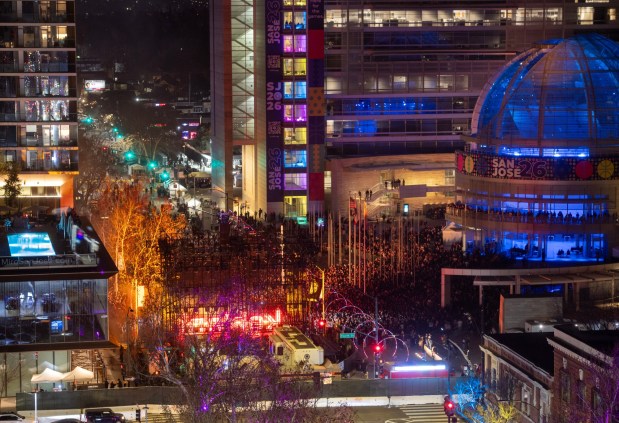 A large crowd attends the Kehlani performance during the Big Game Block Party on East Santa Clara Street in front of City Hall in downtown San Jose on Feb. 7, 2026. (Doug Duran/Bay Area News Group)
The San Jose City Council also voted to create pedestrian malls on portions of San Pedro Street and Post Street. In both cases, the asphalt was covered with colorful street murals, and the closed streets became natural gathering spots for pop-up events.
“Our downtown has at times struggled to be a consistent regional destination,” Mayor Matt Mahan said at a forum on the Future of Downtown in March. But that’s changing, he said. “People are coming because there’s something unique there.”
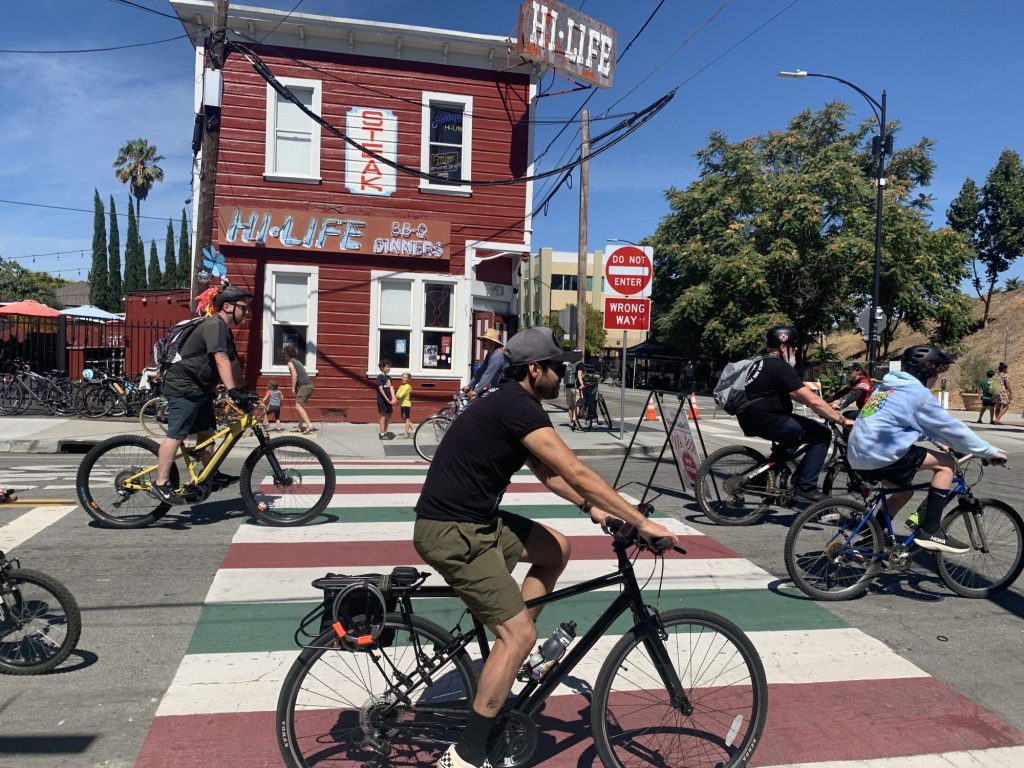
This isn’t the first time that a focus on outdoor culture spotlighting some of downtown’s best assets — great weather and numerous parks and plazas — has worked for San Jose. Christmas in the Park, Music in the Park and San Jose Jazz’s SummerFest have been consistently popular for decades. There are no fewer than six major running events that go through downtown, the summer City Dance series outside the San Jose Museum of Art gets more popular every year, and the routes for Viva CalleSJ — which closes six miles of streets to vehicle traffic and opens them for bikes, skateboards and walkers — almost always go through downtown.
This year, the multiple events connected to national and global sports events like the Super Bowl and the World Cup have supplanted block parties.
On the Friday between rounds of the NCAA Men’s Basketball tournament in March, DJ Diesel — aka NBA legend Shaquille O’Neal — spun tunes for a crowd of about 5,000 people in front of San Pedro Square Market. A few weeks earlier, during Super Bowl weekend, crowds three or four times that size massed on the street in front of City Hall for a pair of music-driven block parties featuring Kehlani and DJ Dom Dolla. The pattern will be repeated this summer when six FIFA World Cup games are played at Levi’s Stadium.
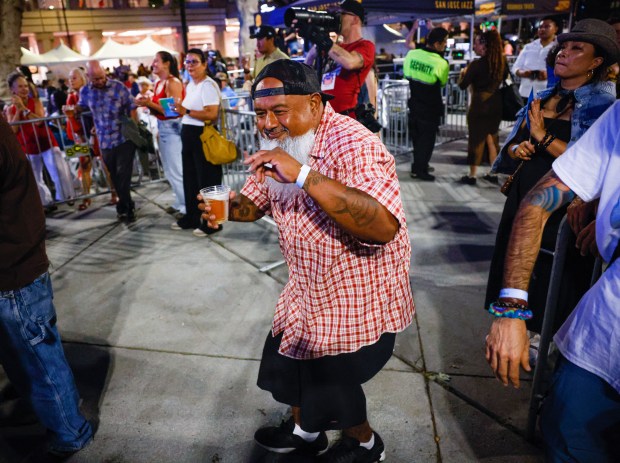 Esteban Vasquez, from San Jose, dances during the 35th annual San Jose Jazz Summer Fest at Plaza de Cesar Chavez in San Jose on Aug. 8, 2025. (Shae Hammond/Bay Area News Group)
“Super Bowl and World Cup are pretty unique experiences,” Mahan said. “But let’s not underestimate the power of creating a reputation and a playbook for being a place that does sports events, conferences, conventions, live music and have that be a repeat driver of the experience economy.”
Local event producer Fil Maresca agrees that the key to the comeback has been creating a consistently enjoyable experience for people, especially those who live in and around downtown.
“The more successful events are the neighborhood events,” Maresca said. “You create a sense of place, and that’s what brings people, as opposed to the headliner or a fireworks show.”
That sense of place can be found at South First Fridays, which has been inviting people to explore downtown’s art galleries and other creative spaces every month for more than two decades, as well as the weekly night markets in Japantown and Parque de los Pobladores and cultural events like the Little Italy Festival.
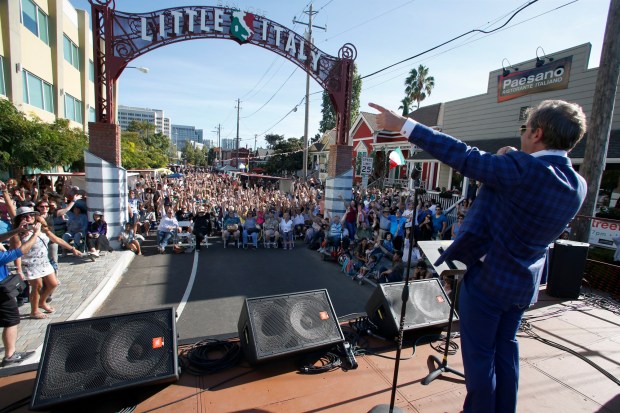 Pasquale Esposito entertains at the 2nd Annual Little Italy San Jose Street Festival on North Almaden Boulevard in San Jose on Oct. 28, 2017. (Karl Mondon/Staff Archives)
Maia Harris, vice president of strategic operations for San Francisco-based developer Jay Paul, said people who haven’t spent much time in downtown San Jose often have a perception of the area being beset by crime and homelessness. “But when you bring those people downtown, you change that perception,” she said at the Future of Downtown forum.
With visitors and residents noticing the resurgent nightlife, the San Jose Downtown Association and the city have started a “stitching districts” initiative to connect different downtown areas with lighting and wayfinding signage.
The goal is to create a seamless downtown where people can start in Little Italy or San Pedro Square and party their way to the SoFA district without missing a beat. And it’s starting to work.
“People say, ‘I can walk across the street on Thursday nights, and there’s a band playing in the park across the street from my house.’ That is a great thing,” Maresca said. “When you say to somebody, ‘I’m going to a night market,’ nobody says, ‘Who’s playing?’ They say, ‘Which one?’”