

California’s public schools have been shrinking for nearly a decade, and new research suggests the decline is in large part fueled by a drop in the number of multilingual students in the state’s schools — but the Bay Area appears to be an exception.
The analysis released June 16 by the nonpartisan think tank Public Policy Institute of California found that the decline in California’s shrinking school age population is entirely due to a drop in multilingual students — students who primarily speak another language at home — rather than English-only students, who primarily speak English at home. Multilingual students is not necessarily the same as English language learners.
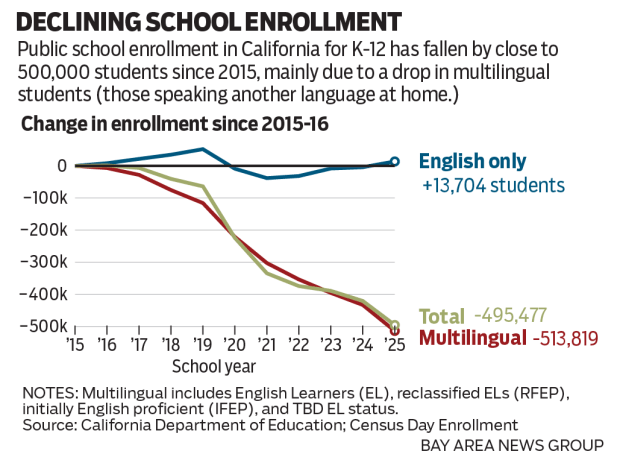 The 2025-26 school year marked the ninth straight year of declining public school enrollment — falling by about 75,000 to a total of about 5.73 million students, with declines projected to continue across the state through the next decade. Research has pointed to a shrinking school age population due to lower birth rates and migration out of state, rather than students not enrolling in public school or missing class.
But the research by senior fellow Julian Lafortune and policy director Laura Hill found that enrollment among English-only students has risen slightly, up 14,000 over the last decade, while enrollment among multilingual students has fallen by 514,000 — a decline that predates the pandemic and has only grown since then. Today, English-only students represent 62% of California’s TK-12 students, about 3.6 million, while multilingual students represent 37%, about 2.1 million — although about 65,000 students’ multilingual status is to be determined, according to the research.
In the last decade, the number of students enrolled in California public schools has fallen by approximately 500,000 students. That drop-off has created financial challenges for many districts, including several in the Bay Area that have turned to layoffs, budget cuts or school closures to downsize as they respond to fewer students and declining revenue.
In nearly all regions across California, enrollment declines have been far greater for multilingual students than English-only students in the last 10 years, the research shows — except for the Bay Area.
Statewide, multilingual enrollment fell 19% over the last decade while English-only enrollment ticked up 0.4%. In Greater Los Angeles, multilingual enrollment fell 31% while English-only enrollment dropped 3%. In the Bay Area, the decline was broader: multilingual enrollment fell 12% and English-only enrollment fell 9%.
Lafortune said while it’s still unclear why the Bay Area has seen such a drop-off in both student groups compared to other regions in the state, it likely comes down to affordability and the Bay Area’s high cost of living.
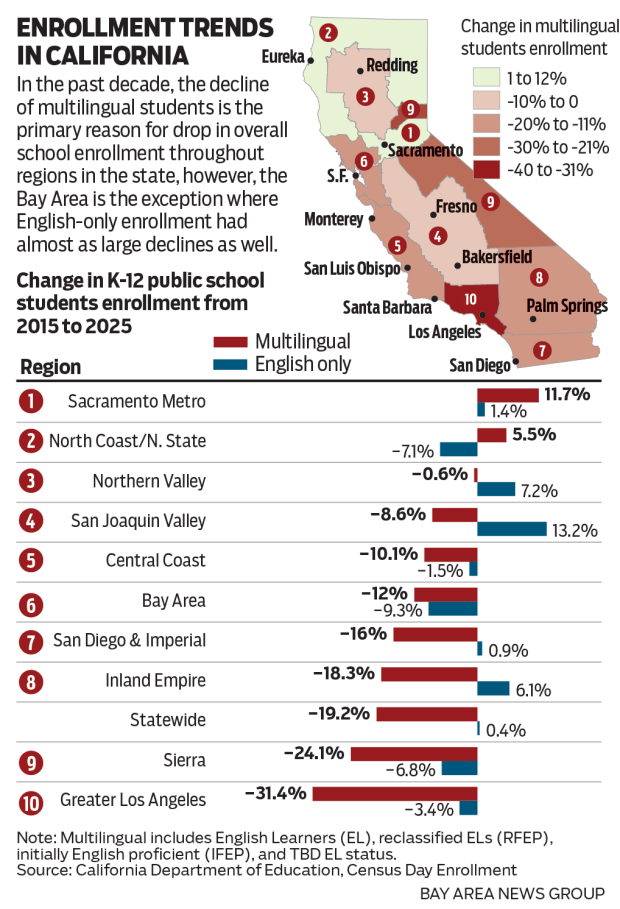 “In the Bay, I would say the difference maybe is less so that there’s a decline in students of multilingual backgrounds, but more that there’s a decline in these English-only students,” he said. “More so than other areas, families of all different backgrounds either not having as many kids or, when they choose to have kids, sending them or moving to areas outside of the immediate Bay Area.”
The pressure is already visible in San Jose, where earlier this year the San Jose Unified School District announced it would shutter five elementary school campuses in response to a 20% decline in enrollment since 2017 — a loss of roughly 6,000 students.
While declining enrollment has slowed since the end of the pandemic in 2023, the loss in students is expected to continue. There were an estimated 6.2 million students enrolled in California public schools in the 2019-2020 school year, but the California Department of Finance projects that number will drop to 5.2 million by 2032.
Bay Area schools are expected to see a nearly 10% decline in students in the next 10 years.
Lafortune said similarly to statewide declining enrollment, the decline in multilingual students is primarily due to lower birth rates, especially among Latina women.
Lafortune also said the number of students considered “multilingual” might be shrinking, as second- and third-generation families may speak primarily in English, compared to first-generation immigrant households.
Immigration shifts are also a factor, he said, with net international immigration — the difference between those moving to the state and those moving abroad — into California slowing significantly in 2025 to about 126,500 people, about half of the previous fiscal year.
Lafortune said federal immigration policy shifts could also be a factor, although it’ll be at least another year before the impact on California student enrollment can be determined, due to infrequent data releases.
“It’s yet to be seen how much that’s going to impact enrollment,” he said.
But the large-scale declining enrollment of multilingual students could have significant implications for school districts, which must balance shifting student populations with staffing needs while also trying to expand bilingual programs, Lafortune said. By 2030, California is aiming to have half of all K-12 students enrolled in dual language immersion programs.
“With that comes additional services and challenges and aspects that schools have to consider,” Lafortune said. “In some ways, fewer multilingual students may be fewer services schools need to provide. But that could also be challenging if maybe before, you had enough of those students to fill a classroom at your school, and now you don’t. … It becomes a more nuanced picture with what’s going to happen or what the pressures facing schools are.”
And as declining enrollment impacts school districts differently in regions across the state, it presents a bigger challenge for California leaders trying to support schools as they downsize to adjust for fewer students in this “era of consolidation,” he added.
“The fact that it does differ so much across regions means it also makes it hard for the state to have a uniform policy,” Lafortune said. “It’s easy to see that there’s going to be fiscal pressures on districts to continue downsizing. And the more you have to downsize, the more challenging that gets. … I don’t know that there’s much the state can do about that.”
But Lafortune said the long-term trend of declining enrollment also presents an opportunity to rethink California’s school system.
“People have talked about this as an opportunity for transformation,” Lafortune said. “You have these disruptions, you have these changes, maybe it’s not (best) to maintain, but actually to try to push for some structural change.”