
This article was produced as a project for the USC Annenberg Center for Health Journalism’s 2025 Data Fellowship. It is Part 2 of a Bay Area News Group series examining why homelessness is so severe in the Bay Area, what sets the region apart and what could help.
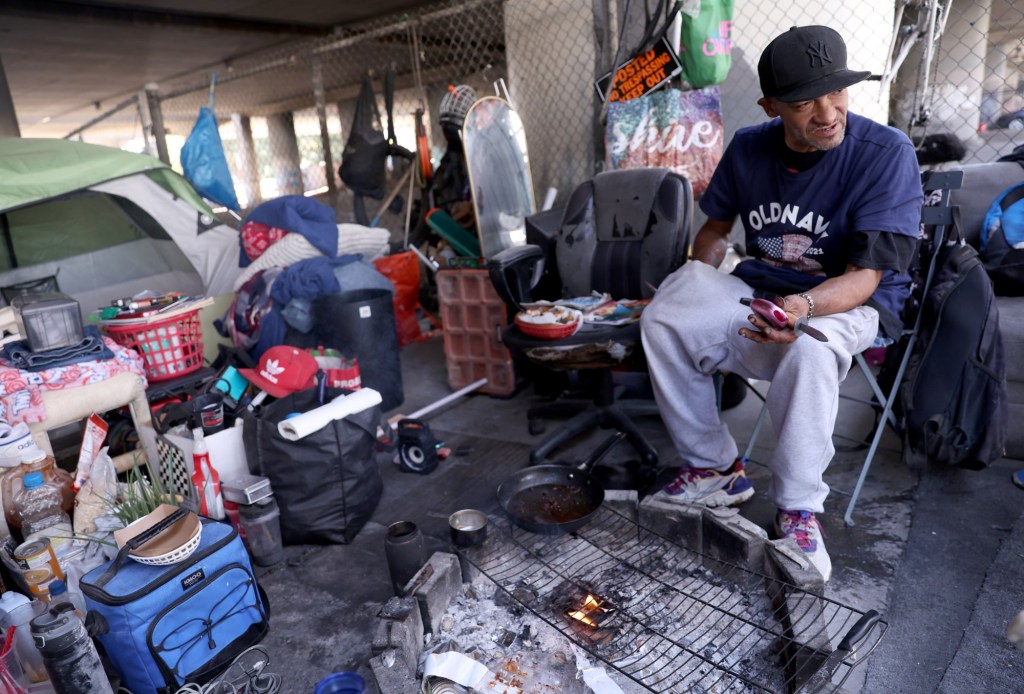
In the shadow of a busy freeway overpass, tents line a city block on the edge of Oakland’s Chinatown. A man cooks over an open flame while another sits slumped and unconscious behind the wheel of a battered green minivan. Shoppers clutching plastic bags of produce walk quickly past, framed by a clothesline strung from a second-story apartment above the discarded bicycle frames and shopping carts scattered below.
The scene is a familiar one to communities across Oakland and other urban parts of the Bay Area, where homelessness has risen faster than in the region’s suburbs over the past decade and a half, according to a Bay Area News Group analysis of homeless count estimates reported to the federal government.
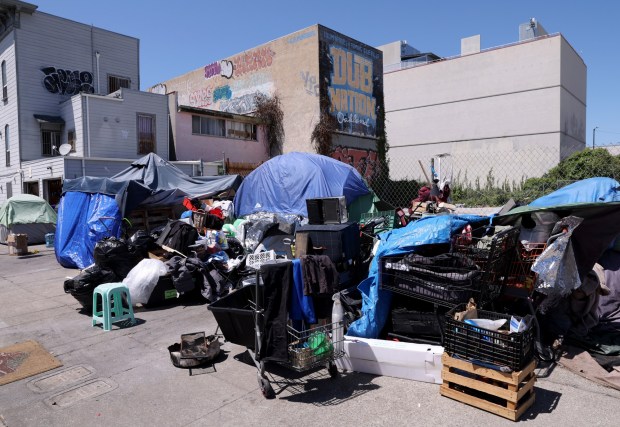 A Golden State Warriors mural overlooks a homeless encampment along 6th Street near Webster Street in downtown Oakland, Calif., on Monday, June 1, 2026. (Jane Tyska/Bay Area News Group)
Since 2011, the number of homeless residents across the entire Bay Area has surged 40% to nearly 38,000, the analysis found. In Alameda, Santa Clara and San Francisco counties — which contain the region’s three largest cities — the local homeless populations have eclipsed that pace, with per-capita homelessness doubling the rates of some suburban counties.
The discrepancy isn’t unique to the Bay Area. According to federal data, just over half of homeless people across the country are concentrated in or near the nation’s 50 largest cities.
“Homelessness tends to congregate in the urban core,” said Gregg Colburn, who researches housing and homelessness at the University of Washington in Seattle.
In the Bay Area, experts say that’s likely due to a variety of factors, including patterns of poverty, local encampment enforcement, access to homeless services and the draw of illicit drug markets.
Some experts first pointed to renter vulnerability: The region’s urban centers generally have higher concentrations of low-income renters, who have been among the most at risk of homelessness as housing costs have soared in recent years. In Oakland, where more than half the population rents, 12% of residents live below the poverty line, about 1.3 times the rate of the surrounding four-county metro area, according to census data.
Across urban communities in the East Bay, “we see a lot of the historical forces that have created and impoverished those neighborhoods to begin with — the gentrification, the displacement, going all the way back to the redlining,” said Jonathan Russell, director of Alameda County’s Health Housing and Homelessness Services agency.
In Oakland, rents have risen fastest in some of the city’s poorest neighborhoods, where investors and small landlords bought up low-cost properties during the late-2000s foreclosure crisis and then raised the rent, pricing many out of their homes, Russell said.
Before falling into homelessness in Oakland about eight years ago, Jameel Smith worked a series of low-wage jobs, including a stint at a noodle restaurant and a souvenir shop at San Francisco’s Pier 39 — while, for years, also using drugs including meth, he said. He lost his apartment after falling behind on rent and has remained on the street in Alameda County most of the time since.
“I was juggling two jobs, and it wasn’t enough,” Smith said.
Since 2011, Alameda County’s homeless population has nearly doubled to an estimated 8,201 people, the largest spike among the region’s three large urban counties, despite reporting an encouraging decline this year. Alameda County also has the second-highest homelessness rate in the Bay Area after San Francisco, which is both a city and a county.
The homelessness rate in Oakland, Alameda County’s largest city, is even higher than in San Francisco, with both places reporting close to 1,000 homeless people for every 100,000 residents.
Some experts also attributed the higher rates of urban homelessness to neighboring suburban communities pushing homeless people into the region’s big cities.
While there’s little data to track this potential trend, Benjamin Henwood, a homelessness researcher at the University of Southern California, said suburban cities and counties may be under greater pressure from residents to clear encampments or issue citations, leading to what he described as “leaf-blowing effects of scattering people around.”
Following a landmark U.S. Supreme Court ruling in 2024 that granted local officials broad authority to clear encampments, however, both suburban and urban cities across the Bay Area have adopted tougher restrictions on encampments and lived-in RVs. Some local officials have explicitly pushed for policies to discourage homeless people from arriving from other jurisdictions.
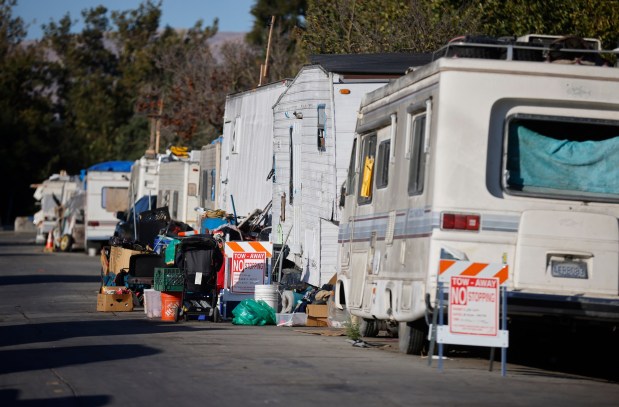 RV’s are parked along Asbury Street next to Columbus Park in San Jose, Calif., on Tuesday, July 29, 2025. (Nhat V. Meyer/Bay Area News Group)
San Mateo County, a largely suburban county, recently made it a crime for homeless people to repeatedly refuse a shelter bed. But officials there said the county’s lower homelessness rate has much more to do with services than enforcement, including a coordinated effort to prevent people from becoming homeless in the first place.
“Whether that’s rental assistance, or getting connected with a lower utility rate plan, or getting connected with the right legal services or health services, there’s a central place to go,” said Amy Davidson, head of the county’s Center on Homelessness.
The county, with an estimated homeless population of 2,240, a slight increase from 2011, has the second-lowest homelessness rate in the Bay Area, after Contra Costa County. Both counties have fewer than 300 homeless people per 100,000 residents, near the national average of 218 per 100,000.
Contra Costa is also one of the few counties in the Bay Area to see its total homeless population decline since 2011, with officials there crediting a 26% drop last year to expanded rental assistance, shelter beds and supportive housing placements. Experts, though, noted that changes in how a county counts its homeless population can contribute to fluctuations in homelessness estimates from year to year.
The urban-suburban pattern is not absolute. In suburban Sonoma County, officials cited similar efforts for reducing the county’s homeless population by more than half since 2011. However, Sonoma County’s homelessness rate has for years rivaled those of Alameda and Santa Clara counties, making it an outlier among the region’s suburban areas.
Officials there said wildfires during the last decade that destroyed more than 2.5% of the county’s housing stock — displacing thousands — have likely contributed to its homelessness rate. Other experts noted the county has significant numbers of farmworkers and seasonal service employees, who often earn low incomes and share crowded living arrangements, putting them at greater risk of homelessness.
Another possible factor at play in the variation in homelessness, experts said, is that cities may draw unhoused people from suburban areas because of more robust services, available public transit, social networks or drug markets.
“County barriers are very, very permeable,” said Dr. Margot Kushel, director of UCSF’s Benioff Homelessness and Housing Initiative. “It is true. Absolutely, people come for the drug market. They come for a whole host of reasons.”
Even so, Kushel said drug markets do not explain most of the variation. Her research has shown that a majority of homeless people in California do not regularly use drugs.
Additionally, surveys conducted alongside local homeless counts have found that in Santa Clara and Alameda counties, only about 20% of homeless residents moved from another county.
In San Francisco, however, the share of homeless residents who came from outside the city is about 40%, which city officials said may be tied to people seeking services and drug markets. San Francisco also has the highest rate of substance use disorder in the region, according to federal data, and officials acknowledge the city’s addiction crisis is clearly linked to homelessness.
“I see anecdotally, substance use disorder becoming more and more of a factor in homelessness,” said Emily Cohen, a spokesperson for the city’s Homelessness and Supportive Housing agency.
While cities may bear the burden of homelessness, experts argue that, given how the crisis operates regionally, solutions must also come at the regional level. They say that in addition to scaling up addiction treatment, tackling the region’s affordable housing shortage across both urban and suburban areas is crucial.
“What we need to do to solve our homelessness problem is work regionally to have a much more robust response to the ability of low-income people, extremely low-income people, to have a place that they can afford to live,” Kushel said.
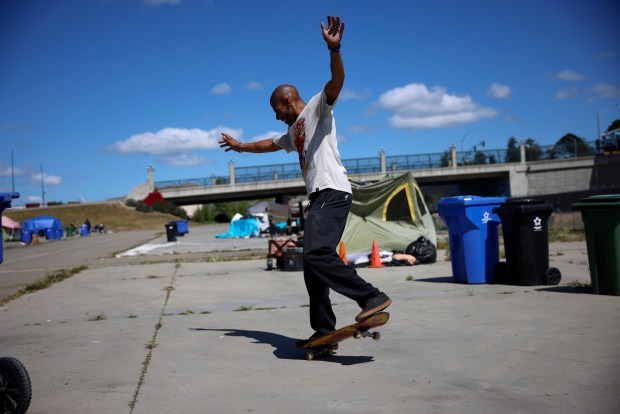 Jameel Smith skateboards at a homeless encampment near Washington Boulevard and Osgood Road in Fremont, Calif., on Thursday, April 2, 2026. (Nhat V. Meyer/Bay Area News Group)
That lack of affordability is part of what keeps many like Smith on the streets. After losing his apartment in Oakland, he eventually found himself living out of a truck at an encampment atop a sun-soaked vacant lot in Fremont.
Recently at the camp, he practiced tricks on his skateboard while describing the challenges of living on the street — from fighting off parasites and bacterial infections to relying on friends to stay vigilant for each other’s safety.
Smith has earned a small paycheck working as a caretaker for a friend in her 70s. But despite the aid of local nonprofits, he said he still hasn’t come close to securing housing he can afford.
“I kind of just gave up on that,” he said.