
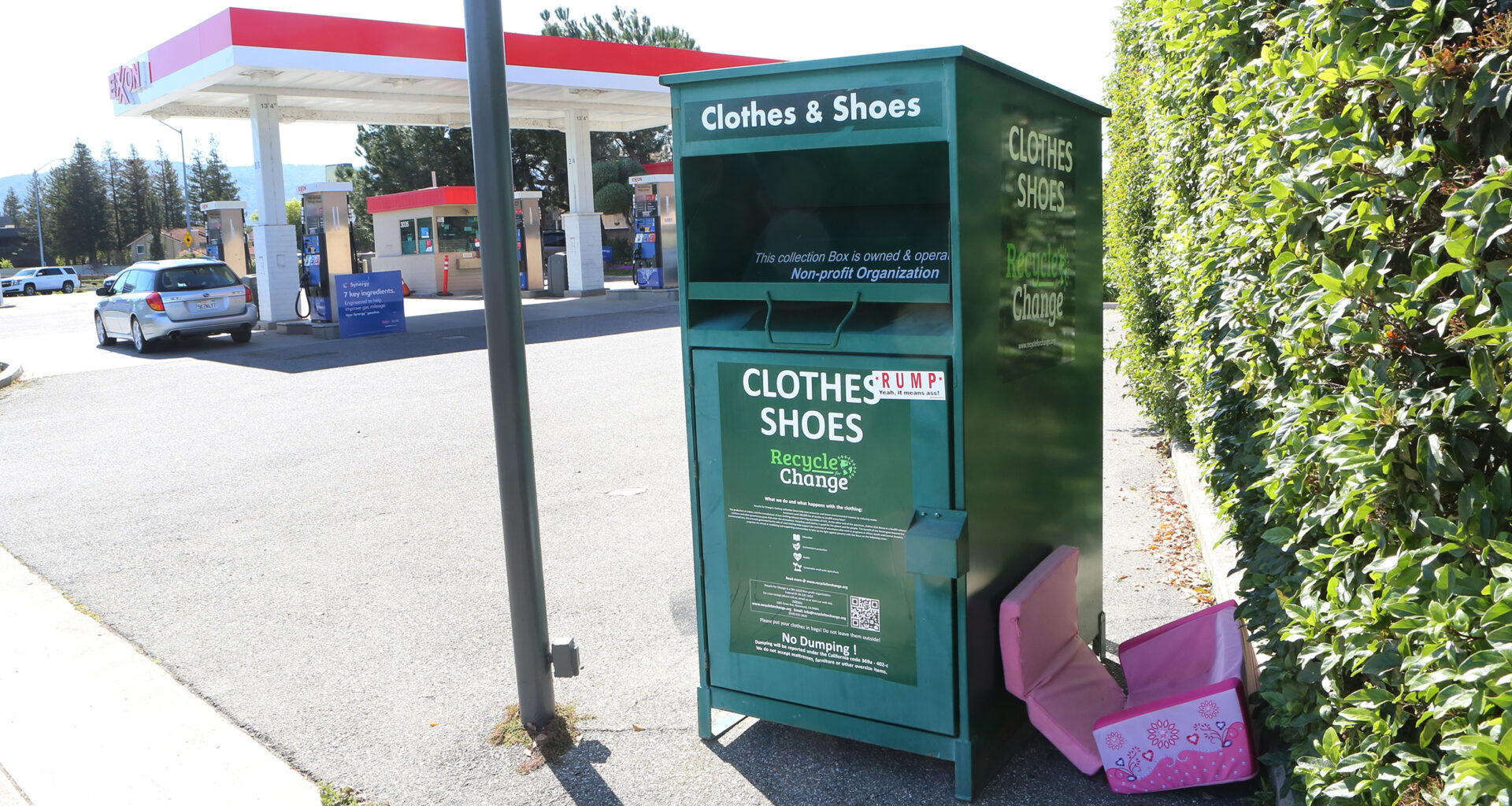
Do you ever see all those big donation bins seeking used clothes and household items sitting in parking lots across San Jose? They are likely illegal.
Goodwill of Silicon Valley has raised the alarm over roughly 300 “rogue” donation bins across the city. The organization warns these unpermitted boxes siphon revenue away from legitimate nonprofits – such as Goodwill, the Salvation Army, and other local charities – that rely on those funds to support the community’s most vulnerable residents.
The bins often sit in commercial parking lots without clear information about who operates them, where donations end up, or who actually benefits.
Councilmember Michael Mulcahy is asking the public to help spot and report them to his office so the city can remove them.
“I started seeing a series of these green bins going up in the district I represent,” said Mulcahy, the District 6 representative whose area includes Rose Garden, Delmas, College Park, and parts of Willow Glen. “We really understood the impact – these sham businesses operate without any approval, permit, or often permission from the property owners. We want to tackle how to get rid of these because they’re taking revenues away from organizations that use the resources.”
San Jose required permits for donation bins over a decade ago, charging a $509 fee, and capped the total number of allowed bins at 18. Yet, the city has issued only two permits so far since 2013 – and it’s unclear if those bins are still in operation, according to city officials. This means most, if not all, of the bins in the city are collecting donations illegally.
“What’s happening as well is that for-profits are putting these donation bins there and they’re not being transparent,” said Christopher Baker, Goodwill of Silicon Valley CEO. “They do a great job of branding, but the reality of it is very little of what gets donated goes back to charities that are noted on those bins.”
The nonprofit organization has been operating in Santa Clara and San Benito counties since 1928. Goodwill does not use drop-off bins, instead accepting donations in stores. The organization says this approach keeps usable goods out of landfills and funds workforce development programs that benefit hundreds of local residents each year – including veterans, formerly incarcerated individuals, unhoused people, and individuals with developmental disabilities.
Baker noted that 86 cents of every dollar in sales goes directly back into those programs.
While there’s no official report on exactly how much revenue operators earn from donation boxes, Mulcahy says “we’re not talking about a little bit of dough here.”
“We’re talking millions of dollars in value getting taken away from local nonprofits that would otherwise be invested back into the things that Salvation Army and Goodwill, and others like them do,” he said.
Unauthorized donation bins and the lack of operator transparency have been long-running issues in San Jose. In 2013, city leaders began requiring operators to secure permits for donation boxes. Two years later, former District 6 Councilmember Pierluigi Oliverio also called for a crackdown on illegal bins.
More than a decade later, little seems to have changed. Part of the problem, Mulcahy said, is that many of the boxes offer almost no information about who is behind them.
“They are protected by layers and layers, and we have not been able to get to the bottom of it,” Mulcahy said.
He’s encouraging the public to reach out to his office to report these bins at District6@sanjoseca.gov.
“What we’re asking the public to do is to let us know where these bins are,” the councilmember said. “Send a photo and address, because we want to start developing an inventory beyond our own district so that we can really get the city to act and get these off the street.”
Baker recognizes the limitations of local government resources, but hopes to work with authorities in pushing for full transparency on the bins, which he says are a problem across the country, “so that well-meaning donors can actually understand where their donations are going.”
To those donating, he encouraged them to choose a transparent local nonprofit “that serves its neighbors, and responsibly handles anything it can sell.”