
About halfway through the quirkfest of a musical known as “Ride the Cyclone,” a character named Ricky Potts makes a statement that might as well be the anthem for the entire show:
“It gets weird now.”
Weird only tells a sliver of this story.
As produced by San Jose’s City Lights Theater Company, “Cyclone” is, well, weird — in the most joyful and profound way possible. It’s not simply the result of a great story presented by a tight group of performers, but also the score, so infectious and loaded with heart, that is unified by the inventive and stellar staging from director Kimberly Ridgeway.
The show, which has become a massive favorite of the TikTok generation, feels like a cousin of other musicals. It has proximity to “Forever Plaid,” with its post-death concert (and connection to Catholic school kids), and to “Six,” with its healthy competition between the mostly beheaded wives of Henry VIII.
In Jacob Richmond and Brooke Maxwell’s delightful musical, members of the St. Cassian High School chamber choir of Uranium City, Saskatchewan, meet their cruel fate when a faulty roller coaster launches them to their demise. Their identities are revealed by a mechanical fortune teller named The Amazing Karnak (Sydney Harmon), who summons the memories of each teen in order to give one lucky soul a chance to return to life.
There are five contestants: The overachieving mega-liberal Ocean (Dale Tanner); Noel (Javier de Guzman), who represents the entire gay population in Uranium; Ukrainian adoptee Mischa (Matt Locke), a YouTube channel rapper; the aforementioned Ricky Potts (Wesley Barker), who witnessed his father’s killing by his pet viper and who deals with his pain through science fiction fantasies about saving sexy cat women; and Constance (Paige Collazo), who’s full of self-loathing despite her outward image as the nicest girl in town.
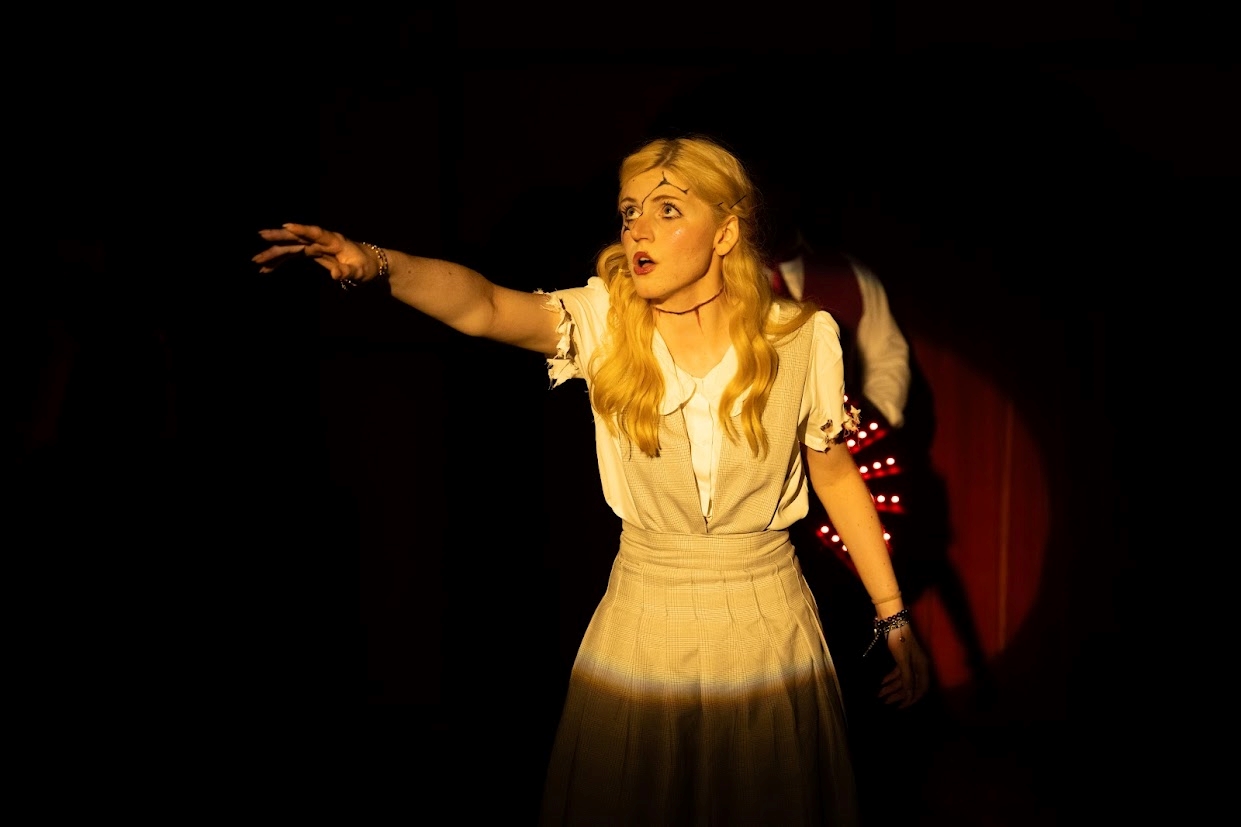
To further complicate matters, Karnak introduces another crash victim contestant, one whose remains were never claimed. She’s known only by her coroner-given name, Jane Doe (Astraea Brown). She was decapitated in the coaster accident, and now has a doll’s head where her real head used to be.
All of this chaos is presented quite straightforward in a very linear narrative, but what is delightful is how varied the storytelling is, to match an extraordinary mixture of vocal stylings. There is plenty of hilarious autotune, post-war French dark cabaret, traditional musical theater fare and some steamy disco-like funk energy.
The show’s structure ensures that each of the teens has a chance to shine, and shine they do. Tanner’s Ocean tackles one of the show’s signature songs, the infectious “What the World Needs” with annoying glee to great effect. De Guzman’s unapologetic turn in the wildly hilarious “Noel’s Lament” is a far cry from the gay teen’s prior self-flagellating stint as a Taco Bell employee, with some big belts and shimmering lingerie to accentuate the point. Locke’s Mischa is all over the place, but the hints of melancholia that drive his big rap numbers are effectively hilarious.
While Barker is granted the show’s strangest and most idiosyncratic number, with dancing cats (even dancing cat crew members) flying all over Ron Gasparinetti’s humdinger of a broken down amusement park warehouse (effectively lit by Edward Hunter), the heart of the show lies within two specific tunes.
The purity of intention within Collazo as she shares in “Sugar Cloud” the destruction of her soul at the hands of a carny (and her deliciously awkward plastic flute solo) is divine, another feather in the cap of Jennifer Cuevas’ frenetically phenomenal choreography.
There is plenty in the show that is wildly funny, driven by Karnak. Harmon’s droll delivery offers humor inside a mysterious vibe, dropping many of the play’s funniest lines and inside baseball theater jokes. A rat who kills Karnak and plays the bass is one of many humorous non-sequiturs the storyline offers.
Yet the true heart of the piece is underlined within the marvelous performance of Brown, who embodies the isolation and emotional hurt of Jane Doe, delivering on arguably the show’s best and most haunting number, “The Ballad of Jane Doe.”
It’s not just simply Brown’s lovely and rangy soprano, but the themes within the number, including the fear of dying alone and forgotten, that deliver powerful gut punches. The sentiment within the song, “time eats all these children in the end” is eerily beautiful and hard to forget.
While “Ride the Cyclone” may not be everyone’s cup of tea, the show’s dark strangeness, wacky weirdness, and taboo subject matter combine for one magical evening.
By the end of the show, it’s safe to say that never has a roller coaster accident been so much fun.
David John Chávez is a former chair of the American Theatre Critics/Journalists Association, a 2020 O’Neill National Critics Institute fellow, and a two-time juror for the Pulitzer Prize for Drama (2022-’23). @davidjchavez.bsky.social.
‘RIDE THE CYCLONE’
Book, music and lyrics by Jacob Richmond and Brooke Maxell, presented by City Lights Theater Company
Through: Aug. 23
Where: City Lights Theater, 529 S. Second St., San Jose
Running time: 90 minutes, no intermission
Tickets: $47-$70; cltc.org