
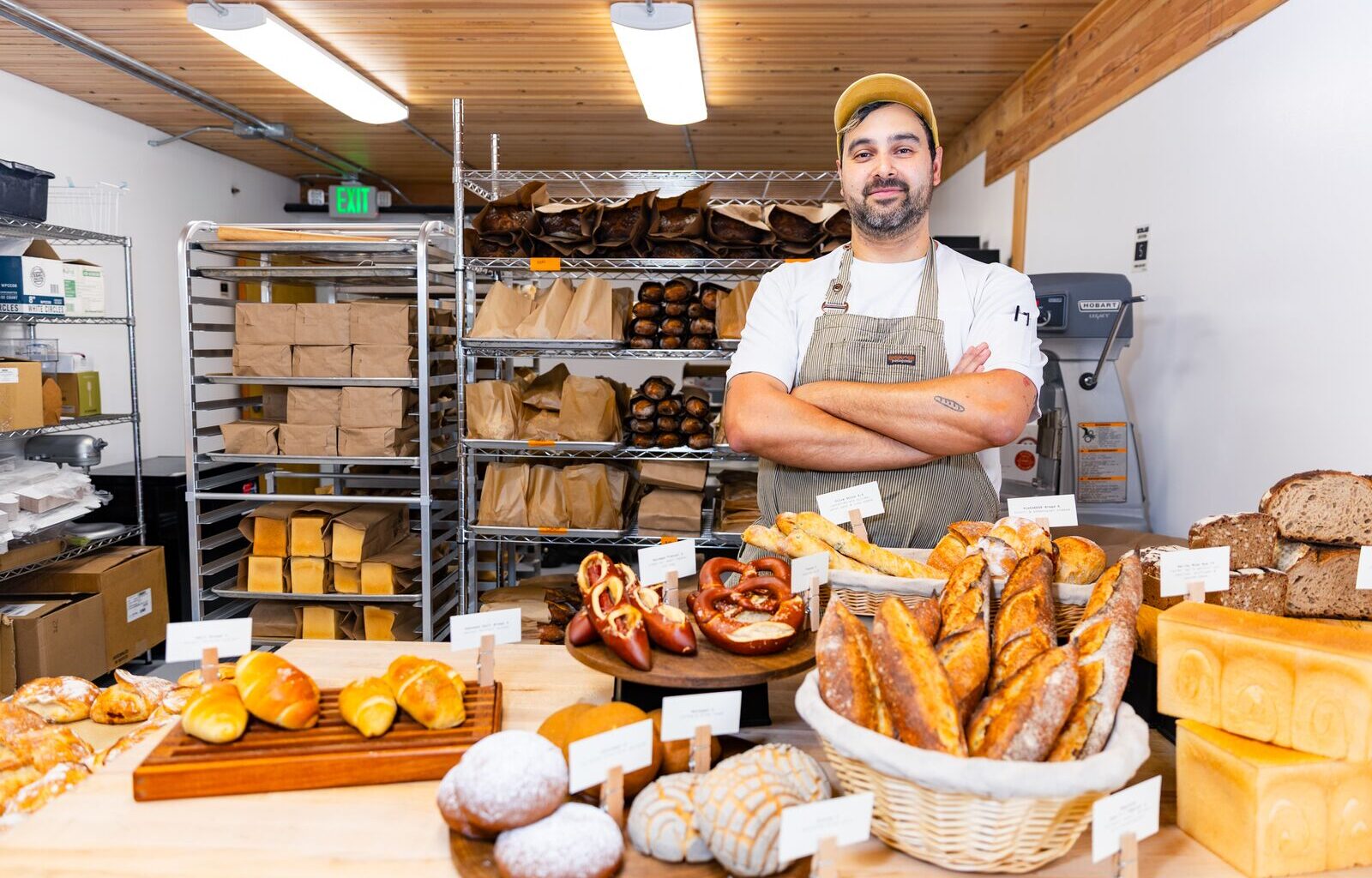
A weekend ago, while on the hunt for my next pastry fix, I found myself wandering around a large, nondescript industrial lot in West Oakland. There was no storefront, no sandwich board, sign thrower or smoke signal that could’ve pointed me towards one of the buzziest bakeries in the East Bay right now. But it turns out the answer was much simpler than I thought. All I had to do was follow the smell of yeast and the faded chalk lines scrawled into the concrete.
2311 Magnolia St., Oakland; instagram.com/studio_estepan/
Follow the Instagram account for the schedule. The next sale is Sunday, Aug. 23 at noon.
Studio Estepan, located at 2311 Magnolia St., sits inside an industrial artisan space called O2 Artisans Aggregate, and is what baker-owner Estevan Silva calls a “part-time bakery”. But the label only speaks to the bakery’s schedule, not his ambition. Each month, he announces his opening dates via Instagram, but typically operates for three Saturdays at a time. He intentionally keeps the operation small to experiment.
“I really wanted it to be a showcase of myself, like more of a creative pursuit than a business,” Silva said.
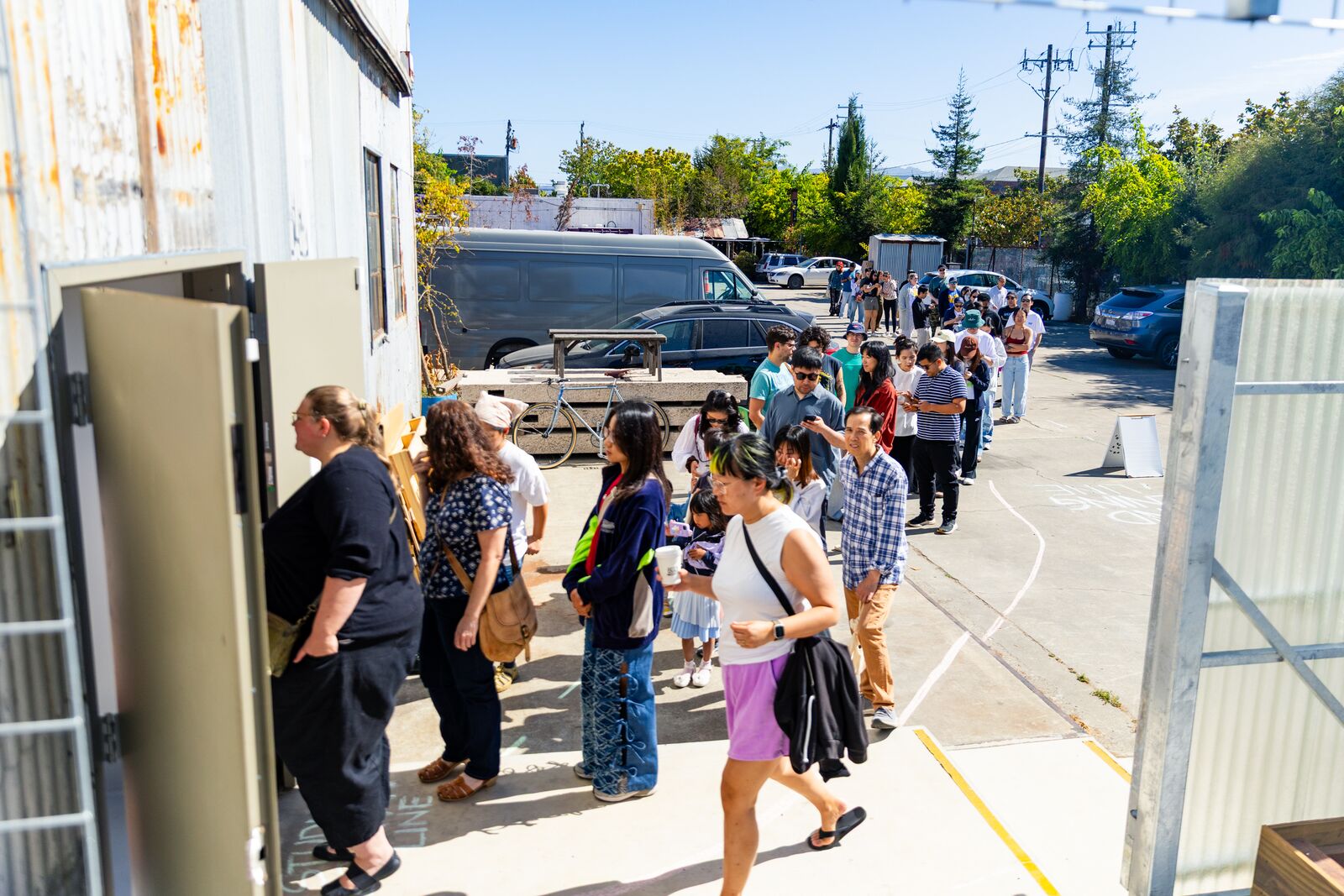 Customers line up inside the O2 Artisans Aggregate industrial lot in West Oakland to get a taste of Studio Estepan. Credit: Estefany Gonzalez for East Bay Nosh
Born in Southern California, Silva has been baking for over a decade, handling bread programs at lauded restaurants like three-Michelin star Quince, Verjus and Cotogna. But in an effort to understand all things bread, Silva bounced around to other spots like Jane the Bakery in San Francisco and Midwife and The Baker in Mountain View. He’s even slung donuts at the now-closed Nickel Diner in downtown Los Angeles. His efforts paid off — earning him the 2019 StarChefs San Francisco Rising Star Award for his work at Quince, where he developed its famed black rice sourdough. But then COVID came, and Silva, like many, took a beat to reevaluate his career.
“COVID was a challenging moment for a lot of people. I think a lot of us got burnt out,” Silva said. “I was at a moment in my life where I wasn’t sure if I wanted to work 16 hours a day, because that was what I was doing. I was like the only person baking for Quince, Cotogna and Verjus. I was baking for three outlets, working like six days a week, 16 hours a day.”
So he pivoted and left Quince to go into baking consulting where, for four years, he helped restaurants and other food businesses like Fiorella and Del Popolo deepen their understanding of flour.
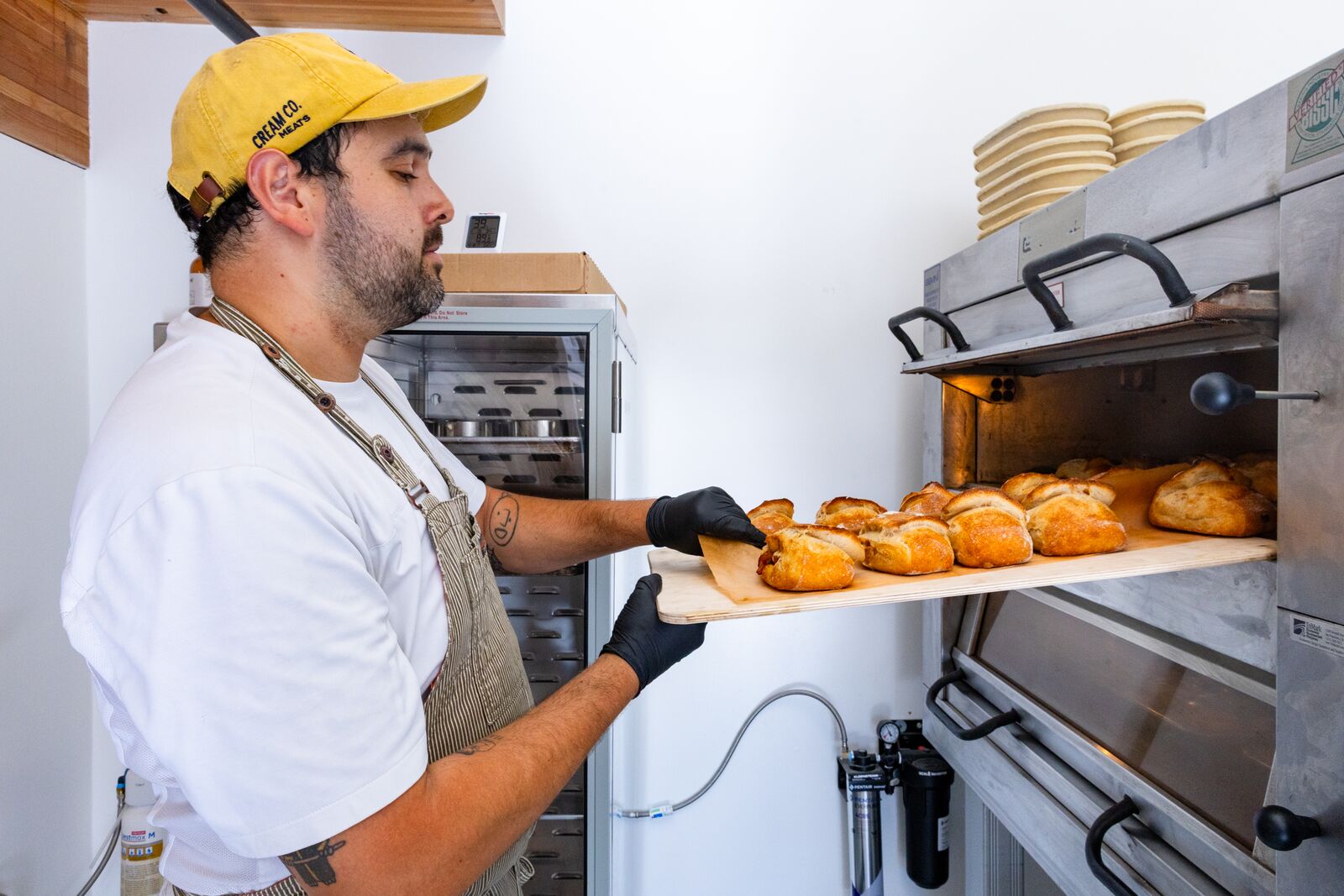 Estevan Silva pulls out steaming tray of his KimCHEESE bread, which is filled with kimchi, emmentaler cheese, and sesame. Credit: Estefany Gonzalez for East Bay Nosh
“They needed help troubleshooting, so like someone who really understands the process behind not just making and baking bread, but [someone] who also understands flour in a deeper way, and that’s kind of like what I really tried to focus on,” Silva said.
Silva initially acquired the bakery’s 1,000-square-foot space to expand his consulting business and have a commercial kitchen to design recipes and troubleshoot remotely for clients. After a difficult loss, he found himself gravitating back towards breadmaking — not as a demanding career but as a creative outlet.
“There was a moment last year where things kind of took a slump for me personally, and business-wise,” Silva said. “My mom passed away, and I had to kind of slow down everything. That [was] the moment where I decided or realized that while I don’t want to be trapped in this full-time bakery lifestyle. There is something innate telling me I need to make bread for my own happiness, and for the happiness of other people. That’s [why] I decided to take a step back from consulting and reactivate the space as a part-time bakery to see if I can make that work.”
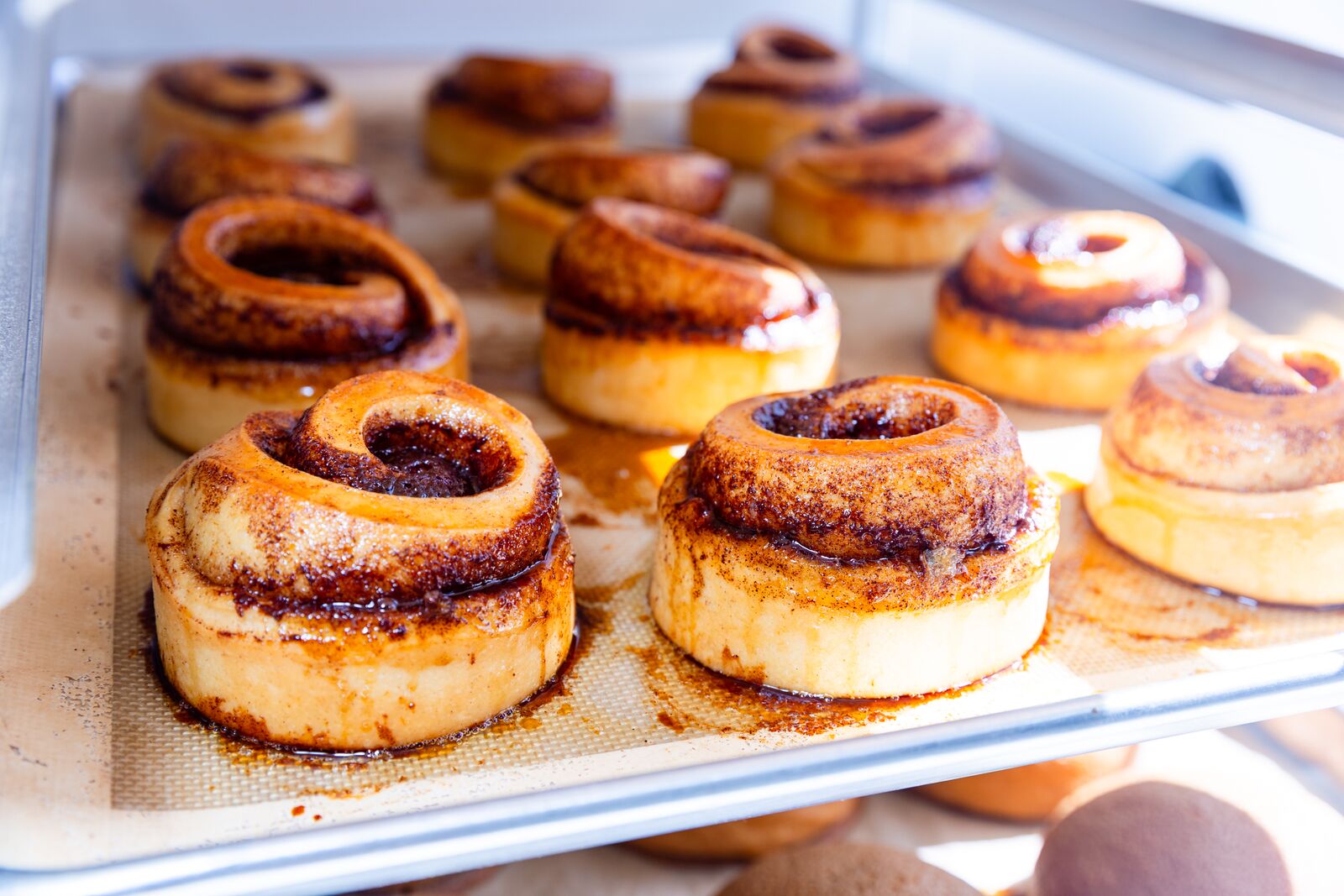 Fresh baked cinnamon rolls topped with kokuto cinnamon sugar, ready for Silva’s homemade cream cheese glaze. Credit: Estefany Gonzalez for East Bay Nosh
So, in early April, Silva took the plunge and opened Studio Estepan. He operates the bakery with his partner Yoojin Chung, an invaluable part of the operation, Silva notes, who handles administrative tasks, rings in customers and manages the bakery’s social media presence.
The bakery name itself is a play on Silva’s first name (Estevan–or in this case EstePAN), an old joke a friend of Chung’s made years ago that stuck with him. It’s also a reference to the size of the space, and Silva’s desire to maintain a small operation.
“I decided to use the name ‘studio’ because I was always looking for something small that didn’t require me to buy big equipment and would kind of force me to do a smaller production style to focus more on the product, not the volume,” Silva said. “ I want people to come in and know and understand that everything was touched by me. I did everything from the mixing to the shaping and baking.”
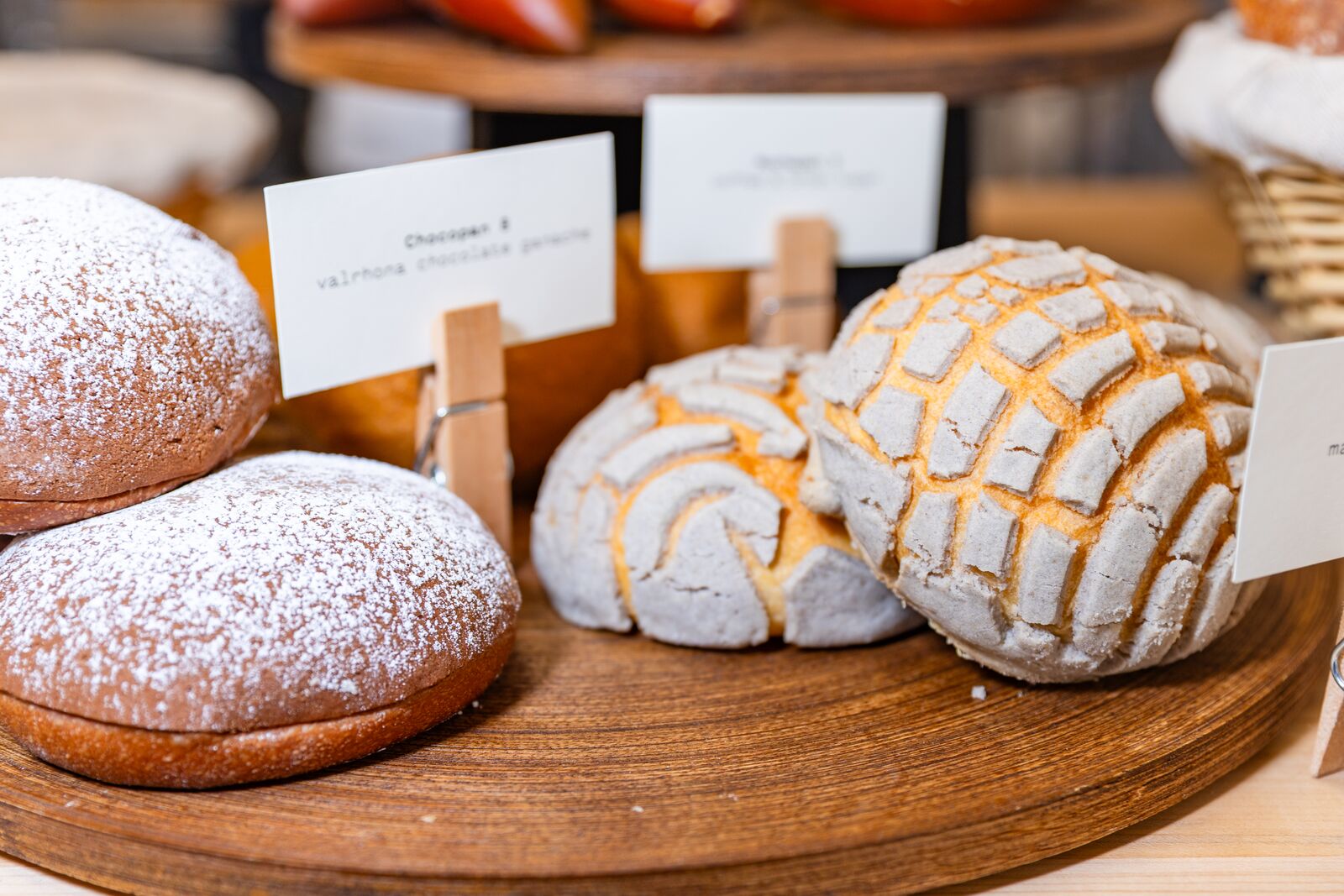 Studio Estepan’s chocopan (left), filled with valrhona chocolate ganache, and the blue corn concha (right) made with masienda blue corn. Credit: Estefany Gonzalez for East Bay Nosh
Silva’s menu rarely changes, with the exception of an item swap or two each week, yet he says the final lineup is still in the works. The menu is inspired by global flavors, and his travels to countries like the Philippines, Italy, France and Mexico. Take Silva’s olive sticks ($4.50) for example — the crusty, slightly chewy elongated sticks of baked lean bread are inspired by Chung’s favorite olive bread from Princi, a Milan bakery, and are made with yuzu kosho and lemon zest. Other offerings like his sourdough shokupan loaf ($15) and his mochapan ($5), which is filled with coffee and brown sugar, are inspired by Japanese bakery favorites.
Popular items include his blue corn concha ($5), an airy Mexican sweet bread with a crumbly sugar topping made from masienda blue corn, and his salt bread ($4). Silva crafts 180 — 200 salt breads each week, hand-shaping semi-soft sweet dough around small blocks of imported Maison Bourdier butter, which he then also wraps around the dough and bakes for maximum richness.
Silva’s dedication to fostering deep relationships with food producers and vendors also shapes his current menu. Most of his doughs are crafted with finely milled heritage wheat, which he purchases from activist and agroecological farmer Farmer Mai in Sebastopol. The smoked cheddar sausages that he sources for his sausage pretzel ($5) is from Oakland meat company Cream Co.
 Studio Estepan’s popular salt bread filled with Maison Bordier butter imported from France. Credit: Estefany Gonzalez for East Bay Nosh
Silva shares the bakery space with Melissa Chou and her bakery Grand Opening. Chou, a San Francisco native and fellow Quince alum, has also worked in other renowned Michelin-starred spots like Aziza and Mister Jiu’s. After lamenting with Chou about the struggles of a brick-and-mortar expansion — like rent, construction, and labor costs – he invited her to share the O2 bakery space. While a majority of the back kitchen is filled with ovens and equipment, Silva and Chou split the front, setting up two separate distribution tables. While Silva’s set-up takes the right, Chou’s Grand Opening resides on the left, where she offers an array of desserts, such as her burnt honey pie (which was named one of the best dishes in the country by the New York Times), smoky char siu-filled baos, and passion fruit macadamia nut cookies.
“I think that together, her and I offer a really unique experience you can’t find in most bakeries,” Silva said.
But the key to snagging a treat at either spot is to line up early. While both bakeries open at 10 a.m, lines start trailing down the industrial lot much earlier as customers, like partners Raji Vasireddi and Sidney Plummer, vie for a spot. Vasireddi has been following Chou’s work for years, and recently learned about Studio Estepan.
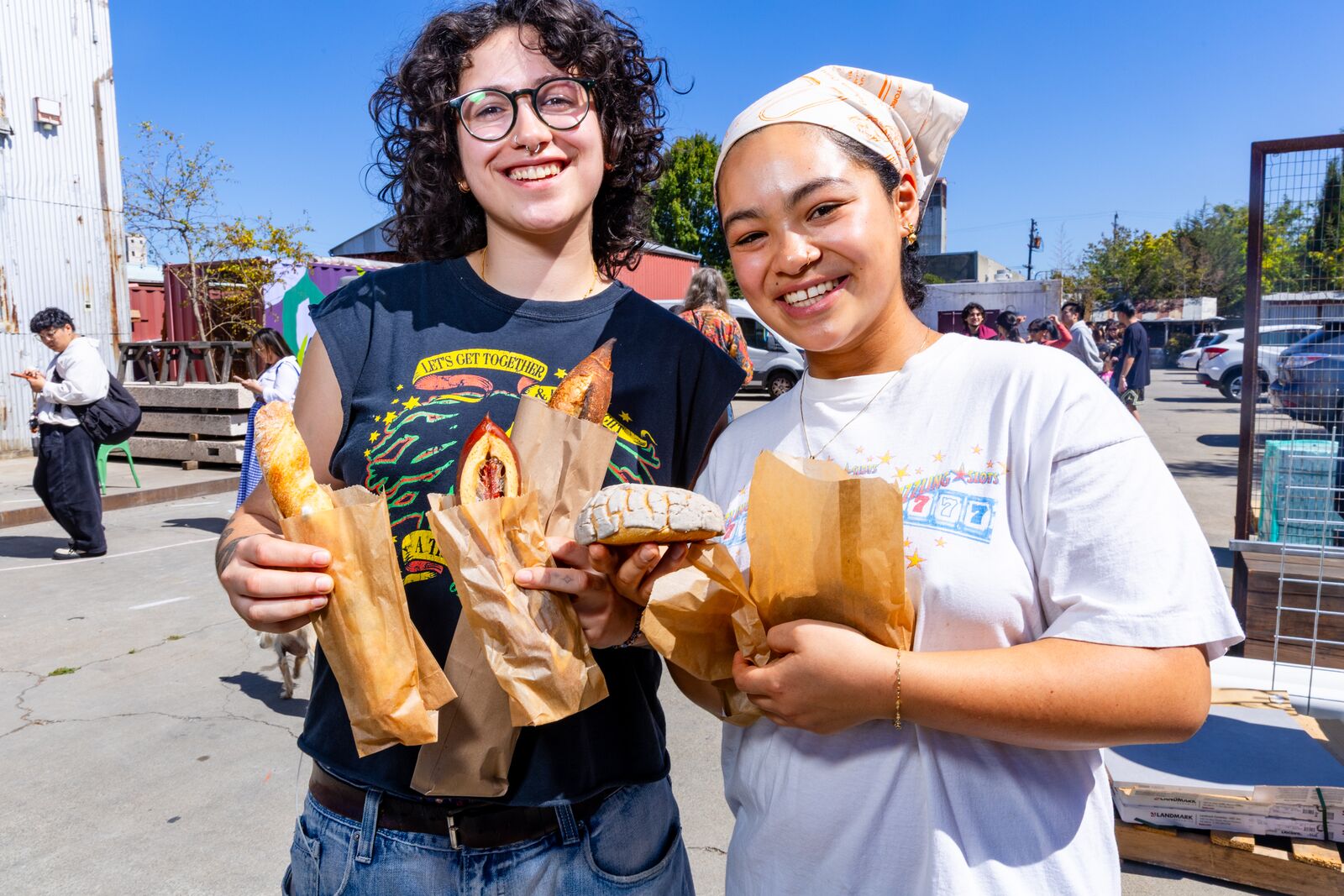 Argi Vasireddi (left) and their partner Sidney Plummer (right) hold several treats they bought outside of Studio Estepan. Credit: Estefany Gonzalez for East Bay Nosh
Vasireddi has a $30 “bakery budget”, or funds they reserve each week that are dedicated to satisfying their sweet tooth. They often turn to bakeries like Studio Estepan and Grand Opening, as opposed to multinational commercial bakeries and coffee shops like Starbucks or Panera Bread for fresh baked goods.
“It’s not just like I’m paying for something that’s tasty for me, but I’m also paying to tell them like ‘Hey, I love what you’re doing and I want you to keep doing it.’” Vasireddi said. “ Even if I only get like one or two things, that’s still so much better than getting six things that were made in a factory and had more machines involved than people.”
While he’s dedicated to keeping Studio Estepan small, Silva is open to eventually expanding the space to give customers a more comprehensive experience.
“I do recognize that if I want to be able to offer a better experience for people who support me, I inevitably will have to grow,” Silva said. “It’s challenging because then the realities of dealing with payroll, insurance and all that stuff changes the dynamic of your business, which is another reason why I’m keeping things very small right now. But I do see a bigger future for Studio Estepan. Maybe it’ll no longer be studio but just Estepan. Like a full bakery with coffee, food and maybe some wine.”
Related stories
August 13, 2026Aug. 13, 2026, 3:24 p.m.
Burdell’s Geoff Davis is bringing back the neighborhood bar and grill
August 17, 2026Aug. 17, 2026, 5:31 p.m.
Coffee Mill, Ben’s, and Nudi Blue temporarily closed
August 14, 2026Aug. 14, 2026, 10:00 a.m.
“*” indicates required fields