
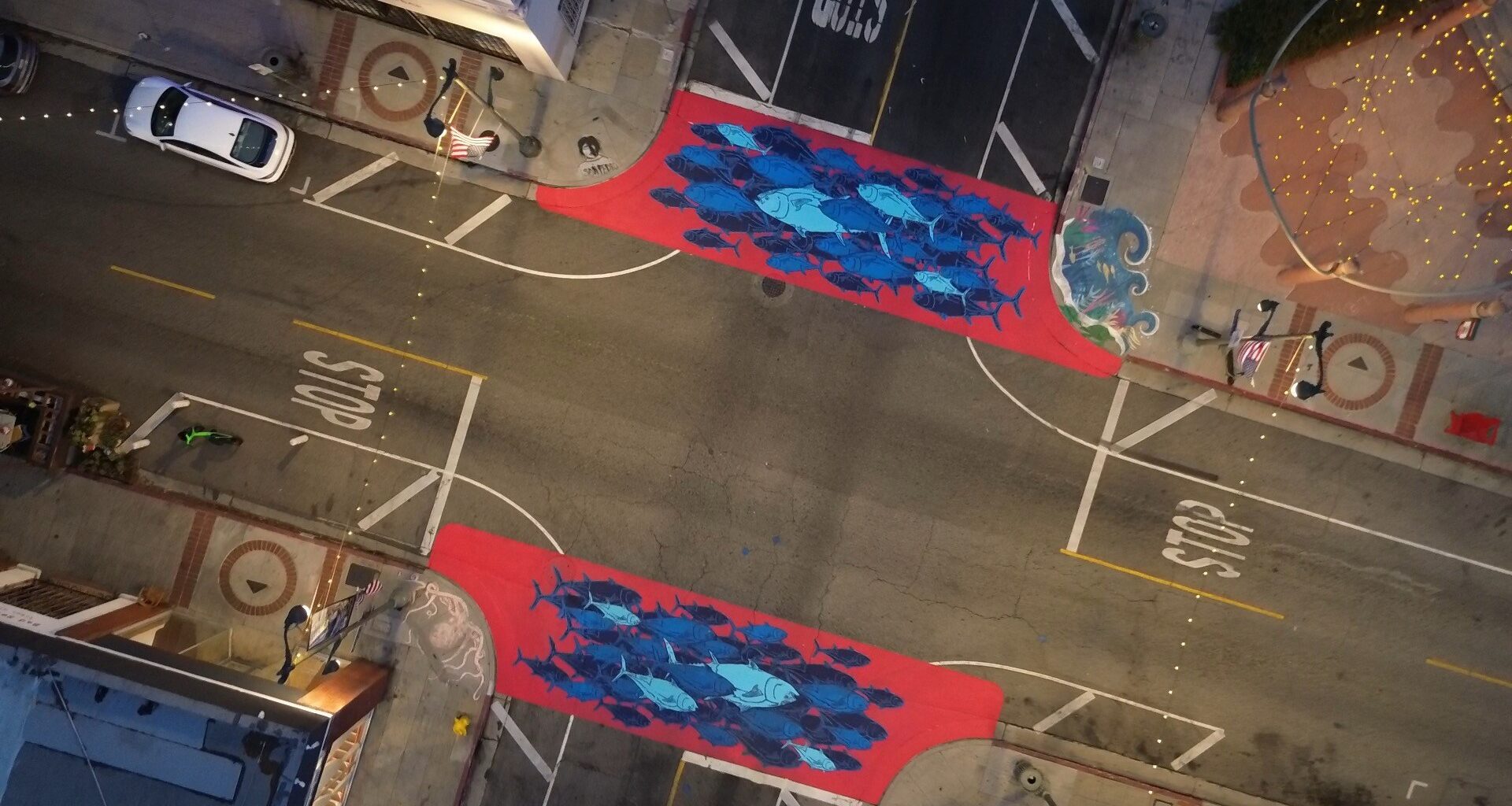

Aerial view shows artist crosswalks at Sixth and Mesa streets in downtown San Pedro. Artist Lua Kobayashi, tapped by the San Pedro Waterfront Arts District and with a Port of L.A. community grant, created the design that reflects the town’s tuna fishing heritage. (Photo by Pamela Torrance, Torrance Productions)

Crosswalk at 6th and Mesa streets in downtown San Pedro by artist Lua Kobayashi honors San Pedro’s past. (Photo by Pamela Torrance, Torrance Productions)

Artist Lua Kobayashi’s work depicting blue fish tuna adorns two crosswalks in downtown San Pedro. The creation under the San Pedro Waterfront Arts District with an award through the Port of Los Angeles’ community grants program can be seen at 6th and Mesa streets and will be formally celebrated at 6 p.m. Sept. 3, 2026, during the town’s First Thursday event. (Photo by Pamela Torrance, Torrance Productions)

The Japanese village on Terminal Island in Nov. 1927. (Photo courtesy of CSUDH Archives)

A statue of Japanese-American fishermen sits on the site of an old fishing village on Terminal Island on Sunday, April 15, 2018. During World War II, 3,000 Japanese-Americans were forced from their homes in their fishing village on Terminal Island and sent to internment camps after a presidential executive order. While they were imprisoned during the war, their homes were razed and their boats were seized, leaving nothing to come back home to. In 2002, the memorial was built and dedicated to the members of the Terminal Island fishing village. (Photo by Scott Varley, Contributing Photographer)

The last remaining buildings of Terminal Island’s Japanese American fishing village in San Pedro on Thursday, Aug. 21, 2025. (Photo by Drew A. Kelley, Press-Telegram/SCNG)

There were once 16 fish canneries on Terminal Island in the commercial fishing heyday. Photo courtesy of San Pedro Bay Historical Society. November 23, 2005. View of Pan Pacific Cannery, circa 1960.
Show Caption
1 of 7
Aerial view shows artist crosswalks at Sixth and Mesa streets in downtown San Pedro. Artist Lua Kobayashi, tapped by the San Pedro Waterfront Arts District and with a Port of L.A. community grant, created the design that reflects the town’s tuna fishing heritage. (Photo by Pamela Torrance, Torrance Productions)
Back in the day, tuna was synonymous with San Pedro where scores of commercial fishing boats were docked and canneries filled the air with the smell of fish.
It all put the ethnic, seaside town on the map.
Now, in a tribute to that heritage, an artist’s new work adorns two key downtown crosswalks in the town that is now home to the busiest container shipping port in the Western Hemisphere.
The colorful images of a school of blue fin tuna grace crosswalks at Sixth and Mesa streets, a tribute to both the port’s commercial fishing history and also to the waterfront’s long-standing state designation as an Arts & Cultural District.
The state bestowed the designation — one of 14 statewide — on the town in 2017. While San Pedro has been home to numerous artists and art galleries, the newly-designated district had further grow and fulfill that namesake.
“Long ago I realized just putting up a sign wasn’t going to capture much attention,” Grimes said of the designation. “We had to do it, we had to show it.”
The now brightened-up corner serves often as a main gathering and performance spot during outdoor festivals. The Arts & Cultural District, which already has sponsored numerous other public art displays throughout the town, has plans to do more.
The work melds the town’s history and heritage and the artist, Lua Kobayashi whose heritage is intertwined with the Japanese fishing industry at Terminal Island.
The artwork was titled “Furusato” — literally “hometown” or “birthplace” in Japanese. But the word means more than that, too; it evokes emotion and nostalgia, as explained by the artist in a video, reflecting one’s true home, family roots and a place where one belongs. It was, she said, the term used by those who lived and worked the boats and the canneries on Terminal Island, many of them Japanese and other immigrants.
For the artist, it also became a trip through her own family history.
Her great-grandfather and other family members immigrated to the area from Japan. One of her great-grandfather’s first jobs was as a fish peddler in San Pedro, transporting fish from San Pedro to Los Angeles, she said.
“It helped establish him in the area and helped give my family a start here,” she said in a video about the crosswalk project.
Later, the family business coalesced around a plant nursery they established in Hawthorne.
After Pearl Harbor, her great-grandmother was taken to Heart Mountain War Relocation Center in Wyoming and her great-grandfather was taken to Rohwer War Relocation Center in Arkansas.
Before they were sent to those locations, they were taken to Santa Anita Racetrack — where the artist many decades later would attend her high school prom.
(An exhibits on the history of the Japanese and the fishing industry can be seen at the Los Angeles Maritime Museum in San Pedro.)
The official unveiling and celebration of the new public crosswalk art installation will be held at 6 p.m. Sept. 3 followed by a gathering at Port Town Brewery). It will be a highlight of town’s monthly First Thursday event that night. But the two colorful crosswalks at Sixth and Mesa streets are already finished and are being noticed.
Wellington Signs oversaw and executed the installation process.
LInda Grimes, executive director of the San Pedro Waterfront Arts District, said the painstaking process took time — from the grant award to selecting the artist and her concept.
Grant money — totaling $39,000 — came from the Port of Los Angeles and Arts United Coalition, with the project sponsored and overseen by the San Pedro Waterfront Arts District.
Internally, the arts district, which was the grant applicant, headed up the design and artist selection process.
The requirements called for the design to include elements of San Pedro’s history as a maritime port; the biodiversity of the marine environment; the variety of the town’s arts and culture; and a color pallet that would be limited to four large blocks of color.
The applications also had to include the applicant’s qualifications and sketches along with an artist statement, resume, references, and images of at least three past public art projects or a website highlight the artist’s work.
A Design Advisory Panel, involving community feedback and voting, evaluated qualifications and ideas were chosen based on artistic quality, technical ability, thematic expression of the crosswalk themes, and compliance to crosswalk design specifications.