
The roots of the A.K. Warren Water Resource Facility run much deeper than its sleek buildings might suggest.
The modern-looking, low-slung complex situated just east of the 110 Freeway on South Figueroa Street in Carson plays a key role in Los Angeles County’s sewage treatment and remediation system.
Its namesake, Albert Kendall Warren, was a surveyor and civil engineer for Los Angeles County. In 1923, together with Assemblymember Hugh Pomeroy and county Board of Supervisors Chair R.F. McLellen, Warren came up with the idea of a countywide network of sewage plants linked to a main treatment plant. They created the Los Angeles County Sanitation Districts.

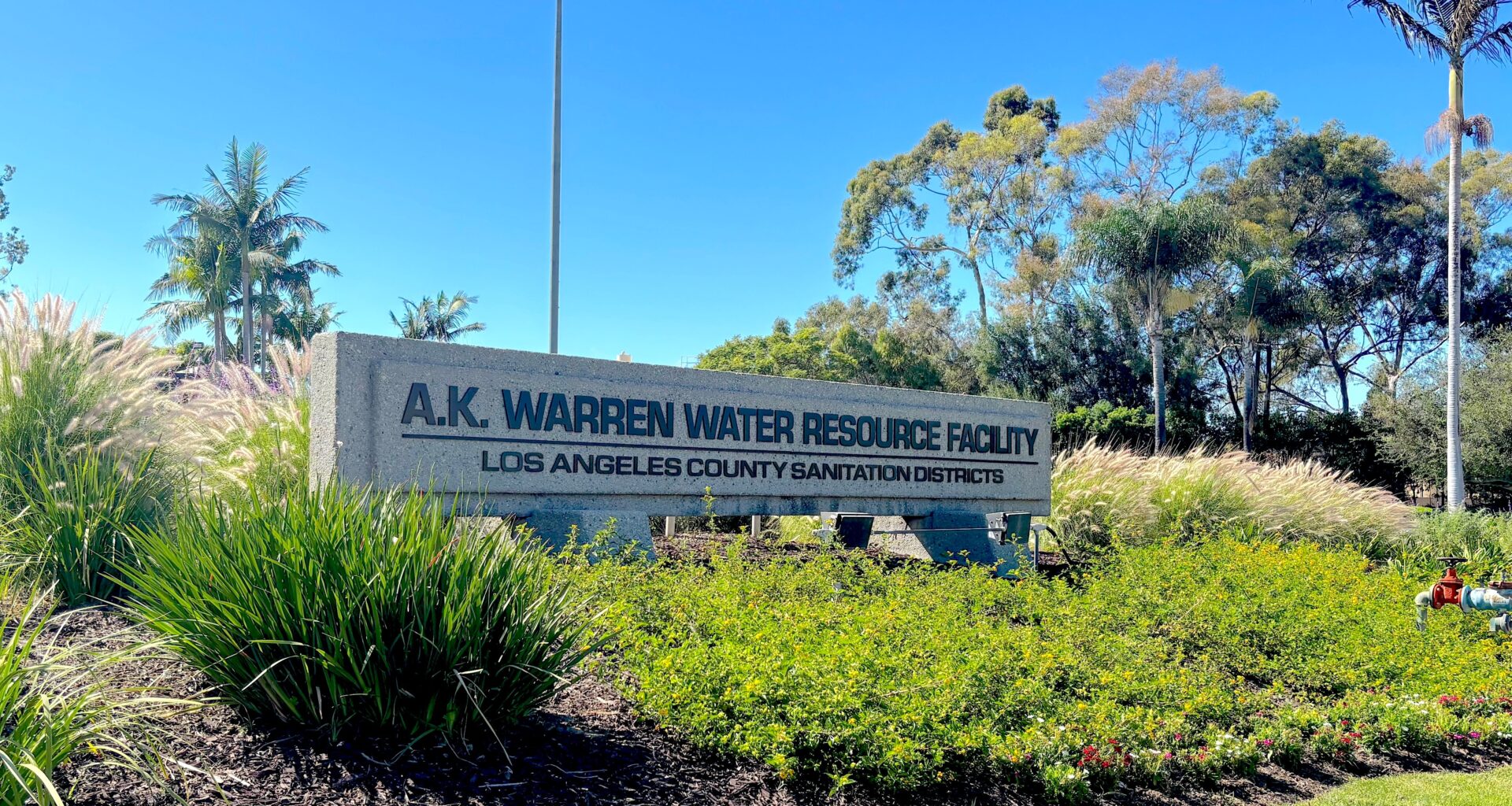
The main entrance to the A.K. Warren treatment plant on Sept. 1, 2026. (Photo by Sam Gnerre, Daily Breeze/SCNG)

Map shows the tunnel path from the Warren Facility, upper right, to the White Point outfall area. (Courtesy of Los Angeles Sanitation Districts)

The A.K. Warren Water Resource Facility, center, currently covers 36 acres. View looking east, with 110 Freeway at bottom and Figueroa St at middle. Undated recent photo. (Courtesy of Los Angeles County Sanitation Districts website)

Construction continues on the White Point sewage tunnel in San Pedro in 1936. (Courtesy of USC Digital Library)

Albert Kendall Warren at his desk. Undated photo, circa 1920s. (Courtesy of California Water Environment Association)
Show Caption
1 of 5
The main entrance to the A.K. Warren treatment plant on Sept. 1, 2026. (Photo by Sam Gnerre, Daily Breeze/SCNG)
The plan offered local control to its member cities, and a larger regional solution for final waste disposal.
Built in Carson in 1928, the Joint Disposal Plant, 24257 S. Figueroa St., was the final stop for human biowaste, brought to the facility through a series of tunnels, known as trunk sewer lines, from other plants throughout the county.
In its early years, very little processing of the waste material was done. The waste mostly went to landfills.
After years of public debate, construction began in 1935 on the White Point sewage outfall project along the San Pedro coastline. This entailed the creation of a huge tunnel linked to the Carson plant that would carry the sewage to an undersea outfall area located roughly 1.5 miles offshore from present-day Royal Palms State Beach. The sewage then would be released in the 200-foot deep waters of San Pedro Bay.
Funding for the massive $2.8-million project came from the Public Works Administration, an agency created as part of President Franklin Delano Roosevelt’s New Deal programs. The 6-mile long tunnel was completed in 1937. (A second parallel tunnel was built in 1958 to increase capacity.)
All the individual cities had to do at that point was to finance the construction of smaller feeder trunk lines to connect to the larger county tunnels carrying effluent to the White Point outfall.
“The South Bay cities have stopped dumping their sewage on their own beaches,” Redondo Beach Mayor Charles Wortham told the Daily Breeze on Sept. 7, 1949.
He was referring to the beach cities of Redondo, Manhattan and Hermosa, which on that day began using the county’s White Point option after years of dissatisfaction with operations at the much-closer L.A. City Hyperion sewage plant near El Segundo.
A couple of decades later, an unexpected new use of the tunnels led to environmental disaster. The successful use of the insecticide DDT to kill mosquitos and thus quell malaria outbreaks among Allied troops fighting in World War II resulted in the wider production and use of the substance.
In 1947, Montrose Chemical Corp. began the commercial manufacture of DDT at its new plant on Normandie Avenue, in the Harbor Gateway, just east of the Torrance city limit. The Montrose plant immediately began dumping unprocessed toxic effluent resulting from its production directly into the county’s sewage system. The deadly chemicals ultimately ended up in San Pedro Bay, via the White Point outfall.
The dumping went on for decades. The 1962 publication of Rachel Carson’s environmental call-to-arms “Silent Spring” (Houghton Mifflin) sounded the initial national alarm about the dangers of DDT. Eventually, it was determined that the chemical and its byproducts were destroying sea life in San Pedro Bay.
Montrose Chemical closed its DDT plant in 1982. It took years, but the ocean wildlife eventually began to return to more normal levels.
In 1963, the year after “Silent Spring” was published, the Joint Disposal Plant’s name was changed to the Joint Water Pollution Control Plant, in recognition of its efforts to treat liquid and solid waste, instead of merely dumping it offshore. This goal would be officially mandated and regulated by the passage of the federal Clean Water Act in 1972.
The L.A. County Sanitation Districts as currently constituted includes feeder plants in La Canada Flintridge, South El Monte, Long Beach, Cerritos, Pomona and Whittier, in addition to the main processing plant in Carson.
The Sanitation Districts initiated the Clearwater Project in 2019, an operation that will modernize and upgrade the tunnel system, some of whose structures date back to the 1930s. Its completion was scheduled for 2027. But it’s unclear when it will be completed now after a breach in July 2025 temporarily stranded workers some 320 feet below Western Avenue just north of Ninth Street. The project has not yet resumed.
Sources: Daily Breeze archives. Los Angeles County Sanitation Districts website. San Pedro News Pilot archives.