
In a hiring upswing, the Bay Area and California both gained thousands of jobs in August, according to a government report released Friday.
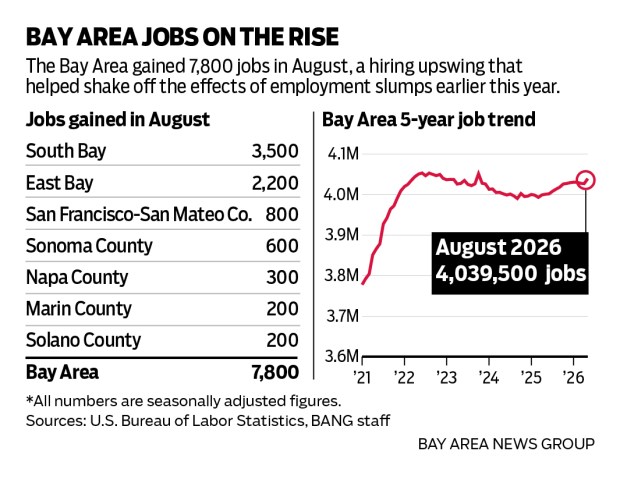
Employers added 7,800 jobs in the Bay Area in August, while California gained 39,400 last month, the U.S. Bureau of Labor Statistics reported. The state saw an overall loss of 15,700 jobs in July.
The August hiring surge came on the heels of a revised gain of 6,800 jobs in the Bay Area during July and losses of 200 in May and 5,600 in June.
The statewide unemployment rate was 5.1% in August, unchanged from July, according to the state Employment Development Department. The California jobless rate has remained at or above 5% since September 2023, when the rate was at 4.9%.
 At 5.1%, the California unemployment rate was in a three-way tie with Connecticut and Oregon for the nation’s highest – Michigan was at 5% and all other states were below 5%.
The South Bay led the Bay Area in hiring in August, with 3,500 jobs added. The Santa Clara County region has added jobs for 13 of the last 14 months.
The East Bay gained 2,200 positions in August, while the San Francisco-San Mateo region added 800.
In the North Bay, employers added 600 jobs in Sonoma County, 300 in Napa County, and 200 in both Marin County and Solano County, the government report showed.
The statewide and Bay Area job figures were all adjusted for seasonal volatility.
The region’s tech industry, however, is still reeling from a long line of layoffs.
“The numbers are encouraging, but we should understand that this is happening despite tech, not because of it,” said Russell Hancock, president of San Jose-based think tank Joint Venture Silicon Valley. “Our technology sector is shrinking right now, and it may continue to shrink for a long while.”
The Bay Area lost 2,900 tech jobs in August, with losses of 2,400 positions in the San Francisco-San Mateo region, according to unadjusted numbers posted by the state EDD.
The South Bay shed 400 tech jobs, and the East Bay lost 100 in August, EDD figures show. Tech industry totals were unchanged in the four North Bay counties.
“The numbers show that though artificial intelligence dominates all employment discussions in California, its impact on job numbers continues to be minimal,” said Michael Bernick, an employment attorney with law firm Duane Morris and a former director of the state EDD.
According to federal data, hiring in the South Bay continues to be strong.
“Right now, the South Bay is outperforming the state and nation in job growth,” said Steve Levy, director of the Palo Alto-based Center for Continuing Study of the California Economy.
Over the one-year period that ended in August, job totals in the South Bay have jumped 1.8%. That’s compared to 1% in the Bay Area, 0.9% in the San Francisco-San Mateo region, 0.3% in the East Bay, 0.8% in California, and 0.4% in the U.S.
Over the last year, the South Bay gained 20,400 jobs, more than half of the 38,500 the Bay Area had during that period.
Similarly, the South Bay’s job gains during the recent 12 months represented 14.7% of the 138,500 jobs gained in California — even though the South Bay market is only 6.5% the size of California’s.
Of the Bay Area’s major urban centers, the South Bay is the only region where the job market has surpassed pre-pandemic levels.
As of August, it had 14,200 more jobs than in February 2020. However, the Bay Area, East Bay and San Francisco-San Mateo region all remain below their pre-COVID totals, government reports show.
“People tend to forget that there are many and multifaceted sectors to the Silicon Valley economy and ecosystem,” Hancock said. “Right now, they include healthcare, construction, education, and local government services. These are growth areas for the region and big job generators.”
But despite the encouraging trends, key obstacles loom, Levy said.
“Going forward there are two sets of headwinds — high and rising interest rates and the recent surge in gas and energy prices,” he said.