
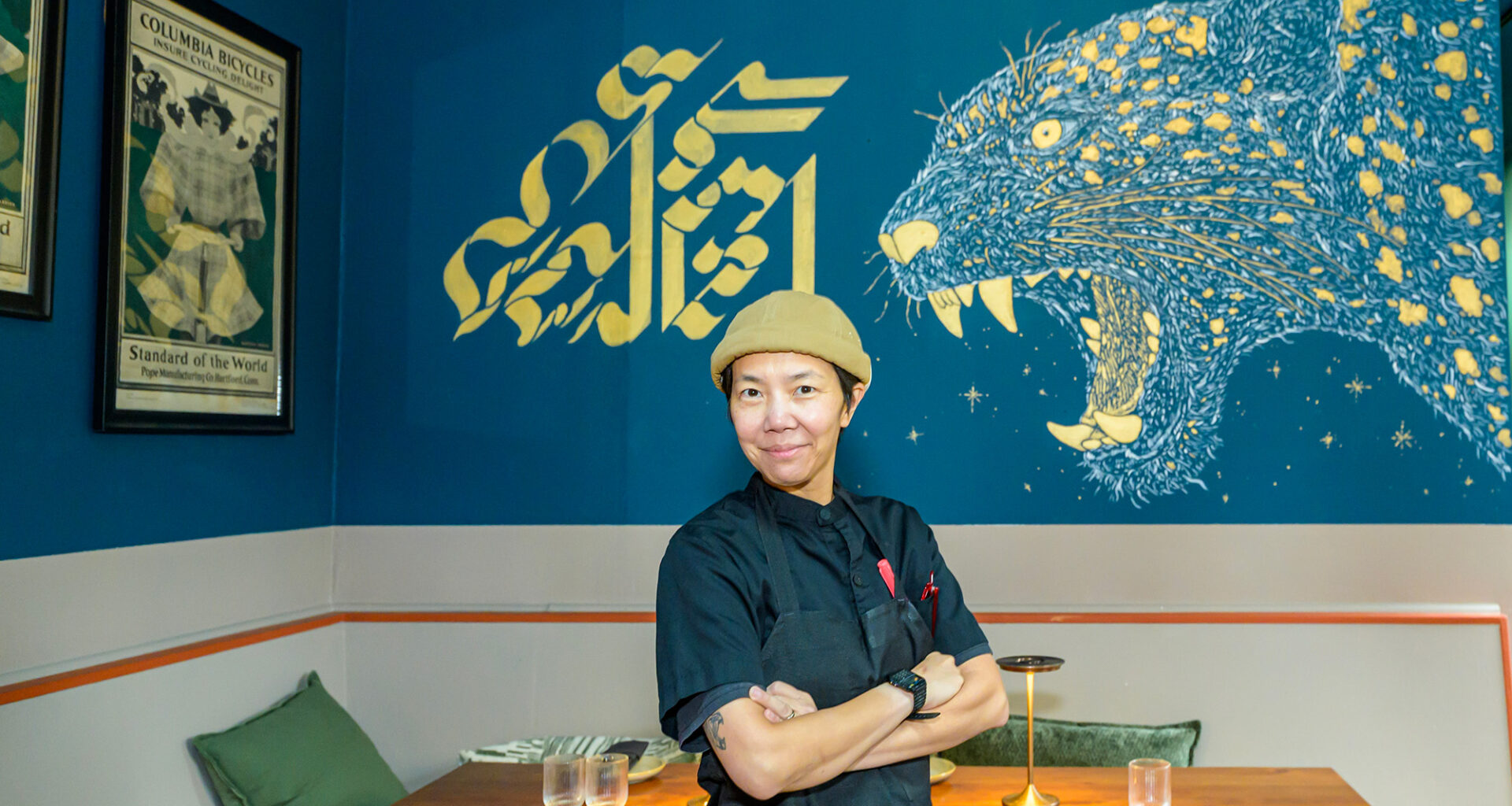
The best Thai food is a symphony where four flavors play in harmony, spicy from red and green chile peppers, fresh and dried, sweet from palm sugar and coconut milk, sour from liberal use of lime juice and tamarind, and salty from fish sauce and fermented shrimp paste. Chef Nattaporn Pinpech, who owns Secrets of Tiger in Emeryville with her husband, Yong Pinpech, masterfully conducts that symphony at Payakk, opened a year ago on the Montclair/Merriewood border, a short walk from the Merriewood Stairs.
Its two cozy, colorful rooms resemble living rooms, if its residents possessed an enviable vinyl record collection. One room features teal walls, round porthole-like windows, a gilded tiger mural in full open-mouthed growl and pillowed banquettes; the other is wood-paneled, but both overflow with trailing plants, curios and framed prints. Her husband, who owns a graphic design firm in Thailand, designed the restaurant, located in a gray stucco standalone building, and handled its interior decoration.
5761 Thornhill Drive, Oakland; www.payakk.com
Hours: Thursday to Monday, 5-9 p.m.
Compared to Secrets of Tiger, Payakk is dinner-only and more expensive ($27 to $46 for large plates). “Payakk is a reflection of me and my husband, our journey. We opened Secrets of Tiger to serve Thai street food, simple and quick, in 2023, but in my dreams I wanted people to have a new experience of Thai food, more upscale, and serve some dishes from the royal family,” Pinpech said.
“I want to communicate beyond the usual dishes,” to share the diversity of different regions in Thai cooking, she added. Southern Thailand features more seafood, thanks to its long coast and islands like Phuket and Koh Samui, more chiles and turmeric, and has a hot tropical climate, while northern Thailand has mountains, a cold winter, and food tends to be less spicy. Nam prik chile pastes are made in differing styles in different regions, and chefs have their own favorite recipe.
 Pla kung, Monterey prawns grilled in the shell over charcoal, is one menu item at Payakk. Credit: Jerome Parmer for East Bay Nosh
Her signature dish, pad Thai Chaiya ($38), is in a southern Thai style made with coconut milk broth, shrimp fat inside the shrimp’s head, chile paste and topped with lots of shrimp, in addition to the tamarind sauce, palm sugar, fish sauce and rice noodles in the standard pad Thai. More flavorful, spicier and creamier than the usual dish, it’s a recipe from Surat Thani province, named after its main town.
Her keang som fried white seabass ($35), very delicately fried, moist and tender, in a sour broth that’s tamarind-forward and chile-spiked, is another southern Thai dish. (My companion found a spoonful of the broth too spicy, but I asked for a side of dried red chile.) In contrast, her Chilean sea bass curry uses a green curry paste made from fresh chiles with turmeric and coconut milk. Her roasted sirloin nam prik num ($37) is grass-fed beef topped with “morning glory,” a water spinach coated in tapioca flour batter, and bits of fried garlic, with two condiments on the side: a northern Thai paste from the Chiang Mai and Chiang Rai region made with grilled green chiles, garlic and shallots (nam prik num) and tamarind sauce. Small plates include ngob pu, crabmeat in a southern Thai red chile paste tucked inside a banana leaf, and choux duck larb, minced duck in a lime juice-fish sauce dressing studded with mint, cilantro, shallots and toasted rice powder within a pastry cup, made with duck fat instead of butter.


Payakk is located on Thornhill Drive at the border of the Montclair and Merriewood neighborhoods in Oakland. Credit: Jerome Parmer for East Bay Nosh
Royal Thai cuisine is refined, marked by balanced, layered flavors, meticulous preparation and elegant presentation, and its dishes were once served in royal palaces.
“For us, it’s a meticulous blend of heritage and modern understanding, not just a marketing buzzword or a vague historical label. We take the exact traditional recipes — each thoroughly researched regarding its historical origins and techniques – ingredient proportions, and classical techniques passed down from the royal kitchens. We then adapt these classical methods to fit the seasonal, fresh ingredients available in the Bay Area, ensuring authenticity in spirit while achieving absolute culinary precision,” she said.
In each dish on her menu, a traditional Thai cooking technique is paired with a food science. “We used to fully understand the chemical processes and physical outcomes of each step. For example, we pound chile pastes with a mortar and pestle, which physically shears and ruptures the cell membranes of the ingredients, and releases the essential oils locked inside, resulting in a much richer, more fragrant, and deeply complex flavor profile,” she said. ”A food processor tends to chop or bruise the ingredients rather than cleanly breaking the cellular walls.”

 Top: Chef Nattaporn Pinpech puts the final touches on the Chilean sea bass curry. Bottom: The choux duck larb from Payakk, made with minced duck in a lime juice-fish sauce dressing with mint, cilantro, shallots and toasted rice powder within a pastry cup, made with duck fat instead of butter. Credit: Jerome Parmer for East Bay Nosh
Pinpech names the Bay Area farms and other providers Payakk works with on the menu (and lists her staff as well). Whimsically adorned with animal illustrations, from a leopard in a jacket and bowler hat, tiger, rabbit and squirrel, the menu is seasonal. “It’s up to the wind, up to the sun,” she notes. (The current menu is from August to November.) She uses Liberty Duck from Sonoma County Poultry, the grass-fed beef hails from Stemple Creek Ranch in Tomales, the hook-and-line-caught seafood from Monterey, Bodega Bay and San Francisco, and the tofu is from Hodo Soy in Oakland. A southern-Thai style crab curry surrounded by betel leaves, and Koh beef dry-aged for 38 days, starred on past seasonal menus.
Every other Friday night Payakk hosts a listening party, where Bay Area DJs play vinyl records. Yong Pinpech sometimes plays from his record collection behind the green-tiled custom-made bar. “It’s 90% Thai music from the 80s-90s, plus jazz and other types,” she adds.
 Payakk has a full bar, and signature cocktails include the “Coocchi Rosa” (left) and the “Old Fashion Romance.” Credit: Jerome Parmer for East Bay Nosh
Wines are from local producers, like Carboniste and Folk Machine in Sonoma, plus Broc Cellars in Berkeley. Some dishes have suggested wine pairings on the menu, such as head-on rockfish glazed in tamarind sauce with fried shallots paired with Folk Machine Chenin Blanc. Craft cocktails include one dubbed Old Fashion Romance: bourbon, Cardamaro (a Moscato wine base plus many botanicals), Cocchi Rosa (red wine base with flower extracts) and Angostura bitters, which tastes of toffee, vanilla, warm spices and a dash of “hibiscus brightness.”
Pinpech, whose Thai nickname is Tobb, studied at two cooking schools in Bangkok, the Dusit Thani hotel and Cordon Bleu, and has a pastry chef credential from Osaka, Japan. Her mother is Hainanese, from the southernmost Chinese island next to Vietnam. In case you’re wondering about that gilded mural, Payakk is Thai for “great tiger.” Like Secrets of Tiger, it’s named after her daughter, 16, born in the Year of the Tiger.
“*” indicates required fields